Polymarket Wallet Profitability & Behavior Analysis
 Alexey Gorbunov5 min read·Just now
--
I collected and analyzed the full historical data of Polymarket to answer a simple question: who actually makes money here? The goal was to measure real wallet profitability, understand how concentrated profits are, and test how much of visible success is driven by survivorship bias. The dataset covers more than 2.3 million wallets, with the main analysis focused on 1.61 million active wallets that participated in at least five markets.
How many wallets earn more than $10,000 per month?
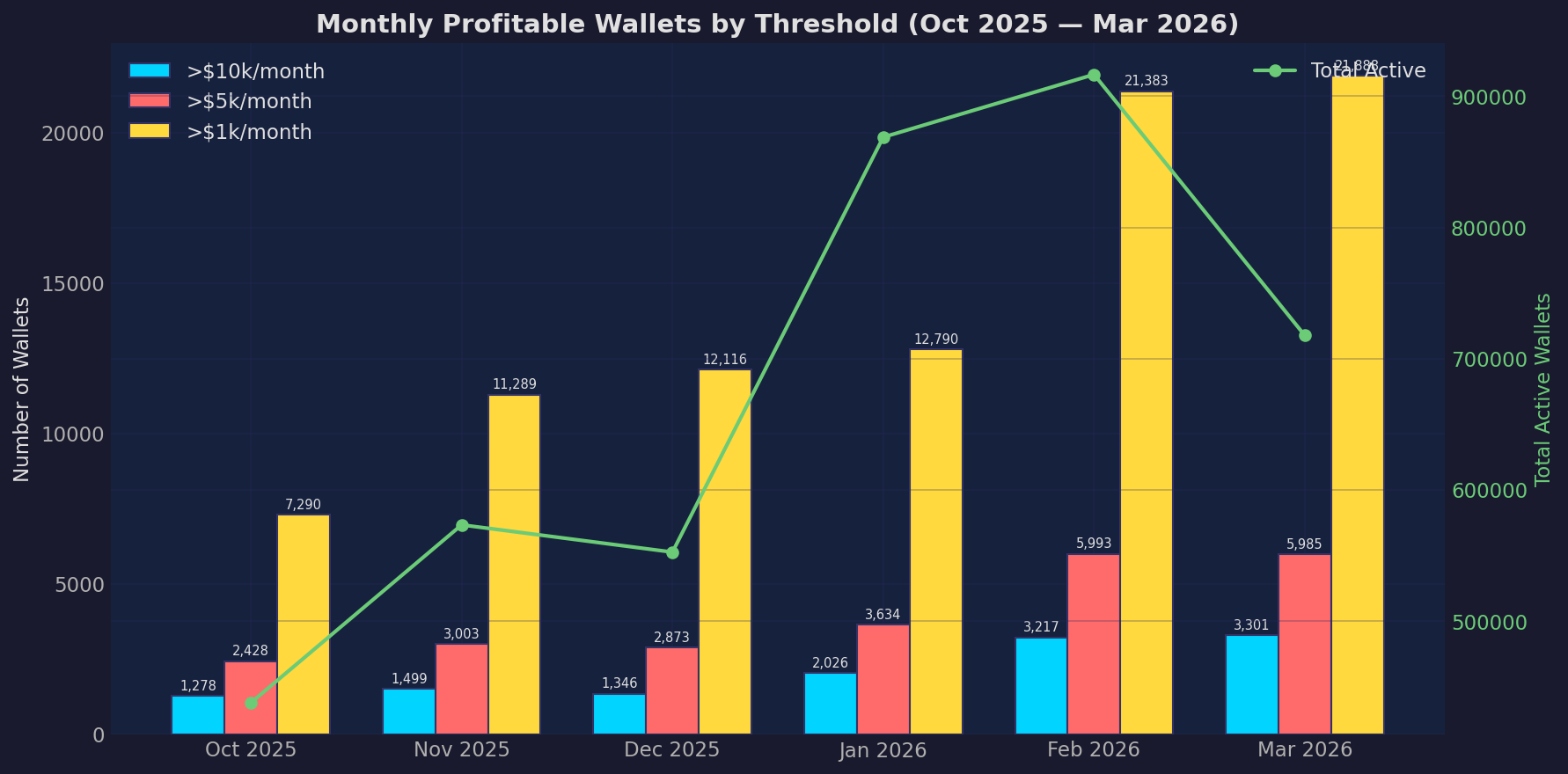
On average, between 3,000 and 3,400 wallets exceed $10,000 in profit within a single calendar month. Over the last 30 days (March 2026), exactly 3,123 wallets reached this threshold.
Monthly trends show a clear increase in high-earning activity:
- October 2025: 1,278 wallets
- December 2025: 1,346 wallets
- February 2026: 3,217 wallets
- March 2026: 3,301 wallets
For comparison, around 6,000 wallets earn more than $5,000 per month, while roughly 21,000 wallets earn more than $1,000 per month.
Which trader types capture the biggest wins?
Wallets were grouped into three categories based on how they manage positions before market resolution, using their resolution ratio as the main signal:
- Resolver — holds positions until the market resolves and the outcome is finalized.
- Scalper — trades price movements and exits before the final outcome is known.
- Moderate — uses a hybrid approach that falls between the two.
Among the 3,123 wallets that earned more than $10,000 over the last 30 days, the distribution across these trader types was as follows:
- Resolvers — 1,641 wallets (52.5%)
- Moderates — 1,166 wallets (37.3%)
- Scalpers — 316 wallets (10.1%)
This distribution suggests that large monthly wins are captured primarily by Resolvers — traders who take directional positions and hold them through resolution. Scalpers account for a much smaller share of these outsized outcomes, which is consistent with their strategy of extracting smaller, shorter-term gains from price movements rather than aiming for large one-off payoffs.
How many wallets stay profitable for months?
o measure consistency, I looked at how many wallets were able to generate more than $5,000 in profit per month over multiple consecutive months. The results reveal a steep survival funnel:
- 1 month (any single month): ~11,000 unique wallets
- 2 consecutive months (Feb–Mar 2026): 942 wallets
- 3 consecutive months (Jan–Mar 2026): 277 wallets
- 6 consecutive months (Oct 2025–Mar 2026): just 32 wallets
This makes one thing clear: long-term profit stability on Polymarket is extremely rare. Out of roughly 1.6 million active wallets, only 32 managed to earn more than $5,000 per month for six straight months. Most major gains appear to come from one or two exceptional periods rather than from steady month-after-month performance.
Is Polymarket just random?
Not really. Most wallets do lose money over time, but the overall distribution does not look random. If Polymarket behaved like a pure casino-style game, profits would be distributed much more evenly. Instead, the data shows a strong fat-tail effect, where a very small fraction of wallets captures a disproportionate share of total profits.
Across the dataset, 35.5% of wallets were profitable, while 64.5% were unprofitable. The median PnL across all wallets was -$2.02, suggesting that the typical participant gradually loses money through fees, spreads, and poor execution. At the same time, profit concentration at the top is extreme: the top 1% of wallets captured 75.0% of all profits, while the top 0.1% alone captured 56.1%.
The analysis also identified 13,683 elite wallets — accounts that traded in more than 50 markets, maintained win rates above 70%, and posted profit factors above 2. Their historical average PnL was +$4,459, which strongly suggests that Polymarket is not purely random and that real edge does exist. But that edge is concentrated among a small minority of highly effective participants.
Do winners eventually give it all back?
To test survivorship bias directly, I tracked a cohort of 2,816 wallets that were consistently profitable (more than $1,000 per month) in both October and November 2025, and then checked their status in Q1 2026. Several months later, the cohort had split into three clear groups:
- Still profitable — 55.5% (1,563 wallets): continued trading at a net profit.
- Turned unprofitable — 37.2% (1,047 wallets): posted net losses in Q1, giving back part or all of their earlier gains.
- Stopped trading — 7.3% (206 wallets): became inactive, likely exiting the market after their profitable period.
The pattern is even more striking among the biggest winners. Among wallets that earned more than $5,000 per month for two consecutive months, 13.1% later fell into deeply negative historical PnL. In other words, even strong short-term performance often proves less durable than it appears at first glance.
Final takeaway
It is absolutely possible to make money on Polymarket, and the market is not purely random. But for most participants, the reality is much tougher than it appears from the outside.
The data points to three core dynamics. Survivorship bias is massive: many wallets that look exceptional are simply being observed at their peak. Profit concentration is extreme: most of the upside is captured by a very small fraction of top-performing wallets. And long-term consistency is rare: even strong performers often fail to maintain their results over time.
The bottom line is simple: Polymarket does reward real edge, but apparent winners should never be evaluated without accounting for concentration, variance, and survivorship bias.