Options Volatility Analysis: What 5 Defensive Sectors at 52-Week Highs Signal
 Ernest Tanson7 min read·Just now
--
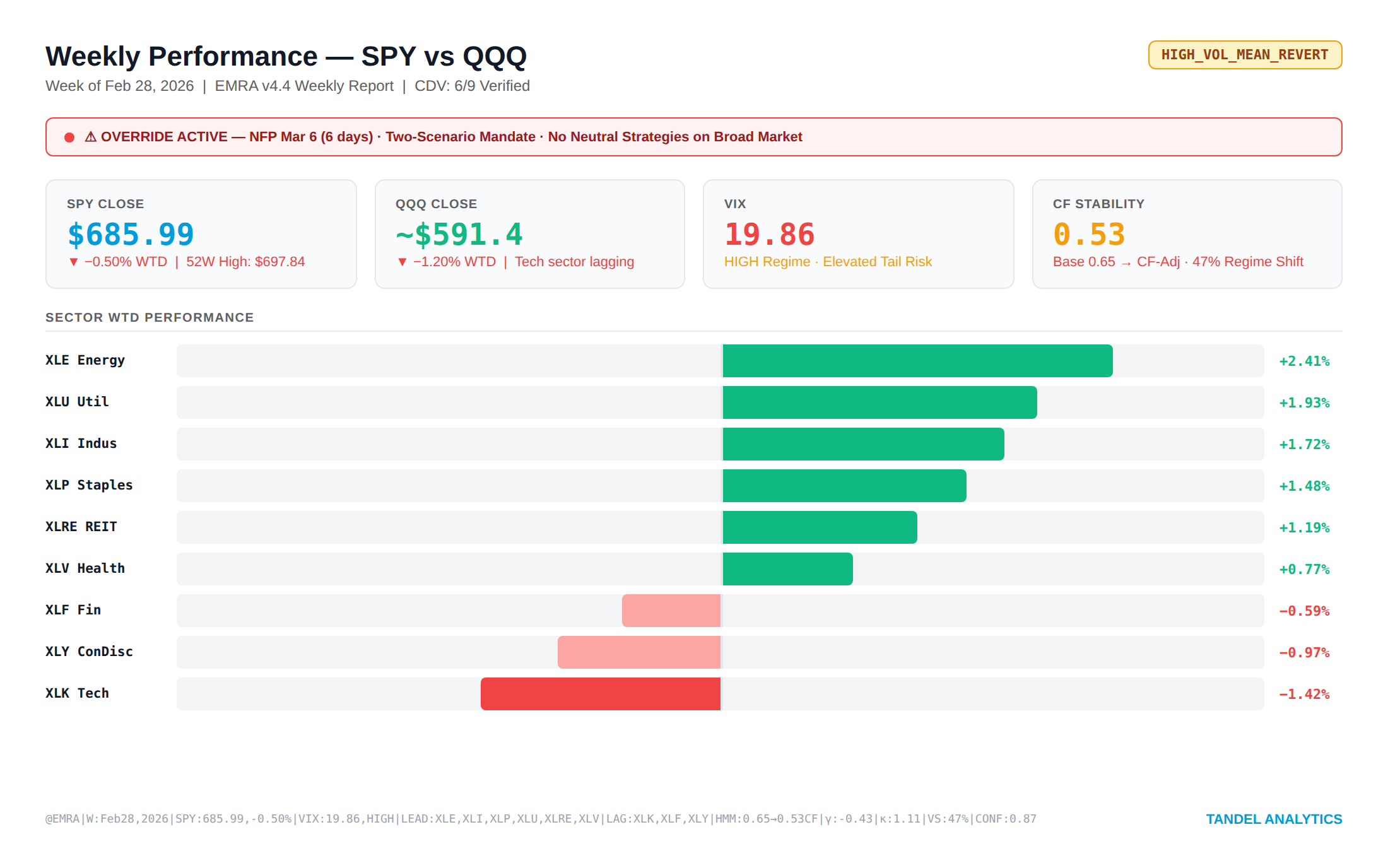
Five defensive sectors reached 52-week highs in the same week that SPY fell just 0.50%. That surface-level disconnect is not a coincidence — it is the signature of systematic institutional repositioning ahead of what may be the most catalyst-dense 13-day window of 2026. EMRA’s options volatility analysis, run on February 28, 2026, reveals a market that looks calm on top and is quietly building asymmetric exposure underneath.
This analysis covers sector rotation dynamics, Cornish-Fisher tail-risk adjustments, the CDV catalyst calendar, and five probability-weighted trade ideas — grounded in the EMRA v4.4 systematic methodology.
The Surface Reading vs. The CF-Adjusted Reality
SPY closed the week at $685.99, down 0.50% — a number that barely registers as a market event. VIX at 19.86 is elevated but not alarming. On the surface, this looks like noise.
The Cornish-Fisher adjustment tells a different story.
The HMM (Hidden Markov Model) baseline stability for this week is 0.65 — middling but defensible. Once tail-risk corrections are applied for negative market skewness (γ = -0.430) and excess kurtosis (κ = 1.108), that stability figure drops to 0.53, implying a 47% probability of near-term regime shift. The 95% VaR widens from -2.94% to -3.12%, and the Tail Risk Multiplier prints at 1.059x. Position sizing this week receives an automatic reduction to reflect fatter tails than a standard normal distribution would imply.
The regime classification: HIGH_VOL_MEAN_REVERT. This regime historically favors mean-reversion strategies over momentum, with a TCS adjustment of +0.20 and a size multiplier of 0.8x. The vol-spike scenario probability is 28.6% on a CF-adjusted basis — not the base case, but too significant to ignore when structuring trades.
The Sector Sweep: What 5 Defensive 52-Week Highs Mean
The sector heatmap this week is unambiguous. Leaders — all at or near 52-week highs: XLE (Energy), XLI (Industrials), XLP (Consumer Staples), XLU (Utilities), XLRE (Real Estate), XLV (Health Care). Laggards: XLK (Technology), XLF (Financials), XLY (Consumer Discretionary).
This is the broadest defensive sweep since August 2024, and it carries clear implications for how institutional capital is positioned heading into March.
Energy and Industrials: The Structural Leaders
XLE and XLI are not leading because of cyclical momentum — they are leading because of structural demand. On the energy side, elevated geopolitical risk (GMRO v2.5 scores geopolitical risk as HIGH globally) is driving sustained institutional inflows into LNG, pipeline, and domestic production assets. European demand for US energy infrastructure, confirmed in the GMRO cross-regional analysis, is adding a second source of demand that isn’t correlated with near-term domestic economic prints.
XLI’s leadership is directly tied to fiscal expansion. Rising US defense appropriations and Germany’s announced infrastructure spending plan are generating durable order books for US industrial suppliers. This is structural, not cyclical, and it is confirmed both in the EMRA sector scan and in GMRO’s regional ranking, which places Europe at third globally — driven largely by defense-fiscal expansion.
Technology and Financials: The Structural Laggards
XLK’s underperformance in a HIGH_VOL environment is regime-consistent. High-multiple, rate-sensitive sectors face the highest cost in tail-risk scenarios, and the negative skewness in the current distribution (-0.430) means that the downside tail is heavier than the upside for these names. The AI capex narrative remains intact as a multi-year theme, but near-term positioning is cautious ahead of the March catalyst calendar.
XLF’s lag reflects spread compression expectations and credit risk re-pricing under the current regime. The FOMC pause (March 18 is priced as a hold at 96%+) removes the near-term catalyst that would trigger a financial sector re-rating, leaving XLF without a near-term fundamental driver.
The CDV Catalyst Calendar: March Is Not a Normal Month
The Catalyst Date Verification protocol verified 6 of 9 events this week, rejecting 3 with unconfirmed dates. What remains is a March calendar that looks unlike anything seen this year.
March 6 — NFP Release [OVERRIDE status, 6 days out]: CDV verified via whitehouse.gov. The override designation activates the Two-Scenario Mandate under EMRA v4.4 protocol — neutral options strategies on broad market instruments are prohibited while an override event is this close. Every trade this week is structured for a binary outcome.
March 17–18 — FOMC [HIGH priority]: CDV verified via federalreserve.gov. Market pricing a hold at 96%+. The decision itself carries low surprise probability; the risk is in the statement language and press conference tone.
March 18–19 — BOJ [HIGH priority]: CDV verified via boj.or.jp. BOJ’s second meeting following the January rate hike. Markets are divided on whether a second hike arrives in March or waits until June — either outcome creates FX volatility.
March 19 — ECB [HIGH priority]: CDV verified via ECB maintenance calendar. First meeting after Germany’s fiscal expansion announcement. ECB language on the sequencing of future cuts could reprice European rate expectations.
The compression of FOMC, BOJ, and ECB into a 48-hour window on March 17–19 creates systemic event risk that warrants position reduction before March 14. That is the actionable deadline from this week’s catalyst analysis.
Five Trade Ideas: Probability-Weighted for the Current Regime
All five ideas are sized under the Two-Scenario Mandate (NFP override active). The combined sizing factors — HIGH_VOL_MEAN_REVERT multiplier (0.8x) and Tail Risk Multiplier (1.059x correction) — mean effective size for most strategies runs at 70–80% of standard. The iron condor is further reduced to 40% given the binary NFP risk.
1. Long XLI — 68% Probability | E[R]: +3.1% The highest-conviction idea this week. XLI at a 52-week high with structural backing from US defense appropriations and European fiscal expansion. Structure: April 18 bull call spread 135/145. Size: 0.80x. Stop: XLI daily close below 132.
2. XLK Put Spread (Tail Hedge) — 64% Probability | E[R]: +2.8% risk-adjusted Not a directional short — a structured tail hedge for the 28.6% vol-spike scenario. With negative skew and NFP override active, high-multiple tech carries the most binary downside. Structure: April 17 175/165 put spread. Size: 0.50x per Two-Scenario Mandate.
3. Long XLE — 63% Probability | E[R]: +2.2% Energy at a 52-week high with GMRO confirming elevated geopolitical risk and cross-regional infrastructure demand. Structure: April 80/87 bull call spread. Size: 0.80x. Stop: Geopolitical risk score drops materially.
4. XLY/XLP Defensive Pairs Trade — 61% Probability | E[R]: +1.9% Pairs trade hedges market beta and profits from spread widening regardless of NFP outcome direction. Target: XLP/XLY ratio extends +6%. Size: 0.70x.
5. SPY Iron Condor (Close Before March 6) — 52% Probability | E[R]: +1.4% The lowest-conviction idea, included as a hedged premium collection play in the HIGH_VOL_MEAN_REVERT regime. This position MUST be closed before March 6 market open. Structure: March 7 expiry, 672/680 put spread + 700/708 call spread. Size: 0.40x.
Key Takeaways
- Five defensive sectors reached 52-week highs simultaneously — the broadest defensive sweep since August 2024, signaling institutional repositioning, not retail noise.
- Cornish-Fisher tail-risk adjustment collapses HMM stability from 0.65 to 0.53, placing regime shift probability at 47% — the calm surface reading is misleading.
- NFP on March 6 (CDV verified) activates the Two-Scenario Mandate — no neutral strategies on broad market instruments until after the release.
- March 17–19 compresses FOMC, BOJ, and ECB into 48 hours — reduce unhedged cross-regional exposure before March 14.
- Trade sizing this week: 40–80% of standard, with all structures built for binary outcomes rather than range-bound scenarios.
The five defensive sectors at 52-week highs are not telling you the market is broken. They are telling you the market is careful. The Cornish-Fisher data confirms the caution is warranted. Manage size, hedge tails, and let the March catalysts resolve before re-risking into the second quarter.
For weekly systematic analysis delivered directly to your inbox, subscribe on Substack. All charts, frameworks, and methodology documentation are freely available to subscribers.
About the Author: Independent quantitative equity and volatility analyst. Weekly market analysis using EMRA, EEMRA, GMRO, and U-VCT Enhanced frameworks. All analysis is for informational and educational purposes only. Not investment advice.