OneBullEx X Space Recap: Headline Driven Crypto Trading
 OneBullEx9 min read·Just now
--
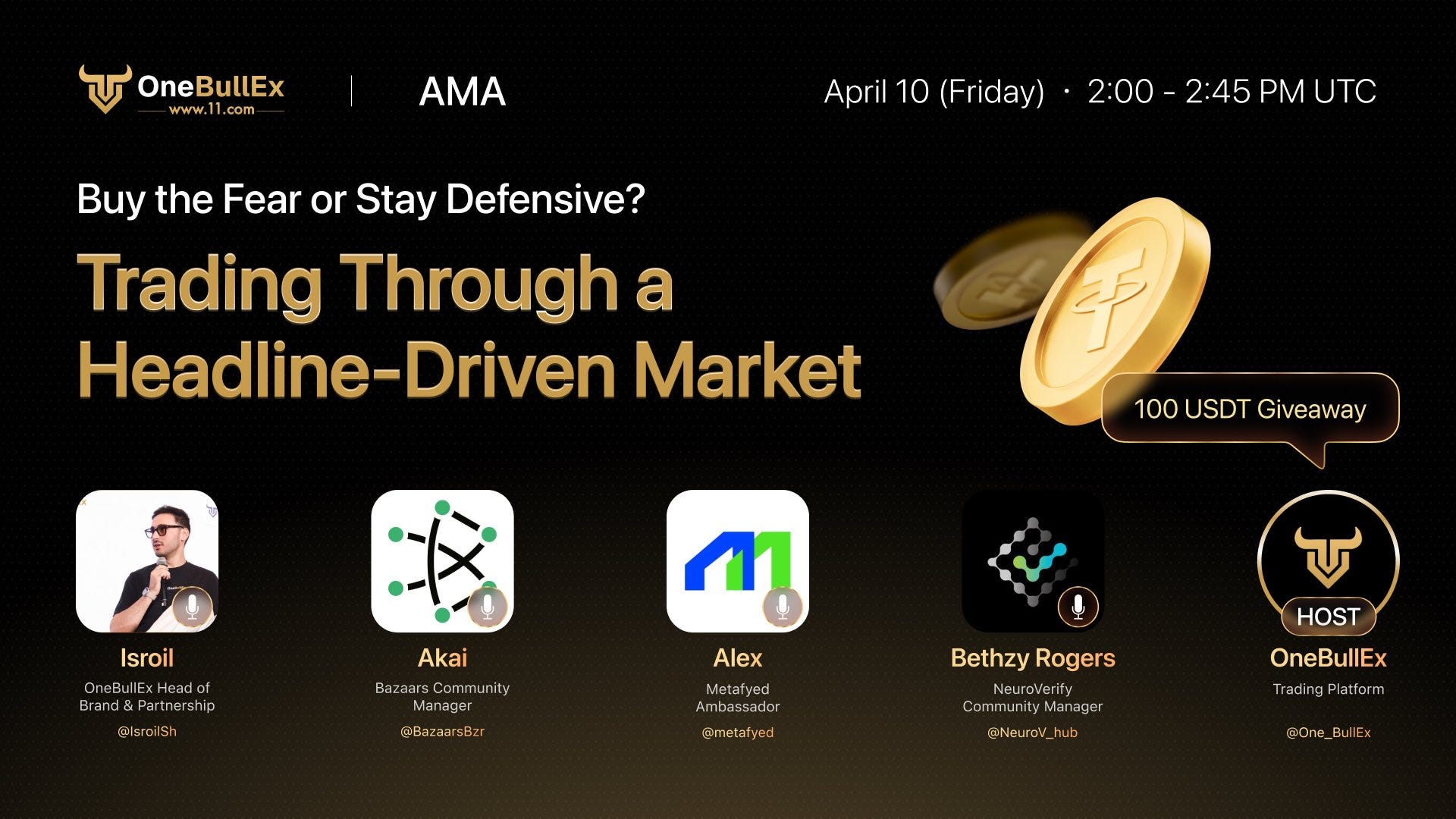
Headline driven crypto trading has defined the first half of 2026, with Bitcoin oscillating between $62,000 and $75,000 as geopolitical shocks and regulatory drafts move prices faster than fundamentals can justify. This OneBullEx Spotlight article recaps the key takeaways from OneBullEx’s April 10 X Space, where four industry guests broke down how to read fear signals, where durable trading edge still exists, and why execution infrastructure matters more than market predictions. The Fear and Greed Index sat at 8 out of 100 as of April 8, 2026, according to CoinMarketCap data, marking one of the longest extreme-fear streaks ever recorded at over 60 consecutive days. Against that backdrop, the panel examined what separates a tradable fear spike from a genuine repricing of risk, and where AI tools add real value to a trader’s workflow.
How Can Traders Distinguish a Real Rotation from a Short-Covering Bounce?
The April 10 Space opened with the question most crypto traders have been wrestling with since the US-Iran ceasefire headlines hit on April 7. Bitcoin jumped from roughly $68,800 to above $72,000 in a single session, and spot Bitcoin ETFs posted $471 million in net inflows on April 6, the strongest daily intake since February. The question: does that constitute a risk-on rotation, or is it shorts getting squeezed?
One guest outlined a three-signal framework grounded in derivatives data. Perpetual funding rates remain negative across major centralized and decentralized venues, meaning the derivatives market is still structurally short. A price bounce with negative funding signals shorts covering into strength rather than fresh capital entering. The confirmation for genuine demand looks different: funding flips positive and holds across multiple cycles while spot price sustains. Rising open interest paired with positive funding is what real demand looks like in derivatives markets. Falling open interest with stable price is just deleveraging.
What Do Cross-Asset Signals Tell Us?
Another panelist brought a traditional finance lens to the discussion. Ceasefire headlines, the speaker argued, are among the least reliable signals to trade because they are inherently unstable. The recommended filter involved three cross-asset checks: oil term structure (watching front-month versus three-month and six-month spreads for genuine backwardation), cross-asset correlation (whether crypto stops behaving as a leveraged NASDAQ proxy), and credit-equity correlation (whether credit spreads narrow alongside equity rallies, or stay wide while equities run). Two of three normalizing suggests short-covering. All three sustained over multiple days might mark a real turn.
CryptoQuant data referenced during the session showed overall net demand for Bitcoin remains deeply negative. Institutions are absorbing near-record volumes through ETFs and treasury strategies, but the rest of the market is selling faster than institutions can buy. Retail is exiting, and older whale cohorts have flipped from accumulation to one of the most aggressive distribution cycles on record. The floor is institutional, but the selling pressure is broad-based.
Where Does Durable Trading Edge Still Exist?
The panel’s most granular discussion centered on which yield and arbitrage strategies remain viable in the current environment.
Is Passive Stablecoin Carry Dead?
One speaker went straight to the regulatory layer. The latest CLARITY Act drafts target passive yield on stablecoins, covering anything that functions like interest, from issuers to exchanges to affiliates. The March 2026 draft text reviewed on Capitol Hill prohibits offering yield directly or indirectly on stablecoin balances. Circle experienced its worst single trading session on record when the language dropped, falling 20% and wiping $5.6 billion in market value. Banks pushed for these restrictions because Standard Chartered analysts estimated yield provisions could redirect up to $500 billion in deposits from traditional banks toward stablecoin products by 2028. As a strategy category, passive stablecoin carry is being legislated out of existence.
The CME futures basis has compressed to levels unseen in years. Cash-and-carry barely clears the risk-free rate after margin and execution costs. One live opportunity remains: persistently negative perpetual funding opens an inverted carry window where a trader goes long perps and short spot, collecting what shorts pay. The spread is thin, reverses quickly into squeezes, and requires real-time funding monitoring across venues. Manual tracking cannot keep pace.
Another panelist echoed the shift. Volatility carry still works when structured properly, such as selling weeklies or running single-stock versus index dispersion trades, but directional carry without disciplined stop architecture will get run over. Cross-venue arbitrage in fragmented crypto markets persists but compresses every quarter as algorithmic competition intensifies.
When Is Fear a Buy Signal and When Is It a Warning?
The Fear and Greed Index had been pinned at extreme fear for over 60 consecutive days as of April 8, 2026, more than doubling the previous record of roughly 30 days during the Terra/Luna collapse. The index hit single digits, a reading that has appeared fewer than 20 times since the index launched in 2018.
One guest acknowledged the historical pattern directly: every previous sub-10 reading preceded substantial returns. The average 90-day return after sub-10 readings has been roughly 48% to 62% depending on the data source, with zero instances producing negative 90-day returns. The critical difference this time: previous extreme-fear episodes were triggered by crypto-native events with modelable resolutions, such as exchange collapses or protocol failures. The current pressure is external and structural, driven by macro headwinds, energy disruption, and rate uncertainty with no clear resolution date.
Why the Institutional-Retail Divergence Matters
The divergence underneath the fear reading is striking. Large investors have been accumulating at some of the highest net levels in over a decade. Exchange reserves sit at multi-year lows as coins move to cold storage. US spot Bitcoin ETFs reversed months of outflows with $1.32 billion in net inflows during March 2026, the first positive month since October 2025. Morgan Stanley launched its own Bitcoin ETF (MSBT) on April 8, 2026, with a competitive 14 basis point fee. Brown University’s endowment took a spot Bitcoin ETF as its largest US equity position.
The warning signs deserve equal weight. The Coinbase premium has been persistently negative since Bitcoin’s all-time high, meaning active US conviction buying has not returned. Bitcoin is correlating with the NASDAQ at elevated levels while gold rallies independently. When Bitcoin behaves like leveraged tech rather than a store of value, fear may reflect legitimate repricing rather than a contrarian opportunity. The floor is structurally higher than any previous extreme-fear period, but buying without tracking realized price compression, the Coinbase premium, and the correlation regime is trading on hope.
Why Does Execution Kill More Traders Than Bad Analysis?
The panel described a scenario most futures traders recognize: a solid thesis backed by negative funding, multi-year low reserves, and recovering options skew, and then a 3 AM headline gaps price past the stop. The trader wakes up liquidated or deep in drawdown making emotional decisions in the dark. The thesis was right. The execution killed the position.
Research consistently shows rule-based execution reduces panic-driven mistakes by nearly half compared to manual trading. The framework discussed stacks four layers. Position sizing comes first, calibrated to worst-case gap scenarios rather than recent average volatility. Above that, hard-coded risk rules execute whether the trader is at the desk or asleep, with parameters the system enforces without human override. Above that, validated strategy logic, because automation without validation produces faster mistakes. The top layer is regime awareness: a trending strategy will chop apart in a range-bound market, and the current environment of compressed range, extreme fear, and negative funding constitutes a specific regime that systems need to recognize.
OneBullEx’s OneALPHA and 300 Spartans were built around this workflow. A trader describes an edge in plain language. The system converts the description to testable code, stress-tests across regimes, checks for overfitting, and shows every line of logic before capital goes behind it. The glass-box architecture means the trader sees where a strategy works and where it might break before risking money.
Where Does AI’s Real Trading Edge Come From?
All active panelists converged on the same conclusion: AI’s value in trading sits in research compression, risk monitoring, and execution quality. The ability to take a live market observation, stress-test the observation against historical analogs within hours, and produce a deployable strategy represents a pipeline that used to take quant teams weeks.
One speaker framed the point directly: using AI to forecast price direction is using a Ferrari for grocery runs. The real applications include scanning thousands of earnings transcripts for sentiment shifts, backtesting hundreds of factor combinations in an afternoon instead of a month, and optimizing execution to save the basis points that compound across a full trading year. JP Morgan data showed total digital asset inflows slowed dramatically in Q1 2026, with Strategy (formerly MicroStrategy) serving as the only meaningful institutional buyer. When margins are that thin, every inefficiency in the research-to-execution pipeline bleeds returns.
The common mistake all speakers flagged: treating AI as a plug-and-play alpha generator. Models trained on 2015–2020 data do not behave the same way in a 5% rate environment with geopolitical tail risk. The edge is knowing when the model works and when to override it. AI does not replace the trader’s thesis, conviction, or judgment about when assumptions have changed. AI is infrastructure that makes traders faster, tighter, and more precise. The panelists’ consensus carried a sharp edge: the traders who treat AI as infrastructure will be here for the next cycle, and the ones looking for a magic box are exit liquidity for everyone else.
Key Takeaways
- Perpetual funding rates, open interest direction, and cross-asset correlation are more reliable rotation signals than price candles or ceasefire headlines in a headline driven crypto market.
- Passive stablecoin yield is being legislated away by the CLARITY Act. The CME futures basis barely clears risk-free rate. Inverted perp funding carry and structured volatility trades remain viable but require real-time infrastructure.
- The Fear and Greed Index below 10 has historically preceded strong returns, but this episode is driven by external macro risk with no clear resolution date, unlike previous crypto-native crises.
- Execution infrastructure, including position sizing, hard-coded risk rules, validated strategy logic, and regime detection, prevents more losses than better analysis does.
- AI’s durable trading edge lives in research speed, risk monitoring, and execution optimization. Using AI for price prediction misapplies the tool’s strengths.
FAQ
What signals distinguish a real crypto rotation from a short-covering bounce?
Perpetual funding rates flipping positive and holding across multiple cycles, rising open interest paired with positive funding, and cross-asset correlation breaking down (crypto decoupling from NASDAQ) all confirm genuine rotation. Negative funding with rising price indicates shorts covering, not new demand entering.
How does the CLARITY Act affect stablecoin yield strategies?
The CLARITY Act’s latest Senate draft prohibits platforms from offering yield directly or indirectly on stablecoin balances. The language covers exchanges, brokers, and affiliated entities, effectively closing workarounds that allowed platforms to pass stablecoin rewards to users.
What does a Fear and Greed Index reading below 10 mean for traders?
Historically, every sub-10 reading since 2018 has preceded positive 90-day returns averaging 48% or higher. The current streak exceeds 60 consecutive days in extreme fear, more than double the previous record during the Terra/Luna collapse.
Why does execution matter more than market analysis in volatile conditions?
Headline-driven gaps can trigger liquidations or fill stops far below plan regardless of thesis quality. Rule-based execution reduces panic mistakes by nearly half compared to manual trading, according to industry research.
Where does AI add the most value in crypto trading workflows?
AI’s strongest applications are research compression (scanning data and testing hypotheses in hours instead of weeks), risk monitoring (tracking correlation shifts and concentration risk in real time), and execution optimization (reducing slippage across venues). Price prediction is AI’s weakest and most overhyped application.
What is OneALPHA?
OneALPHA allows traders to describe a trading edge in plain language. The system converts the description into testable code, stress-tests across market regimes, checks for overfitting, and displays every line of logic transparently before capital is deployed.
Disclaimer: This article is for informational purposes only and does not constitute financial advice. Trading cryptocurrency derivatives involves substantial risk of loss. Past performance of fear-based signals does not guarantee future results. Always conduct your own research and consult a licensed financial advisor before making investment decisions.