The End of Expensive Image AI? What Nano Banana 2 means for Pro-tier models, creative automation, and the future cost structure of generative design.
In 2024, image AI was about spectacle.
In 2025, it became about speed.
In 2026, it’s about economics.
When Google introduced Nano Banana 2 (Gemini 3.1 Flash Image) on February 26, 2026, most headlines focused on one thing: “Flash speed at near-Pro quality.”
But that framing misses the real story.
Nano Banana 2 doesn’t just compete with Pro-tier models.
It changes how product teams should architect creative pipelines.
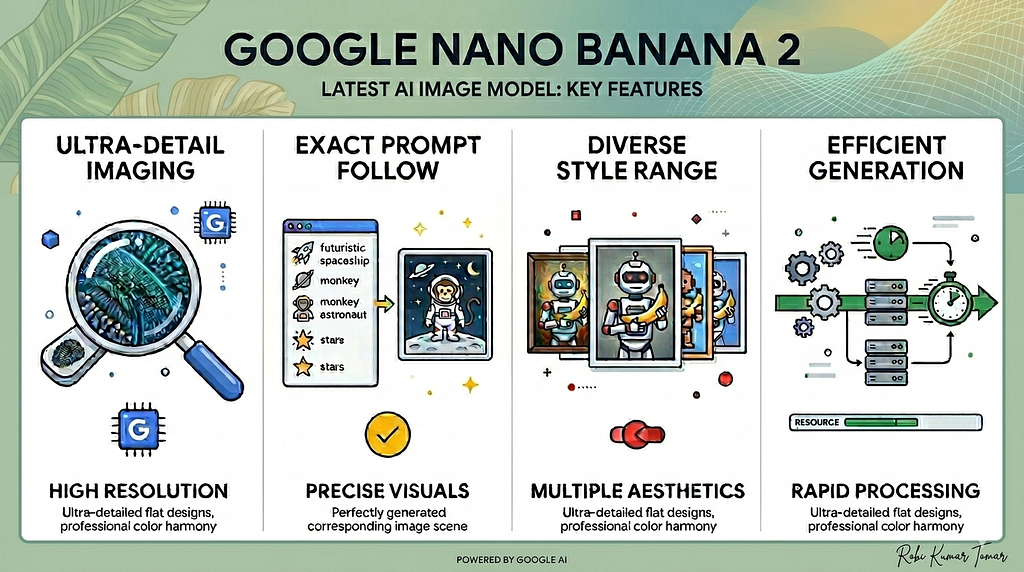
What Nano Banana 2 Actually Is (no Hype)
Nano Banana 2 is Google’s Flash-optimized image generation model, designed for:
- High throughput
- Lower latency
- Production deployment
- Strong instruction adherence
- Real-world knowledge grounding
It is now rolling out across:
- Gemini app (consumer + Workspace)
- Developer APIs (Gemini API / AI Studio)
- Enterprise deployment via Vertex AI
This is not an experimental sandbox model.
It’s built for production.
The Technical Upgrades That Actually Matter
Let’s separate marketing from engineering.
1. Flash Architecture, Production First
Nano Banana 2 runs on the Gemini 3.1 Flash Image stack — optimized for speed and cost efficiency rather than maximum refinement passes.
This means:
- Faster generation cycles
- Higher batch throughput
- Lower serving overhead
- Better suitability for iterative workflows
It is not “Pro, but cheaper.”
It’s a different optimization target.
2. Real-World Knowledge Grounding
Unlike purely generative diffusion models, Nano Banana 2 can pull from Gemini’s knowledge base and web imagery to improve factual rendering of:
- Landmarks
- Historical references
- Infographic data
- Architecture
Important caveat: grounding reduces hallucinations — it does not guarantee factual correctness. Validation is still required for high-risk use cases.
3. Thinking Levels (Underrated Feature)
One of the most powerful but under-discussed capabilities:
You can configure “thinking levels.”
- Minimal → prioritizes speed
- Dynamic / High → allocates more reasoning time before rendering
This effectively gives you a latency vs reasoning dial.
That’s not just a feature — it’s an architectural control lever.
Most competitors don’t expose this explicitly.
4. Resolution & Aspect Ratio Expansion
Nano Banana 2 supports:
- 512px (ultra-fast ideation)
- 1K
- 2K
- 4K outputs
- Extreme ratios: 4:1, 1:4, 8:1, 1:8
This matters for:
- E-commerce banners
- YouTube thumbnails
- Social carousels
- Display ads
- Localization campaigns
Extreme aspect ratios used to require compositional hacks.
Now they’re native.
5. Multi-Subject & Object Consistency
Official documentation indicates:
- Up to 5 characters preserved
- Between 10–14 objects depending on deployment context (Gemini app vs broader model documentation)
This discrepancy likely reflects UI limits versus broader model capacity.
Either way, the model is optimized for multi-entity scene coherence — a known weakness in earlier Flash-tier systems.
6. Provenance & Watermarking
Images include:
- Invisible SynthID watermark
- Visible watermark in Gemini product UI
- C2PA Content Credentials integration roadmap
This matters for enterprise publishing and AI compliance.
It also means marketing teams must plan for watermark removal policies depending on deployment context.
Where Nano Banana 2 Sits in the 2026 Image AI Stack
Let’s zoom out.
There are now three practical tiers in image AI:
High-End Studio Models
- Maximum fidelity
- Slower
- Higher cost
- Ideal for final polish
Flash-Tier Models
- Fast
- Scalable
- Optimized for volume
- Designed for iteration
Open Diffusion Systems
- High control
- Higher friction
- Infrastructure overhead
Nano Banana 2 is the first Flash-tier model that meaningfully narrows the gap with studio-grade systems.
That’s the disruption.
The Hidden Shift: Speed Changes Human Behavior
This is the part nobody is talking about.
When generation takes 30 seconds, people think carefully before prompting.
When it takes 5–8 seconds, they experiment.
More experimentation leads to:
- More divergent concepts
- More A/B creative testing
- More risk-taking
- Better conversion outcomes
Latency isn’t just a performance metric.
It’s a creativity amplifier.
The Hybrid Architecture Pattern (The Real Opportunity)
Here’s the winning design pattern:
Flash → Rank → Pro → Export
- Generate 50 candidates with Nano Banana 2
- Score them (human or algorithmic)
- Promote top 5 to Pro-tier refinement
- Export final polished assets
Nano Banana 2 becomes your front door.
Pro becomes your finish line.
This hybrid model:
- Reduces cost
- Increases experimentation
- Maintains quality ceiling
Companies that productize this flow will win.
Where Nano Banana 2 Wins
✔ Batch catalog generation
✔ A/B ad testing
✔ Rapid thumbnail creation
✔ Infographics with grounded data
✔ Localization campaigns
✔ Real-time product previews
Where Pro Still Wins
✔ Pixel-perfect texture fidelity
✔ Hyper-detailed typography edge cases
✔ Luxury branding photography
✔ High-resolution print campaigns
Nano Banana 2 narrows the gap.
It doesn’t eliminate it.
Real Limitations You Should Know
To keep this honest:
- Grounding ≠ guaranteed correctness
- Visible watermark may affect some workflows
- Extreme aspect ratios can distort composition logic
- 4K outputs may still require post-processing
- Thinking-level tuning requires experimentation
If you ignore these, your deployment will underperform.
Enterprise & Developer Angle
Nano Banana 2 is available via:
- Gemini API
- Google AI Studio
- Vertex AI (enterprise deployment)
Paid API key required for production usage.
This confirms it is intended for scalable systems — not just consumer experimentation.
If you’re building:
- AI design tools
- E-commerce automation
- Marketing SaaS
- Creative copilots
This model is architected for you.
The Real Strategic Takeaway
Nano Banana 2 isn’t trying to beat Pro.
It’s redefining the default.
The future of image AI isn’t one perfect model.
It’s multi-tier orchestration.
The teams that:
- Embrace Flash for velocity
- Use Pro selectively for refinement
- Automate the handoff intelligently
Will dominate creative economics in 2026.
Closing Thought
In AI, speed is leverage.
Nano Banana 2 gives you leverage.
The question is not:
“Is it better than Pro?”
The question is:
“Have you redesigned your pipeline to exploit it?”
Lets share your thoughts in comment section.
Your move 👇
❤️If this shifted how you think about the economics of Image AI, clap 👏, save it for your next product discussion, and follow for practical, architecture-level AI insights — not hype.
👉 Explore 9 RAG architectures every serious builder should know (and the failure modes each one hides).
Nano Banana 2 Isn’t Just Faster — It Changes the Economics of Image AI was originally published in Level Up Coding on Medium, where people are continuing the conversation by highlighting and responding to this story.