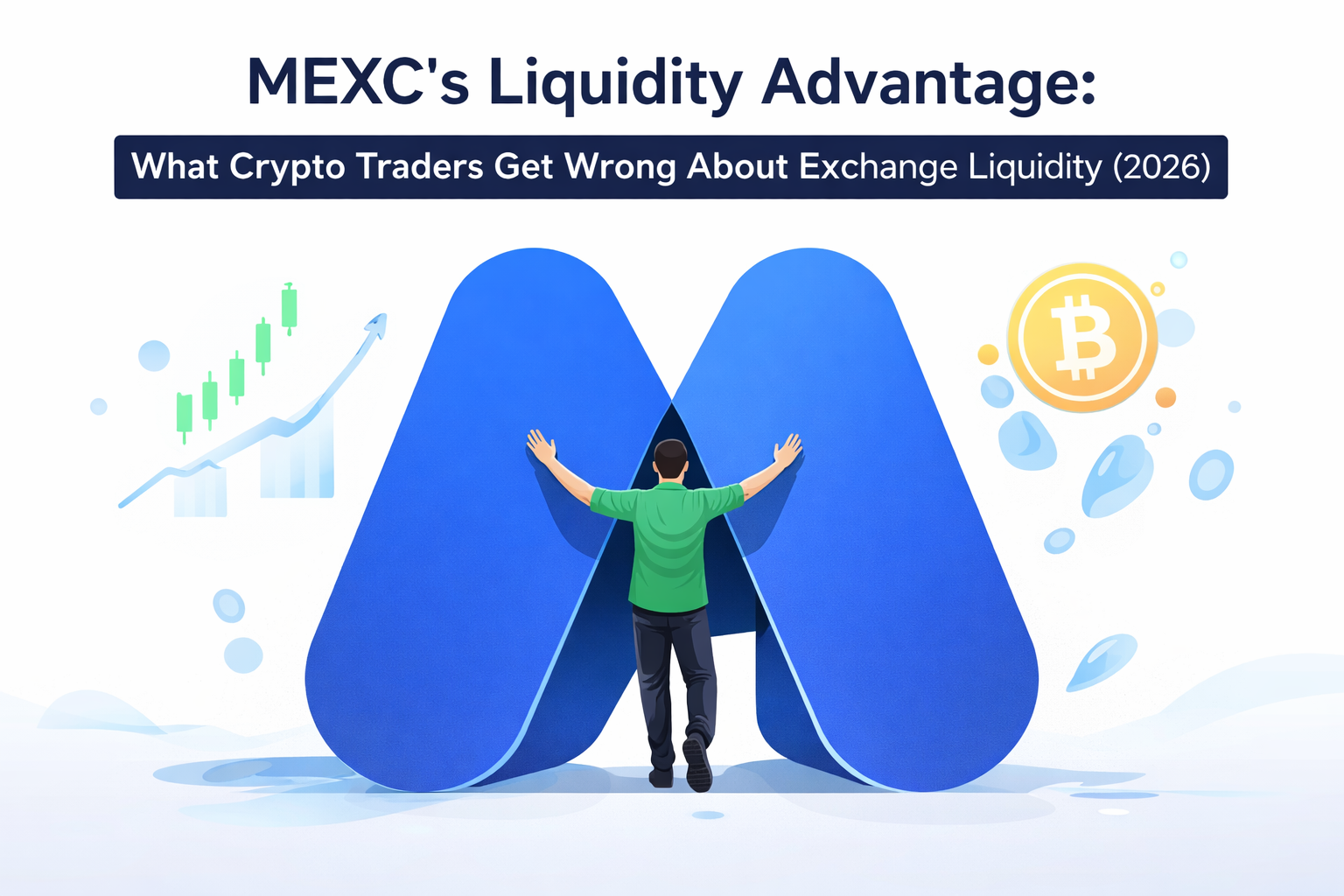
MEXC’s Liquidity Advantage: What Crypto Traders Get Wrong About Exchange Liquidity (2026)
 Deborah John11 min read·Just now
--
Summary
When most people open a crypto exchange account, they ask two questions: “Is my favorite coin listed here?” and “Are the fees low?”
Liquidity rarely makes the shortlist. That is a costly mistake.
After analyzing crypto exchange performance across multiple market cycles, I can tell you with confidence that exchange liquidity is the single most underappreciated factor separating consistently profitable traders from those who wonder why their entries and exits never quite hit where they expected.
In 2026, MEXC has built one of the deepest and most verifiable liquidity ecosystems in the global crypto market, and independent data now backs this up across multiple third-party sources. In this article, I break down exactly what exchange liquidity means, why most traders misread it, and why MEXC’s structural advantages translate to real, measurable outcomes for every trade you make.
Key Highlights
- MEXC recorded $95.9B in spot volume in February 2026, ranking as the 2nd largest exchange globally according to CoinGecko
- MEXC’s global market share nearly doubled from 5% to 9% in two years, meaning more traders, deeper order books, better fills
- MEXC’s BTC futures order book is 2.6x deeper than the nearest competitor so you get less slippage on every trade you make
- MEXC charges 0% maker fees on both spot and futures
- MEXC listed 1,333 new tokens since January 2025, ranked #1 globally, giving you earliest access to emerging markets
- MEXC’s reserves grew 274.6% since 2024, backed by a 100M+ USDT Guardian Fund so your funds are always protected
- MEXC holds a 10/10 CoinGecko Trust Score, the highest independent rating any exchange can receive for liquidity and reliability
1. What Is Exchange Liquidity and Why Do Most Traders Get It Wrong?
The most common misconception I encounter is this: “If I can buy a coin on an exchange, the exchange has enough liquidity.”
That is not what liquidity means, not in any technically meaningful sense.
Liquidity in crypto markets refers to your ability to execute a trade at or near your intended price, without your own order shifting the market against you. A truly liquid market has four defining characteristics:
- Tight bid-ask spreads: the gap between what buyers will pay and what sellers ask is narrow
- Deep order books: enough buy and sell orders are stacked at multiple price levels to absorb large trades without significant price movement
- High and consistent trading volume: ongoing activity keeps prices stable and fair
- Low slippage: the price you receive is close to the price you saw when you placed the order
On an illiquid exchange, a $50,000 purchase of a mid-cap altcoin can push the price up by 3–5% before your order fully fills. You are immediately underwater before you have held the position for even a second. On a genuinely liquid platform like MEXC, with deep order books and a dense market-maker network, that same trade barely moves the needle.
For retail traders, this feels like small percentages. Compound it across hundreds of trades per year and it becomes the difference between a portfolio that grows and one that quietly erodes. Understanding slippage is not optional for serious traders, it is foundational.
2. MEXC’s Market Position in 2026: The Numbers Are Hard to Ignore
Before getting into the mechanics of liquidity, it is worth grounding the conversation in MEXC’s current market standing, because the scale of adoption is itself a structural driver of liquidity.
According to CoinGecko’s Spot CEX Report 2026, published April 13, 2026, MEXC’s global spot market share grew from 5% in early 2024 to 9% in 2026, nearly doubling in just two years. In February 2026, the exchange recorded $95.9 billion in spot trading volume, securing its position as the second-largest exchange globally in this category for that month.
These are not marketing claims. They come from an independent multi-exchange analysis covering 12 of the world’s leading centralized exchanges.
Further validation comes from MEXC’s Q1 2026 Ecosystem & Growth Report, which confirms that both spot and futures volumes surged over 130% year-over-year in 2025. TradFi futures volume alone climbed 246% in Q1 2026. In March 2026, MEXC recorded net capital inflows of approximately $22.97 million, placing it among the top 5 exchanges by this metric on DeFiLlama.
Add a user base of 40+ million registered traders across 170+ countries and a CoinGecko Trust Score of 10/10 for spot liquidity reliability, and the picture is clear: MEXC has earned its liquidity depth through consistent execution and verifiable growth, not promotional noise.
3. Order Book Depth: Where the Liquidity Advantage Becomes Concrete
Abstract praise for “deep liquidity” is easy to produce. The MEXC order book is where this advantage becomes measurable.
For BTC/USDT futures, one of the most benchmarked trading pairs in crypto, MEXC maintains approximately $82 million in total limit orders within ±5 basis points of the mid-price. According to independent analysis by CoinLaw, a leading top-3 competitor holds roughly $31 million at the same depth, making MEXC’s futures order book approximately 2.6 times deeper on this benchmark.
For spot markets, liquidity at the 0.1% depth level sits at $3.11 billion across MEXC’s order books, a figure that significantly outpaces most industry competitors at the same measurement point.
What this means in practice:
- Large spot trades, even approaching $5 million, can execute with a 0.05% average price improvement rate, meaning MEXC’s matching engine often delivers a better fill than the price you quoted
- Tight spreads on major pairs reduce the invisible cost baked into every round-trip trade
- During volatile market conditions, stop-loss and liquidation orders execute closer to intended levels because the order book has enough depth to absorb the flow
For experienced traders, these mechanics are familiar. For beginners, the takeaway is simple: every percentage of slippage is money leaving your account before fees are even considered. Deep liquidity is what minimizes that invisible drain.
4. The Zero-Fee Flywheel: How Low Costs Create Even Deeper Liquidity
Here is a structural insight that most exchange reviews overlook: on MEXC, low fees and deep liquidity are not separate features, they actively reinforce each other.
MEXC’s fee structure charges 0% maker fees and 0.05% taker fees for spot trading, and 0% maker with 0.02% taker fees for futures trading. According to the CoinGecko Spot CEX Report 2026, this makes MEXC the exchange with the lowest baseline trading costs among all 12 major exchanges analyzed. Most competing platforms charge 0.10% or higher, with some reaching up to 0.50%.
Now follow the logic of what this fee structure creates at scale:
When fees approach zero, more traders choose MEXC over alternatives. More active traders generate more orders in the order book at any given moment. A denser order book produces tighter spreads and better fills. Better fills and lower costs attract even more traders. Over time, this becomes a self-reinforcing flywheel, each turn producing more liquidity, which in turn sustains volume.
The data confirms this model is working. MEXC’s zero-fee program spanning more than 3,000 trading pairs enabled 3.44 million users to save a combined 1.1 billion USDT in trading fees over the past year. That is capital that remains in traders’ accounts, continuing to circulate through the market, sustaining volume and, by extension, sustaining the liquidity depth that benefits every participant.
To illustrate the dollar impact: a trader executing $100,000 in BTC spot across 10 complete buy-sell cycles in a month would pay roughly $2,075 in fees on a standard exchange. On MEXC, that same activity costs approximately $430, a saving of over $1,600 per month per $100,000 traded. That capital compounds over time into a meaningful, structural performance advantage.
5. DEX+: Bridging Liquidity Gaps Across Fragmented Markets
One of MEXC’s more technically sophisticated liquidity tools is its DEX+ hybrid model, which combines the order book depth of a centralized exchange with liquidity sourced from decentralized platforms.
This matters because a fundamental problem in crypto markets is liquidity fragmentation, the same asset trading across multiple venues simultaneously, with each pool too shallow to support meaningful trade sizes without slippage. A token might have $3 million in daily DEX volume split between Uniswap, Jupiter, and PancakeSwap, but no single venue has enough depth to execute a $20,000 order cleanly.
MEXC’s DEX+ model aggregates this fragmented liquidity into a unified interface, while maintaining the execution speed and reliability of a centralized order book. In practice, this delivers two tangible benefits:
- Earlier access to emerging tokens with real tradable depth, not just a ticker listing with $5,000 in 24-hour volume
- Better pricing on niche and mid-cap assets, because DEX+ draws from multiple liquidity sources simultaneously rather than depending on a single shallow book
6. Altcoin and Futures Liquidity: Where the Gap Is Most Pronounced
Let me be direct: for BTC and ETH spot trading, most top-tier exchanges offer adequate liquidity. The gaps open significantly in two specific markets.
6.1. Altcoin Listing Speed and Depth
Since January 2025, MEXC has listed 1,333 new spot tokens, approximately 100 new assets per month, ranking first among all major exchanges in listing velocity, per CoinGecko. MEXC listed approximately 17% of all newly created tokens, while most major competitors captured less than 5%.
In Q1 2026 alone, MEXC added 399 new token listings, with the top 10 by spot trading volume posting an average peak gain of 2,534%. Solana-ecosystem projects and AI-sector tokens led the gainers list, with SOL accounting for four of the top ten spots.
This listing velocity means traders get first-mover access to price discovery, on a platform with genuine order book depth behind those listings, not just a listing in name only.
6.2. Futures Market Depth
In futures trading, liquidity depth shifts from a preference to a necessity. With leverage of 10x, 20x, or higher, a 0.5% slippage event represents a 5% hit to position equity. A stop-loss executing 1% below your set level can be the difference between a controlled loss and a margin call.
MEXC supports over 1,200 perpetual futures contracts across USDT-M, Coin-M, and USDC-M settlement types, with leverage up to 500x on USDT-M perpetual contracts. The platform reports millisecond-level execution latency, 30 times faster than comparable platforms, a speed advantage that becomes critical when entering or exiting positions during high-volatility windows.
7. Verified Reserves: Liquidity Backed by Real Assets
Deep order books mean nothing if the exchange holding your assets is not solvent.
MEXC publishes monthly independent Proof of Reserves audits conducted by Hacken, upgraded from bi-monthly cadence in late 2025. The most recent reports confirm reserve ratios consistently above 100% for all major assets: BTC at 141%, USDT at 126%, USDC at 127%, and ETH at 107%. Every user can independently verify their share through the on-chain Merkle Tree verification system embedded directly in the platform.
According to CoinGecko’s 2026 CEX Report, MEXC’s total reserve value grew by 274.6% between January 2024 and February 2026, a direct reflection of sustained institutional and retail capital inflows.
In June 2025, MEXC deployed the MEXC Guardian Fund, capitalized at over 100 million USDT. This fund exists specifically to provide structural protection against cybersecurity events and technical disruptions, ensuring that liquidity remains accessible even under stress conditions rather than being frozen when you need it most.
When a platform maintains this level of over-collateralization and submits to independent monthly audits, the liquidity you see in the order book is backed by real, accessible capital.
8. What You Need to Understand Before Placing Your Next Trade
If you are new to crypto and reading this to figure out where to start, here is what matters most:
Do not pick an exchange based solely on which coins they list or what the headline fee looks like. Ask: how liquid is this market?
Liquidity protects you from:
- Paying meaningfully more than the market price due to slippage
- Being unable to exit a position quickly when the market moves against you
- Watching your stop-loss trigger at a price far from where you actually set it
MEXC makes liquidity a transparent, data-backed competitive advantage, not something you only discover when a trade goes badly. With 40+ million active users, a 10/10 CoinGecko Trust Score, independently audited reserves, and the deepest altcoin order books in the industry, the infrastructure is built and running at scale.
Understanding this before you trade is not advanced knowledge. It is the most fundamental form of edge available to any market participant, and the only cost to accessing it is choosing the right platform.
Conclusion
Most traders optimize things that matter only at the margin, sign-up bonuses, a clean mobile app, referral credits. These are fine to consider, but they are rounding errors compared to the cumulative impact of where your orders actually execute and at what price.
In 2026, MEXC has built a structurally superior liquidity environment that independent data consistently backs up. A 9% global market share nearly doubled in two years, $95.9 billion in February 2026 spot volume ranking second globally, BTC futures depth 2.6 times deeper than the nearest competitor, 0% maker fees sustaining the volume flywheel, and a perfect 10/10 CoinGecko Trust Score, these are not marketing claims. They are the measurable output of a platform that chose liquidity as its central competitive strategy and executed on it consistently.
The traders who understand what liquidity actually means have a real edge on every trade they place. Now you do too.
Stop leaving money on the table through slippage and inflated fees. Create your free MEXC account and trade with the deepest order books, 0% maker fees, and a platform built to give every trader a real edge.
Frequently Asked Questions
1. Is MEXC safe to use in 2026? Yes, for most traders it is considered safe. MEXC holds a 10/10 Trust Score on CoinGecko, publishes monthly Proof of Reserves audits through Hacken confirming over 100% backing for all major assets, and maintains a $100 million Guardian Fund as a security buffer. The platform also stores 95% of user assets in cold wallets.
2. What are MEXC’s trading fees? MEXC charges 0% maker fees and 0.05% taker fees for spot trading, and 0% maker with 0.02% taker fees for futures, among the lowest of any major exchange globally. Holders of MEXC’s native MX token can unlock additional fee discounts on top of these base rates.
3. Does MEXC have good liquidity? Yes. MEXC recorded $95.9 billion in spot trading volume in February 2026, ranking it the second-largest exchange globally according to CoinGecko. Its BTC/USDT futures order book depth is 2.6 times deeper than its nearest competitor, which means less slippage and better price execution on every trade.
4. How does MEXC compare to Binance? Both are top-tier exchanges, but they differ in key areas. MEXC lists significantly more tokens, over 3,000, and has faster listing speeds, making it better for trading early-stage and emerging altcoins. Its fees are also lower, with 0% maker fees versus Binance’s standard 0.10%. Binance, however, has stronger regulatory licensing in more countries and broader fiat deposit options.
5. Is MEXC good for beginners? MEXC is beginner-friendly in terms of setup and access, registration is straightforward, no KYC is required for basic trading, and a demo account is available to practice futures without real money. However, the platform’s wide range of features, high leverage options, and large number of low-cap altcoins can be overwhelming for first-time traders. Beginners should start with spot trading on major pairs before exploring futures or leverage.
Disclaimer: This article is written for informational and educational purposes only and does not constitute financial or investment advice. Cryptocurrency trading involves significant risk, including the possible loss of principal. Always conduct your own research and consult a qualified financial advisor before making investment decisions.