Ledger vs Trezor vs Tangem: How to Choose the Right Hardware Wallet
--
A simple guide for beginners who are stuck between flexibility, transparency, and easy cold storage.
Choosing a hardware wallet sounds simple at first. You just want a safe place to store crypto.
But once you start comparing Ledger, Trezor, and Tangem, it quickly becomes confusing. One wallet focuses more on flexibility. Another focuses more on open-source self-custody. Another feels much simpler because it works like a card.
That is exactly why I built WalletMatcher:
https://walletmatcher.com/
The idea is simple: instead of telling everyone that one wallet is “the best,” WalletMatcher helps people compare the tradeoffs and find the wallet style that fits how they actually use crypto.
The problem with most hardware wallet comparisons
Most comparisons focus on one question:
Which wallet is the safest?
But that is not always the best starting point.
A better question is:
Which wallet will I actually understand, use correctly, and feel comfortable with?
Because hardware wallet security is not only about the device. It is also about the user.
If the backup process confuses you, that is a risk.
If you do not understand what you are signing, that is a risk.
If the wallet is too inconvenient and you stop using it properly, that is also a risk.
So the real comparison is usually between:
- security
- transparency
- simplicity
- supported assets
- recovery method
- daily usability
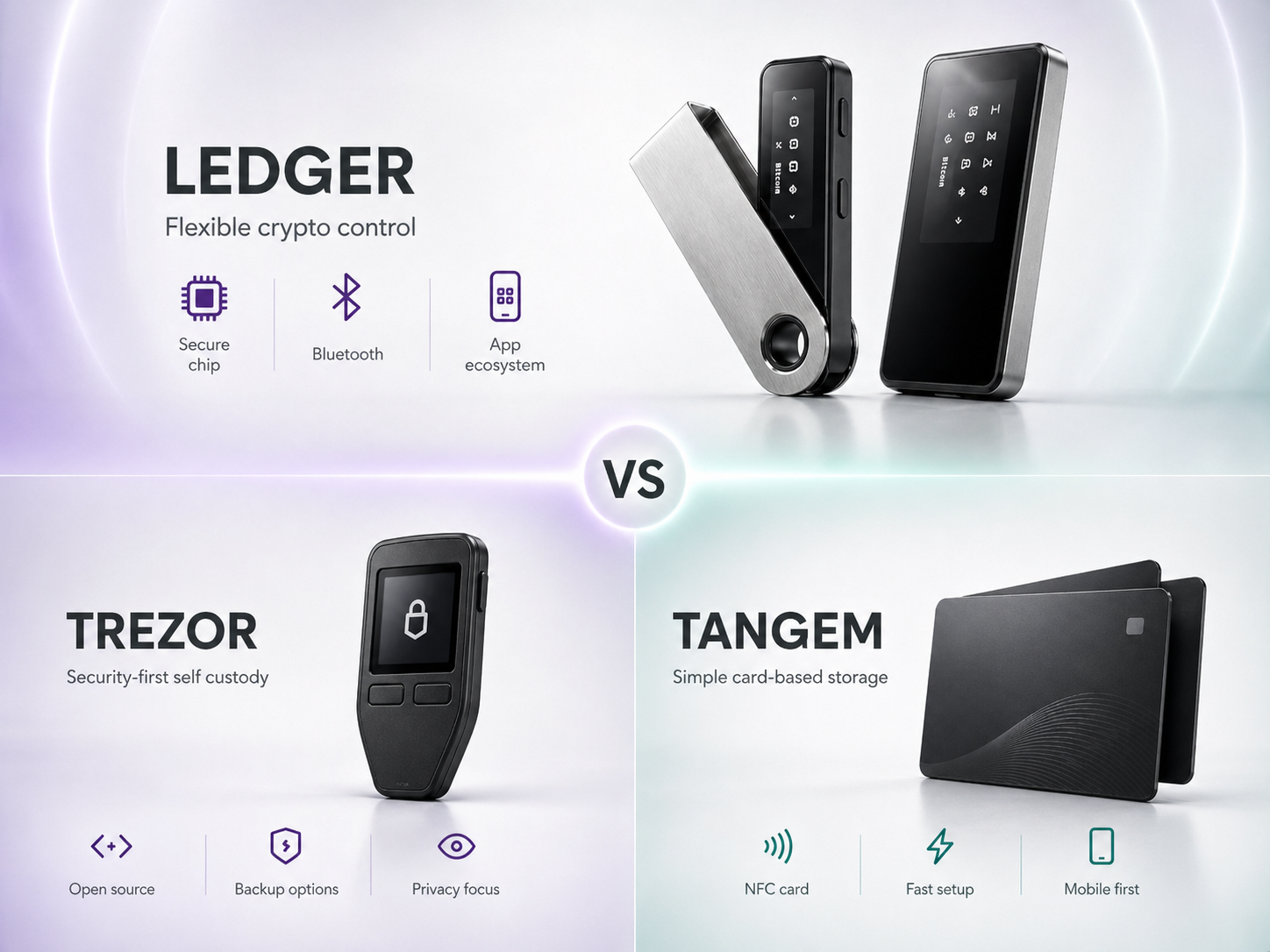
Ledger: better for flexible crypto management
Ledger is usually a strong fit for people who want broad crypto management and app flexibility.
According to Ledger’s official site, Ledger highlights 8M+ signers sold, 20%+ global crypto secured, and “Zero hacks” as brand claims. Ledger also positions its ecosystem around managing many crypto assets and using its wallet app experience.
That makes Ledger interesting for users who want to manage different assets, use more crypto services, and have a more flexible wallet ecosystem.
The tradeoff is that some users are less comfortable with Ledger’s more closed-source approach and ecosystem decisions. So for some people, Ledger feels powerful and practical. For others, it requires more trust in the company.
Trezor: better for open-source self-custody
Trezor is often the cleaner choice for people who care about transparency and traditional self-custody.
Trezor’s official site says it is trusted by over 2 million users worldwide, has 12+ years in crypto security, and is rated 4.6 out of 5 on Trustpilot. It also describes Trezor as having advanced open-source security and a powerful crypto app for mobile and desktop.
Trezor also says its wallets support thousands of coins and tokens, unlock 70,000+ dApps, and connect with 30+ leading crypto wallet apps.
For users who want a more traditional hardware wallet experience, Trezor is easy to understand as a self-custody option.
The tradeoff is that it may feel less simple than Tangem for complete beginners.
Tangem: better for simple card-style cold storage
Tangem is different because it does not feel like a typical hardware wallet.
It is a card-style wallet, which makes it attractive for beginners and mobile-first users. Tangem’s official site highlights a 25-year limited hardware warranty, and its wallet design is built around a chip and antenna with no fragile components like batteries or cables.
Tangem’s main advantage is simplicity. For many users, tapping a card with a phone feels easier than managing a traditional device.
The tradeoff is that you should clearly understand the backup model before putting serious funds on it. Simplicity is useful, but only if you understand how recovery works.
So which wallet should you choose?
Here is the simple version:
Choose Ledger if you want flexibility, broad crypto management, and a strong app ecosystem.
Choose Trezor if you care more about open-source transparency, self-custody habits, and traditional hardware wallet control.
Choose Tangem if you want the simplest card-style experience and mobile-first cold storage.
There is no single perfect answer for everyone.
The best wallet depends on how you use crypto.
Why I built WalletMatcher
I built WalletMatcher because many people ask the same question:
Should I buy Ledger, Trezor, or Tangem?
But most of the time, they do not need a generic ranking. They need a practical recommendation based on their own behavior.
Someone who only holds Bitcoin long term may need a different wallet than someone who uses many chains and apps. A beginner may value simplicity more than advanced features. A security-focused user may value transparency more than convenience.
WalletMatcher compares Ledger, Trezor, and Tangem by:
- setup simplicity
- security style
- supported assets
- backup model
- daily usability
- user type
You can also take a short quiz to see which wallet style fits you best:
Wallet Selector | Hardware Wallet Quiz
Compare hardware crypto wallets in under 60 seconds. Answer 6 quick questions and get the best cold wallet…
walletmatcher.com
Final thought
A hardware wallet is not only a product choice. It is a responsibility choice.
The right wallet is the one you understand well enough to use safely.
For some people, that will be Ledger.
For some, it will be Trezor.
For others, Tangem will be the most practical option.
The important thing is not to buy based only on hype or fear. Compare the tradeoffs, understand the recovery process, and choose the wallet that matches your comfort level.
Not financial advice. Always verify product details on the official wallet provider websites before buying.