The cloud era optimized what was provisioned. The AI era must optimize what is generated.

Every few years, the enterprise hits a moment where the story changes. Not because a new technology arrives, but because the old excuses stop working. This is that moment.
Across industries, leaders are waking up to a truth they’ve been avoiding for a decade: AI isn’t stalling because the models are weak — it’s stalling because the data is dirty. And the numbers are no longer polite about it.
The Data Hygiene Reckoning
The research is blunt.
- Gartner now predicts that through 2026, organizations will abandon 60% of AI projects that are not supported by AI‑ready data. In the same research, 63% of organizations say they either do not have, or are unsure if they have, the right data management practices for AI.
- Data engineering teams are burning 70-80% of their capacity just keeping pipelines alive — not innovating, not mining, not advancing the business.
- 61% of companies admit their data isn’t prepared for AI, and most don’t have the management practices required to support AI at scale.
This isn’t a tooling problem. This isn’t a talent problem. This is a hygiene problem.
The enterprise built a decade of dashboards, lakes, warehouses, and pipelines — but skipped the part where the data becomes trustworthy, complete, and usable by machines that are far less forgiving than humans.
The Shift From Mining to Maintenance
For years, the enterprise obsession was “data mining.” Find patterns. Find insights. Find value.
But the AI era flipped the physics.
Before you can mine, you must maintain. Before you can discover, you must de‑duplicate. Before you can predict, you must govern.
And leaders are finally admitting it.
- According to PYMNTS, more than 7 out of 10 data leaders say data quality and completeness are the #1 barrier to AI success — outranking model accuracy, compute cost, or talent shortages.
- High‑performing AI organizations are investing 4× more in data foundations — hygiene, governance, architecture — than their struggling peers.
- More than 90% of organizations report AI‑related data quality failures, from duplicate records to broken integrations to inconsistent semantics.
AI didn’t expose a new problem. AI exposed the problem that was always there — and made it impossible to ignore.
The Obstacles Are Not Subtle
Here’s what enterprises are actually fighting:
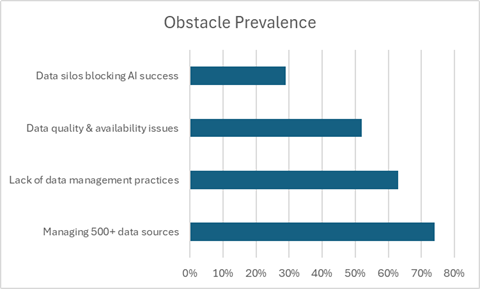
This is not a “fine‑tuning” issue. This is structural.
When an enterprise is juggling hundreds of data sources, each with its own semantics, lineage, ownership, and quality profile, the idea that a model can “just learn around it” is fantasy.
AI amplifies whatever it’s fed. And chaos scales faster than quality.
The Real Story: AI Didn’t Break the Enterprise — It Revealed It
For years, organizations could hide behind dashboards and KPIs that smoothed over the inconsistencies. Humans compensated. Humans interpreted. Humans cleaned up the mess.
AI does not compensate. AI does not interpret your intent. AI does not clean up after you.
It reflects the truth of your data back to you — at scale, at speed, and without apology.
This is why abandonment rates are climbing so quickly. This is why the ROI gap is widening. This is why the leaders who invested early in hygiene are now pulling away from the pack.
The New Mandate for 2026 and Beyond
If enterprises want AI that performs, scales, and yields value, the mandate is simple:
Stop treating data hygiene as a cost center. Start treating it as the foundation of your AI operating system.
The organizations that win the next decade will be the ones that:
- Invest in data quality before model quality
- Build governance before generative workflows
- Architect for readiness before experimentation
- Treat data as infrastructure, not exhaust
AI is not magic. AI is multiplication. It multiplies whatever you give it — good or bad.
And right now, the enterprise is learning that multiplication without hygiene is destruction.
This Week’s Flagpole
If you’re a leader walking into Monday with an AI roadmap, here’s the question that matters:
Is your AI failing because the models are weak — or because your data is unfit for intelligence?
If you can’t answer that, you don’t have an AI strategy. You have an AI aspiration sitting on top of a data liability.
This is the week to start fixing that, because the enterprises that solve data readiness first will define the AI winners of the next decade.
It’s Time the Enterprise Finally Admits: AI Isn’t Failing — The Data Is was originally published in DataDrivenInvestor on Medium, where people are continuing the conversation by highlighting and responding to this story.