Is Mining Bitcoin Still Worth It? I Ran the Numbers for 2026
--
Bitcoin mining has transformed from a laptop-based hobby into an industrial-scale operation requiring specialized hardware and strategic planning. As we navigate the post-2024 halving landscape, miners face a crucial question: is the pursuit still financially viable?
With block rewards now at 3.125 BTC and mining difficulty at all-time highs, profitability depends on a complex interplay of hardware efficiency, electricity costs, and Bitcoin price movements. Having operated mining facilities since 2017, I’ve witnessed firsthand how these variables create wildly different outcomes for different miners.
This analysis cuts through the hype to examine when Bitcoin mining makes financial sense in 2026 — and when you’re better off simply buying Bitcoin outright.
Key Takeaways:
- Mining profitability hinges primarily on access to electricity below $0.05/kWh
- ASIC efficiency (J/TH) has become the critical hardware metric post-halving
- Home mining faces significant challenges beyond just equipment costs
- Commercial operations maintain advantages through economies of scale
- Direct Bitcoin purchase remains the better option for most investors
Understanding Bitcoin Mining Fundamentals in 2026
Bitcoin mining is the computational process that secures the network, validates transactions, and introduces new bitcoins into circulation. At its core, mining requires specialized computers solving complex mathematical puzzles through the proof-of-work consensus mechanism.
Every 10 minutes (on average), a miner successfully creates a valid block, receiving both the block reward and transaction fees. However, the Bitcoin protocol automatically adjusts difficulty every 2,016 blocks (approximately two weeks) to maintain this 10-minute block time regardless of how much mining power (hashrate) joins the network.
This self-regulating difficulty mechanism is crucial for understanding mining economics. As more miners join, the difficulty increases, making each unit of hashrate less productive. When miners leave, difficulty decreases, making each remaining unit more productive.
Post-2024 Halving Reality Check
The April 2024 halving marked a significant shift in mining economics. Block rewards dropped from 6.25 BTC to 3.125 BTC, instantly cutting miner revenue by approximately 50%. This halving — the fourth in Bitcoin’s history — was particularly impactful as it occurred during a period of unprecedented network hashrate growth.
While previous halvings were eventually offset by price appreciation, miners must operate assuming current prices. The reduced block reward means miners now need either twice the hashrate or half the operational costs to maintain pre-halving profitability levels.
What Is the Block Reward in 2026?
The block reward in 2026 remains at 3.125 BTC per block — the amount set by the 2024 halving. This represents a significant decrease from Bitcoin’s initial 50 BTC block reward in 2009. The halving schedule built into the Bitcoin protocol reduces the block reward by 50% approximately every four years (or 210,000 blocks).
The next halving will occur around May 2028, further reducing the block reward to 1.5625 BTC. This progressive reduction is fundamental to Bitcoin’s fixed supply cap of 21 million coins and creates the increasing scarcity that many believe drives long-term value appreciation.
How Long Does It Take to Mine 1 Bitcoin?
Individual miners rarely mine exactly 1 BTC — instead, they earn fractional rewards proportional to their contributed hashrate through mining pools. With the current 3.125 BTC block reward, a miner contributing 1% of a pool’s hashrate would earn approximately 0.03125 BTC when their pool finds a block.
For perspective, a modest 100 TH/s miner (representing about 0.00001% of the network) might earn around 0.000000312 BTC per block. At current difficulty, this would yield roughly 0.000045 BTC daily, meaning it would take over 60 years to mine a full bitcoin — assuming difficulty remained constant, which it never does.
Key Factors That Determine If Bitcoin Mining Is Worth It
Mining profitability revolves around a straightforward equation: Revenue minus Costs. However, each component contains variables that can dramatically swing outcomes. Revenue depends on hashrate production, Bitcoin price, and mining difficulty, while costs encompass hardware investment, electricity consumption, cooling requirements, and operational overhead.
Successful miners focus relentlessly on optimizing these variables. They seek the most efficient hardware, negotiate the lowest electricity rates, and minimize additional costs like facility maintenance and staff. Even small advantages in any category can separate profitable operations from those operating at a loss.
Let’s examine each key factor to understand when mining makes financial sense in 2026:
ASIC Hardware: Efficiency and Investment Analysis
ASIC (Application-Specific Integrated Circuit) miners are specialized computers designed exclusively for Bitcoin mining. Since general-purpose computers became unprofitable for mining years ago, ASICs from manufacturers like Bitmain, MicroBT, and Canaan now dominate the industry.
The primary metric for ASIC evaluation is efficiency, measured in joules per terahash (J/TH) — the energy required to generate one trillion hashes. Lower J/TH means more hashrate for the same electricity consumption.
Newer models offer substantially better efficiency but come with higher upfront costs. Hardware depreciation is a critical factor often overlooked — an ASIC typically loses 30–50% of its value annually as newer, more efficient models enter the market.
Bitcoin Mining Hardware Turnoff Prices
The “turnoff price” is the Bitcoin value at which mining becomes unprofitable with a specific ASIC at a given electricity rate. When Bitcoin falls below this threshold, rational miners should temporarily halt operations to avoid operating at a loss.
For example, at $0.05/kWh, an Antminer S21 Pro (15.5 J/TH) has a turnoff price of approximately $12,600, while an older S19 Pro (29.5 J/TH) has a turnoff price around $24,000. This difference explains why older hardware gets decommissioned during market downturns while newer machines continue operating.
Understanding your specific hardware’s turnoff price is essential for operational decision-making. Mining below this threshold means you’re effectively paying a premium to acquire Bitcoin compared to simply buying it on an exchange.
Electricity Costs: Why Location Is Everything for Mining Profitability
Electricity represents 70–80% of ongoing mining expenses, making it the single most critical factor in operational profitability. Rates vary dramatically worldwide, from as low as $0.02/kWh in some regions with hydroelectric or stranded energy to over $0.30/kWh in high-cost residential areas.
Miners with access to electricity below $0.05/kWh maintain a significant competitive advantage. This explains why mining operations cluster in regions like Washington state (hydropower), Texas (deregulated energy market), Kazakhstan (fossil fuels), and Iceland (geothermal energy).
To calculate your electricity costs:
- Determine your miner’s power consumption in kilowatts (W ÷ 1000)
- Multiply by 24 hours and your electricity rate ($/kWh)
- Compare this daily cost against your expected daily revenue
For example, a 4,000W miner at $0.06/kWh costs $5.76 daily to operate (4kW × 24h × $0.06).
Profitability with Different Electricity Rates
The stark reality of electricity’s impact becomes clear when comparing identical hardware at different rates. Consider a 250 TH/s miner operating at different electricity costs:
The difference is stark — the same hardware generates healthy profits at industrial rates but operates at a loss under typical residential rates. This reality makes location or electricity rate negotiation the cornerstone of successful mining operations.
Mining Difficulty and Network Competition
Bitcoin’s difficulty adjustment mechanism ensures blocks are created every 10 minutes regardless of total network hashrate. As more miners join, each unit of hashrate produces proportionally less Bitcoin.
This creates a profitability treadmill effect — even if you maintain constant hashrate, your Bitcoin production gradually decreases as network difficulty rises. Historically, network difficulty has grown 20–40% annually, though this rate fluctuates with market conditions.
Any profitability projection must account for this difficulty growth. Many novice miners calculate returns based on current difficulty, only to discover their actual production falling short as difficulty increases month after month.
Solo Mining vs. Pool Mining: Risk and Reward
Bitcoin mining offers two participation models: solo mining and pool mining. Solo miners work independently, attempting to solve blocks alone and receiving the full 3.125 BTC block reward only when successful. Pool miners combine resources with others, sharing rewards in proportion to contributed hashrate.
Solo mining provides maximum reward potential but with extreme variance — a small miner might go years without finding a block. In contrast, pool mining provides predictable, frequent payments but incurs pool fees (typically 1–3% of rewards).
For practical purposes, solo mining has become mathematically unfeasible for most miners. With current network hashrate exceeding 650 exahashes per second, even a substantial 1 PH/s operation (over $300,000 in hardware) would expect to find a block only once every 2–3 years on average. The variance is simply too high for rational risk management.
Choosing a Reliable Mining Pool
For most miners, joining a mining pool is the only viable option. When selecting a pool, consider these factors:
- Fee structure: Most pools charge 1–3% of rewards. Lower isn’t always better if the pool offers superior services or stability.
- Payout method: PPS+ (Pay Per Share Plus) offers stable, predictable rewards regardless of pool luck. PPLNS (Pay Per Last N Shares) rewards loyal miners but introduces more variance.
- Minimum payout: Lower thresholds allow faster access to your earned Bitcoin.
- Server locations: Closer servers reduce rejected shares due to latency.
- Reputation and reliability: Established pools with transparent operations reduce counterparty risk.
Is It Worth Mining Bitcoin At Home in 2026?
Home mining presents unique challenges beyond the basic profitability equation. While industrial miners optimize for scale, home miners contend with residential electricity rates, limited space, noise constraints, heat management, and potential electrical system limitations.
A modern ASIC typically draws 3,000–4,500 watts — similar to running multiple space heaters continuously — and generates considerable noise (70–80 dB, comparable to a vacuum cleaner). These machines run 24/7 and produce substantial heat requiring ventilation or active cooling, which further increases electricity consumption.
Most homes in the US have 100–200 amp electrical service, limiting the number of miners that can safely operate. A single 15-amp circuit can typically support only one modern ASIC, and electrical upgrades can cost thousands of dollars.
Despite these challenges, home mining can make sense for enthusiasts with specific advantages like free or very low-cost electricity, space where noise isn’t problematic, or the ability to use the heat productively.
The Real Costs of Home Mining Often Overlooked
Beyond the obvious expenses of hardware and electricity, home miners often underestimate several significant costs:
- Electrical upgrades: Dedicated circuits, increased capacity, or 240V conversions ($500-$2,000)
- Cooling solutions: Ventilation fans, ducting, or additional air conditioning ($300-$1,500)
- Noise mitigation: Soundproofing materials or enclosures ($200-$800)
- Internet bandwidth: Upgraded service for reliable connectivity ($20-$50 monthly)
- Maintenance supplies: Compressed air, replacement parts, cleaning materials ($100-$300 annually)
- Property impact: Potential effects on home insurance, warranties, or landlord permissions
- Time investment: Setup, monitoring, troubleshooting, and optimizing operations
These additional expenses can easily add 20–40% to the total operational cost, turning marginally profitable setups into money-losing propositions.
Is CPU or GPU Mining Worth It in 2026?
CPU and GPU mining for Bitcoin is absolutely not viable in 2026. The efficiency gap between general-purpose computing hardware and specialized ASICs has grown too vast. A top-end gaming GPU might produce 0.000001 BTC daily while consuming more electricity than a modern ASIC generating 0.0005 BTC — a 500x efficiency disadvantage.
This performance gap exists because ASICs are designed exclusively for SHA-256 hashing. A modern ASIC can perform this specific calculation thousands of times more efficiently than general-purpose hardware, which must handle diverse computational tasks.
While GPUs remain viable for mining certain alternative cryptocurrencies, they simply cannot compete in Bitcoin mining. Anyone claiming otherwise is likely misinformed or selling outdated information.
Commercial Mining Operations: Economies of Scale
Commercial mining operations achieve profitability through advantages unavailable to individual miners. They negotiate electricity rates at industrial scale (often below $0.03/kWh), purchase hardware in bulk at discounted prices, optimize facility design for efficient cooling, and spread fixed costs across thousands of machines.
These operations typically maintain staff with specialized expertise in electrical engineering, HVAC systems, and ASIC maintenance. They can also afford to develop custom firmware optimizations and implement sophisticated heat recovery systems that further reduce effective operating costs.
Many commercial operations achieve electricity costs 60–80% lower than residential rates, giving them a substantial margin of safety during market downturns. This advantage explains why industrial mining has progressively dominated Bitcoin’s hashrate distribution — in 2026, over 90% of mining hashrate comes from professional operations.
Bitcoin Mining Farms: What They Are and How They Work
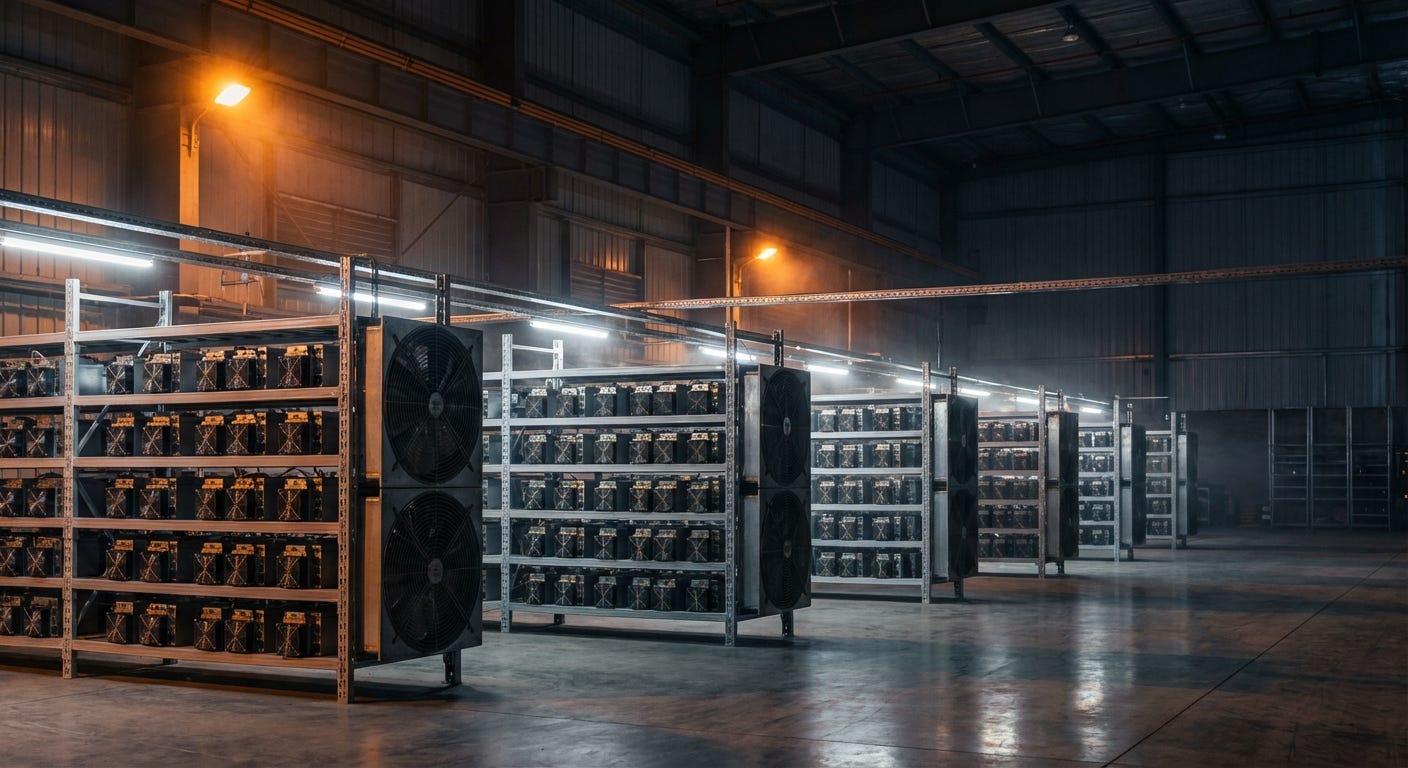
Mining farms are purpose-built facilities housing thousands of ASICs in optimized configurations. These operations range from warehouse conversions to custom-designed structures with specialized power and cooling infrastructure.
A typical farm features:
- Power distribution: Industrial electrical systems delivering multiple megawatts
- Cooling systems: Immersion cooling tanks or massive air handling units
- Racking infrastructure: Custom racks organizing ASICs for maintenance access
- Network connectivity: Redundant, high-speed internet connections
- Security measures: Physical and cyber protections for valuable equipment
- Monitoring systems: Real-time performance tracking of thousands of miners
Successful farms select locations based primarily on electricity costs, followed by climate considerations (cooler regions reduce cooling expenses) and regulatory stability. Some operations even relocate seasonally to capitalize on electricity price variations.
Mining For Bitcoin vs. Buying Bitcoin: The Hard Math
The fundamental question for potential miners is whether mining offers superior returns compared to simply purchasing Bitcoin directly. This comparison requires analyzing multiple scenarios with different variables.
Let’s compare investing $30,000 in mining hardware versus buying Bitcoin outright:
This simplified analysis shows that direct purchase yields more Bitcoin in the short term. Mining eventually catches up only if Bitcoin price appreciates significantly while difficulty growth remains modest — an uncertain combination.
The mining approach offers some advantages: dollar-cost averaging into Bitcoin over time, potential tax benefits (depending on jurisdiction), and hardware resale value. However, it comes with significant operational complexities and greater exposure to Bitcoin price volatility.
When Mining Bitcoin Makes Financial Sense
While direct purchase is often the better strategy, mining can outperform under specific circumstances:
- Access to extremely cheap electricity: Below $0.03/kWh changes the economics dramatically
- Heat utilization: Operations where mining heat offsets existing heating costs
- Stranded energy access: Using energy that would otherwise be wasted
- Favorable tax situations: Jurisdictions where mining expenses are more tax-advantaged than direct investment
- Hardware access advantages: Ability to acquire ASICs below market rates
- Operational expertise: Specialized knowledge that reduces costs or improves performance
Without at least one of these advantages, direct Bitcoin purchase typically produces better risk-adjusted returns than mining.
A Worked Example of Mining Profitability
Let’s analyze a realistic mining scenario using current data:
Investment: 3x Bitmain S21 Pro ($27,000 total)
Hashrate: 750 TH/s combined
Power consumption: 11,625W (11.625 kWh)
Electricity cost: $0.05/kWh
Bitcoin price: $60,000
Current difficulty: 78.16T
Initial daily calculation:
- Revenue: 750 TH/s × 0.000042 BTC/TH/day = 0.0315 BTC/day ($1,890)
- Electricity cost: 11.625 kW × 24h × $0.05 = $13.95/day
- Gross profit: $1,890 — $13.95 = $1,876/day
However, we must account for:
- Difficulty increases (~2% monthly = ~27% annually)
- Hardware depreciation (~40% annually)
- Maintenance costs (~5% of hardware value annually)
Adjusted first-year outcome:
- Total BTC mined: ~8.4 BTC
- Electricity costs: ~$5,100
- Maintenance: ~$1,350
- Hardware value after one year: ~$16,200
This example assumes stable Bitcoin price and moderate difficulty growth — both highly variable factors that significantly impact actual results.
Final Verdict: Is Mining Bitcoin Worth It in 2026?
After examining all relevant factors, the profitability of Bitcoin mining in 2026 depends primarily on your specific circumstances. There is no universal answer that applies to everyone.
Mining can be profitable when you have:
- Access to electricity at industrial rates ($0.02-$0.04/kWh)
- Capital for latest-generation ASIC hardware
- Physical space with proper cooling capabilities
- Technical knowledge to maintain and optimize equipment
- Ability to manage noise and heat considerations
For most people, particularly those with residential electricity rates, mining Bitcoin at home in 2026 will not be profitable compared to simply purchasing Bitcoin directly. The combination of high electricity costs, hardware depreciation, and rising difficulty creates a challenging economic environment for small-scale miners.
Commercial operations with economies of scale and industrial electricity rates can still achieve profitability, but even they operate with increasingly thin margins compared to earlier eras of Bitcoin mining.
Alternative Ways to Participate in the Bitcoin Ecosystem
If mining doesn’t make financial sense for your situation, consider these alternatives:
- Dollar-cost averaging: Regularly purchasing small amounts of Bitcoin regardless of price
- Bitcoin-related stocks: Investing in public mining companies, Bitcoin spot ETFs, or technology firms with Bitcoin holdings
- Lightning Network participation: Running a Lightning node to facilitate transactions (requires minimal hardware)
- Bitcoin lending: Earning interest on Bitcoin holdings through reputable platforms
- Mining stocks: Gaining exposure to mining economics without direct operational challenges
These approaches offer exposure to Bitcoin’s potential appreciation without the operational complexities and high capital requirements of direct mining.
The Future of Bitcoin Mining: Trends to Watch
Looking ahead, several trends will shape Bitcoin mining over the coming years:
- Energy integration innovations: Miners increasingly partnering with energy producers to utilize excess or stranded energy
- Heat recycling: More sophisticated systems to capture and productively use ASIC heat
- Immersion cooling dominance: Wider adoption of immersion cooling for improved efficiency
- Renewable energy shift: Greater percentage of hashrate powered by renewable sources
- Geographic diversification: Continued movement of hashrate across diverse regions to reduce regulatory risk
- Efficiency improvements: New ASICs pushing closer to theoretical efficiency limits
These developments may gradually improve mining economics, but the fundamental challenge remains: with each halving, miners must become twice as efficient or Bitcoin’s price must double for profitability to remain constant.
Frequently Asked Questions
- Is Bitcoin mining worth it anymore?
Bitcoin mining remains profitable for operations with electricity costs under $0.05/kWh using latest-generation ASICs. For most home miners with residential electricity rates, direct Bitcoin purchase typically offers better returns with less complexity and risk. - Is Bitcoin mining still profitable in 2026?
Profitability in 2026 depends primarily on your electricity costs and hardware efficiency. Operations with industrial rates ($0.02-$0.04/kWh) and latest-generation ASICs can remain profitable, while those with residential rates ($0.10-$0.20/kWh) generally cannot compete effectively. - How long would it take to mine 1 Bitcoin?
Mining exactly 1 Bitcoin isn’t how the process works. With 3.125 BTC created every 10 minutes and distributed across all miners proportionally to hashrate, a miner with 1 PH/s (about $300,000 in hardware) would earn approximately 0.00015 BTC daily at current difficulty — taking over 18 years to accumulate 1 BTC. - Can You Make Money From Bitcoin Mining?
Yes, but with specific requirements: electricity below $0.05/kWh, efficient ASICs with under 20 J/TH, proper cooling infrastructure, and realistic expectations about difficulty increases. Without these advantages, direct Bitcoin purchase typically provides better returns. - What electricity cost do I need to mine profitably in 2026?
With current-generation ASICs (15–20 J/TH) and Bitcoin at $60,000, you need electricity below $0.08/kWh to generate any profit. For meaningful returns that justify the operational complexity, you typically need rates below $0.05/kWh. - How do you know if you can profit from Bitcoin mining?
Calculate your break-even point: multiply your ASIC’s efficiency (J/TH) by electricity cost ($/kWh) by 0.024. If this number exceeds the daily Bitcoin reward per TH/s (currently around 0.000000042 BTC), mining isn’t profitable at current prices. - Can I mine Bitcoin at home in 2026?
Technically yes, but economically challenging. Home mining requires managing noise (70–80 dB), heat (3,000–4,500W per ASIC), electrical capacity (dedicated 20A circuits), and typically high residential electricity rates that often make direct Bitcoin purchase more profitable. - Which ASICs are viable for 2026?
Only the most efficient ASICs remain viable in 2026 — those achieving under 20 J/TH like Bitmain’s S21 series (15.5 J/TH), MicroBT’s M60 series (16.0 J/TH), and Canaan’s A13 series (16.5 J/TH). Older machines over 30 J/TH are essentially obsolete. - How do I compare mining vs just buying BTC?
Calculate total mining costs (hardware + electricity + maintenance) over your timeframe. Compare this to buying the equivalent amount of Bitcoin directly. Include hardware depreciation (30–50% annually) and difficulty increases (20–40% annually) in your mining projections. - What’s the future of bitcoin mining?
Bitcoin mining is becoming increasingly industrialized with operations integrating directly with energy producers. Expect continued efficiency improvements, greater renewable energy usage, more sophisticated heat recycling, and geographic diversification as the industry matures from entrepreneurial to corporate.