Imagine explaining modern DeFi to someone from 2020.
--
“Yeah bro, now I manually manage liquidity ranges across multiple chains, compound rewards every few hours, monitor emissions schedules, rebalance positions, and optimize capital efficiency daily.”
At that point you’re not farming yield anymore.
You’re running air traffic control for stablecoins.
And this is exactly why DeFi vaults are becoming essential infrastructure.
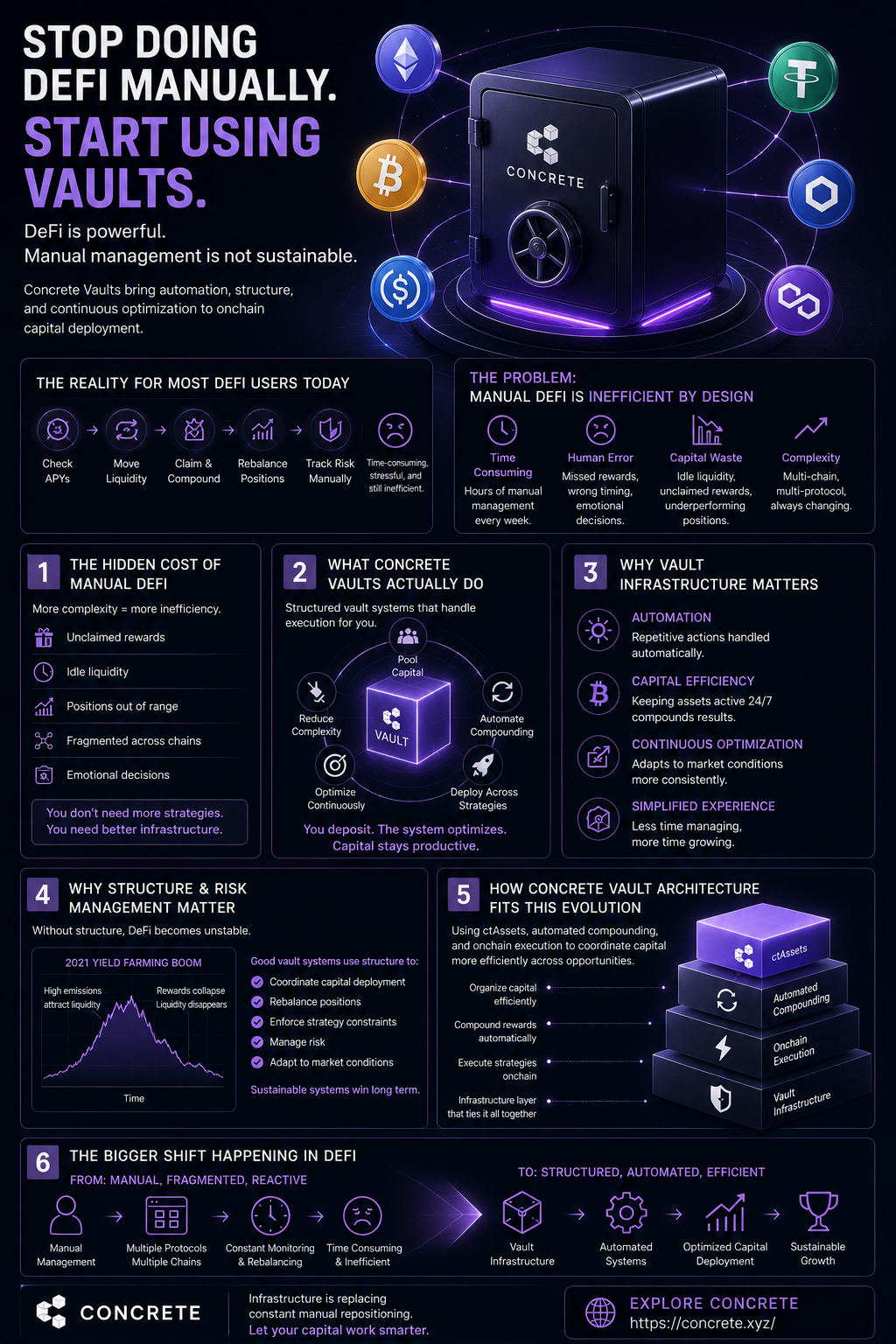
🧱 1️⃣ The current DeFi experience is breaking users
Most DeFi users today are stuck in an endless loop:
— check APYs
— move liquidity
— claim rewards
— compound manually
— rebalance positions
— repeat forever
The problem is not that DeFi lacks opportunities.
The problem is that participating efficiently has become operationally exhausting.
One real example?
Uniswap V3.
Concentrated liquidity dramatically improved capital efficiency.
But suddenly LPs needed to actively manage ranges themselves.
If ETH moved too far?
Your liquidity stopped working effectively.
Meaning users had to constantly:
— monitor price movement
— reposition liquidity
— adjust exposure manually
Capital efficiency improved.
Human efficiency collapsed.
That was a huge wake-up call for DeFi.
Because once systems become this complex, infrastructure becomes more important than manual execution.
🧱 2️⃣ What Concrete Vaults actually do
Concrete Vaults simplify this entire process through structured DeFi systems.
Instead of users manually managing every step themselves, vault infrastructure coordinates execution automatically.
Concrete Vaults help users:
— pool capital together
— automate compounding
— deploy across strategies
— optimize positions continuously
— reduce operational complexity
This changes the relationship users have with DeFi.
Instead of constantly reacting to markets manually…
Users gain exposure to a system designed to manage onchain capital deployment more efficiently behind the scenes.
And honestly, that shift was inevitable.
Because humans are bad at maintaining 24/7 financial operations forever.
Especially in crypto.
🧱 3️⃣ Why vault infrastructure matters
Most people still underestimate how inefficient manual DeFi management really is.
Think about how much capital currently sits inactive across the ecosystem:
— unclaimed rewards
— idle stablecoins
— unmanaged LP positions
— fragmented liquidity across chains
That’s billions of dollars operating below maximum efficiency.
Vault infrastructure helps solve this coordination problem.
⚙️ Automation
Vault systems automate repetitive actions like compounding and rebalancing.
Users no longer need to micromanage positions constantly.
💰 Capital efficiency
Keeping assets continuously productive matters.
Idle capital is one of the largest hidden inefficiencies in DeFi.
📈 Continuous optimization
Markets evolve constantly.
Vault systems can systematically adjust positions over time instead of relying on inconsistent manual execution.
🧩 Simpler participation
Most users do not want to become full-time liquidity managers just to participate in DeFi.
Vaults simplify access to structured strategies.
🧱 4️⃣ Why structure & risk management matter
Concrete Vaults are not just “yield wrappers.”
The important part is the architecture underneath.
Vault systems need mechanisms to:
— coordinate capital deployment
— rebalance positions
— enforce strategy constraints
— adapt to changing market conditions
Without structure, DeFi systems become unstable very quickly.
We already saw this during the yield farming boom.
Protocols attracted massive liquidity using unsustainably high emissions.
Capital rushed in.
Rewards collapsed.
Liquidity disappeared overnight.
The issue wasn’t only the APY.
The issue was weak infrastructure and poor coordination.
That’s why institutional DeFi is increasingly focused on systems instead of hype cycles.
Institutions care about:
— scalable execution
— operational consistency
— efficient capital deployment
— structured exposure
And vault infrastructure aligns directly with those goals.
🧱 5️⃣ How Concrete Vault architecture fits this evolution
Concrete Vaults use systems like ctAssets, automated compounding, and onchain execution to coordinate capital more efficiently across opportunities.
Instead of users manually hopping between protocols trying to optimize every move…
Vault systems become the coordination layer itself.
That means:
— rewards compound automatically
— strategies execute systematically
— positions optimize continuously
— capital remains active longer
This creates a more scalable model for structured DeFi participation.
And scalability is becoming the most important factor in the next phase of DeFi growth.
Because eventually:
manual strategy management stops being an edge.
It becomes a bottleneck.
🧱 6️⃣ The bigger shift happening now
The future of DeFi likely does not belong to users endlessly clicking between dashboards trying to out-optimize each other manually.
It belongs to infrastructure.
To systems.
To automation.
To coordinated vault architecture.
The same way cloud infrastructure replaced manually managing physical servers…
Vault infrastructure may eventually replace much of today’s manual capital management.
And the winning users may not be the ones working the hardest manually.
They may simply be the ones connected to the most efficient systems.
That’s the direction structured DeFi is heading.
And Concrete Vaults are building directly into that future.
Explore Concrete at https://concrete.xyz/