If You Can’t Explain Yield, You Are the Yield: Navigating the DeFi Mirage
 kadji4 min read·Just now
--
The DeFi dashboard is a masterpiece of psychological engineering. Neon-green numbers flicker, APYs climb into the triple digits, and the “Deposit” button is always just one click away. It feels like a financial cheat code — until the music stops.
In the world of decentralized finance, there is an old poker adage that has never been more relevant: If you’ve been at the table for thirty minutes and you don’t know who the sucker is, it’s you.
In DeFi, we say it differently: If you can’t explain the yield, you are the yield.
1. The Illusion of the Magic Money Tree
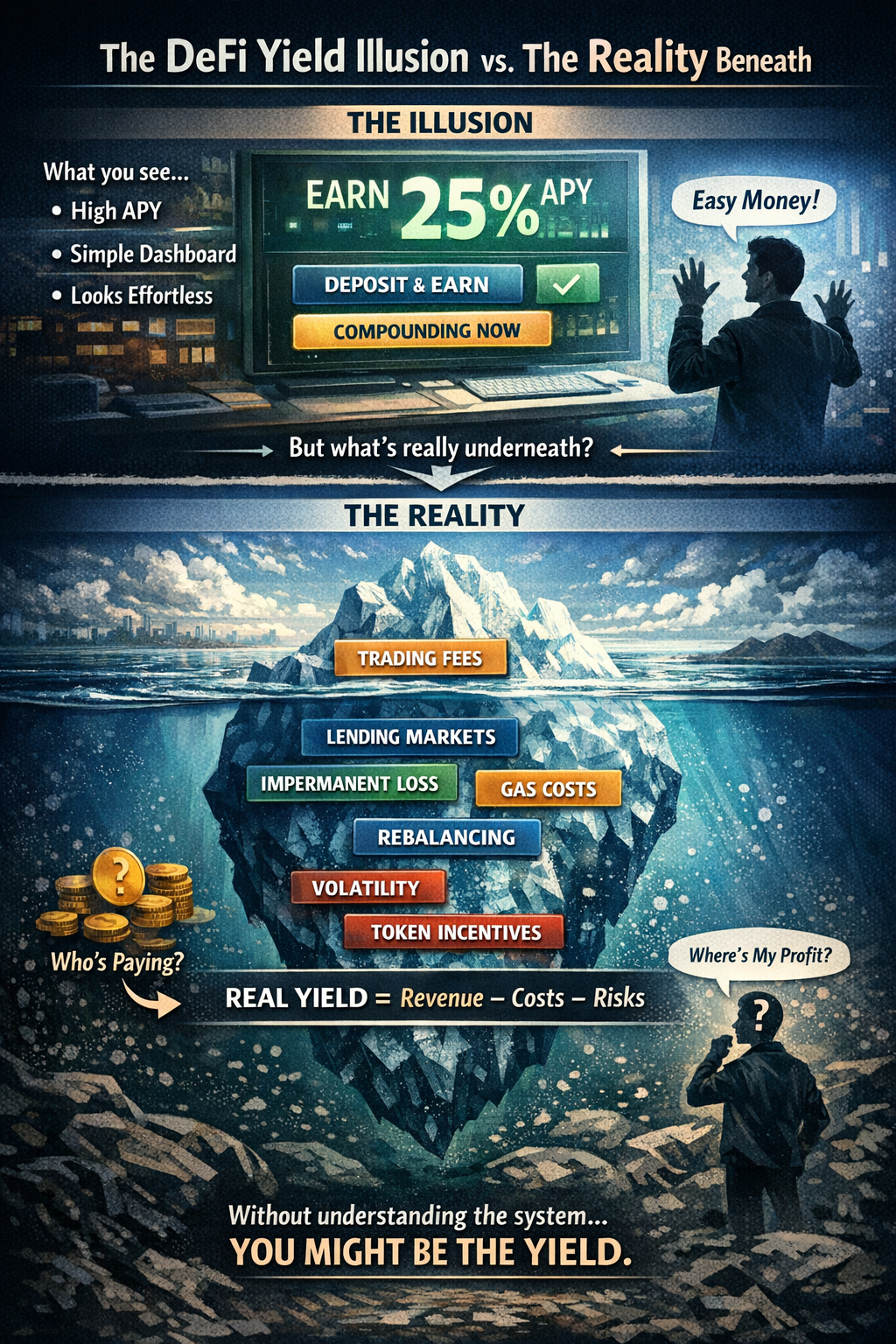
Today, yield is presented as a passive, frictionless outcome of simply “being there.” We see 20%, 50%, or 100% APY on sleek interfaces with minimal explanation of the mechanics behind the curtain. The flow is deceptively simple: Deposit → Earn.
But this simplicity is an illusion. Yield doesn’t materialize out of thin air. On the surface, it looks like a reward for participation; underneath, it’s a complex web of risk, liquidity, and value transfer.
2. The Gap: Why the Number on Your Screen is Lying
The APY displayed on a dashboard is rarely what ends up in your pocket. There is a massive “Reality Gap” between Displayed Yield and Realized Yield.
When you see a high number, you aren’t seeing the hidden “yield killers”:
- Impermanent Loss (IL): The silent assassin of liquidity providers.
- Rebalancing Costs: Gas fees and slippage that eat your compounding interest.
- Execution Friction: The technical overhead of moving assets between protocols.
- Volatility Impact: A 50% yield means nothing if the underlying asset drops 80%.
A “gross” return of 40% can quickly compress into a “net” return of -5% once these factors are accounted for.
3. Where Does Yield Actually Come From?
To survive in DeFi, you must categorize your returns. Not all yield is created equal. Sustainable yield typically comes from:
- Trading Fees: Users paying to swap assets (Real utility).
- Lending Activity: Borrowers paying interest to use your capital.
- Liquidations & Arbitrage: Profits generated by maintaining market efficiency.
Then, there is Incentive/Emission Yield. This is often temporary — the protocol printing its own “funny money” to attract TVL. If the protocol doesn’t transition to real revenue, those emissions eventually dump, and the yield evaporates.
4. The Hidden Value Transfer
This is the core tension of the market. If you are earning 20% but don’t understand the risks, you might actually be subsidizing the more sophisticated players.
You might be:
- Providing “exit liquidity” for others.
- Absorbing the downside of a volatile pair while more experienced traders hedge their positions.
- Participating in a system where your capital is the “buffer” for someone else’s profit.
5. Same System, Different Outcomes
Why do some participants thrive while others get “rekt” in the same pool?
- The Yield Chaser: Optimizes for the highest number on the screen. They are reactive, manual, and often ignore cost/risk.
- The Engineer: Analyzes the structure. They model outcomes, account for gas, and hedge against downside.
The difference isn’t luck; it’s understanding. Institutional players don’t “hope” for yield; they model it.
6. From Yield Chasing to Yield Engineering
We are witnessing a fundamental shift in DeFi. The era of blind yield chasing is dying, replaced by Yield Engineering. Yield Engineering means moving away from “set it and forget it” and moving toward:
- Active risk management.
- Algorithmic rebalancing.
- Focusing exclusively on Net Returns (Yield minus Costs).
7. Concrete Vaults: Infrastructure for the Informed
This is where the complexity of DeFi meets the power of automation. Understanding yield is hard; managing it 24/7 is nearly impossible for a solo human.
Concrete Vaults are designed to bridge this gap. Instead of guessing which pool is safe or when to rebalance, Concrete’s infrastructure:
- Automates Allocation: Moving capital to where the real yield is.
- Manages Strategies: Executing complex moves that would be too costly or slow for a manual user.
- Reduces Errors: Removing the emotional “chase” and replacing it with structured exposure.
By using Concrete, you stop being the “subsidizer” and start being the “optimizer.”
8. The Core Insight
Yield is not just a “magic number.” To the sophisticated investor:
Yield = {Revenue} — {Cost} — {Risk}
If you can’t solve that equation for the pool you’re in, you aren’t the investor — you’re the revenue.
Stop guessing and start engineering your financial future.
Ready to move beyond the dashboard illusion?
Explore Concrete at app.concrete.xyz and take control of your yield.