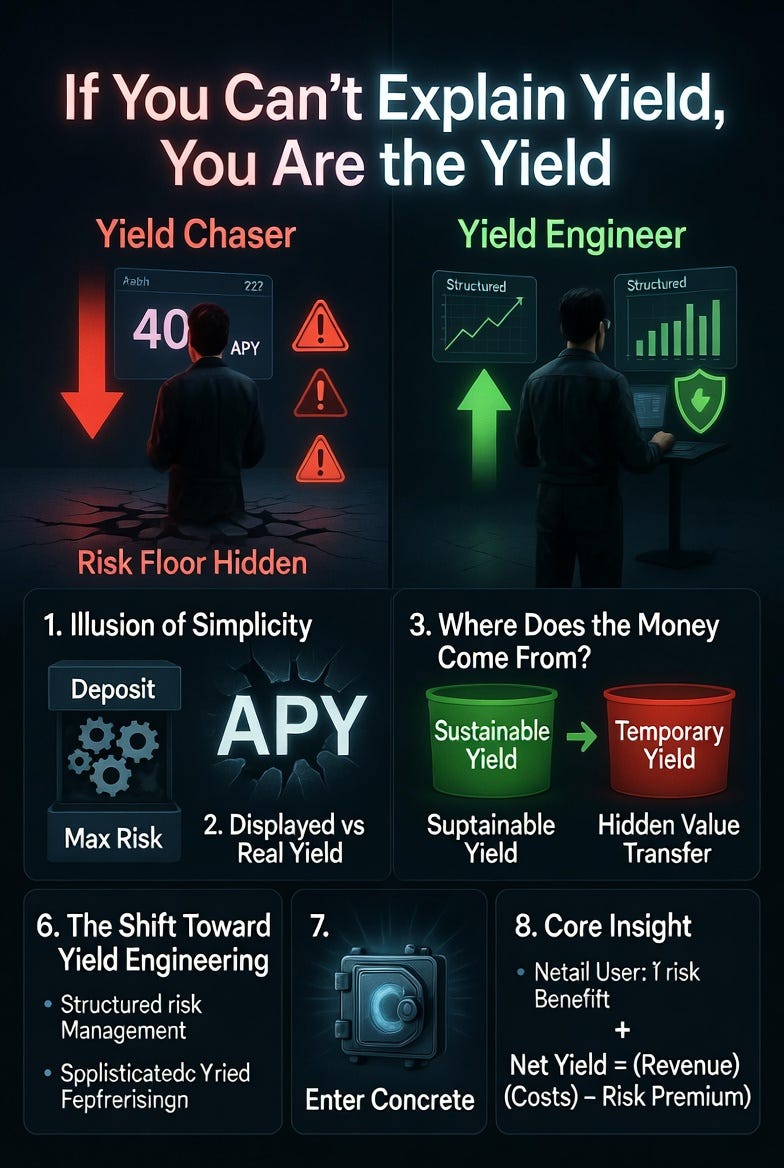
If You Can’t Explain Yield, You Are the Yield
--
The Yield Mirage: Why DeFi’s Simplest Number is its Most Complex Lie
In the current DeFi landscape, yield is often marketed as a finishing line — a static prize waiting at the end of a “Deposit” button. You open a dashboard, see a flashing 45% APY, and follow a seamless flow to stake your assets. It feels like magic: minimal explanation, maximum excitement.
But beneath the polished UI of modern dashboards lies a core tension. Yield looks like a simple interest rate on the surface, but the machinery underneath is a chaotic gear-system of risk and math. The gap between what you see and what you actually keep is where most investors lose their way.
Breaking Down the Gap: Why APY is Misleading
That high-double-digit number on your screen is rarely your “take-home pay.” To find the real yield, you have to subtract the friction that dashboards conveniently hide:
- Gross vs. Net Return: The displayed APY usually ignores gas fees, platform performance fees, and withdrawal taxes.
- Impermanent Loss (IL): In liquidity pools, if the price of your assets diverges, the loss in value can easily outpace the fees you earned.
- Rebalancing Costs: Maintaining an “optimal” position often requires frequent trades, each eating a percentage of your principal.
- Execution Friction: Slippage during entry and exit can shave 1–2% off your capital instantly, requiring months of yield just to break even.
When adjusted for volatility and costs, a 20% APY can quickly compress into a net 2% — or even a loss.
The Anatomy of a Return: Where Does the Money Come From?
To navigate DeFi, you must stop looking at yield as a “bonus” and start looking at it as revenue. Not all yield is created equal:
- Sustainable Yield: Generated from utility. This includes trading fees paid by swappers, lending activity from borrowers, and liquidations where the protocol captures a penalty.
- Transitory Yield: Generated from incentives and emissions. These are “printed” tokens used to bootstrap liquidity. They are effective marketing, but they are often inflationary and unsustainable long-term.
The Hidden Value Transfer: Are You the Subsidy?
There is an old adage in finance: If you don’t know where the yield is coming from, you are the yield.
In many cases, retail liquidity providers unknowingly subsidize the profits of sophisticated actors. By providing liquidity without understanding the underlying Greeks or modeling outcomes, you may be absorbing the downside of market volatility while more experienced traders arbitrage your position. You aren’t just “participating”; you are providing a service — often at a discount to its true risk.
The Great Divide: Chasing vs. Engineering
Why do two people using the same protocol get vastly different results? It comes down to their mental model:
- The Chaser: Optimizes for the highest displayed APY. They move capital frequently, ignore slippage, and fail to account for the “cost of carry.”
- The Engineer: Analyzes structure, cost, and risk. They model expected outcomes before deploying capital and focus strictly on net-net returns.
The difference isn’t luck; it’s the shift from Yield Chasing to Yield Engineering.
Enter Concrete: The Infrastructure for Structured Exposure
The future of DeFi isn’t about finding the “hottest” pool; it’s about automating the complexity that humans are bad at managing manually. This is where Concrete Vaults change the game.
Instead of guessing and checking, Concrete provides the infrastructure to move toward engineered outcomes. Concrete Vaults help bridge the gap by:
- Automating Allocation: Moving capital to where it is most efficient based on real-time data.
- Managing Strategies: Executing complex movements that would be too expensive or time-consuming for a manual user.
- Risk Mitigation: Rebalancing positions to protect against volatility and reducing the manual errors that lead to “fat-finger” losses.
By using a structured approach, you stop being the “subsidy” and start being the beneficiary of professional-grade execution.
The Core Insight
Yield is not just a number on a screen. It is a formula:
$$\text{Yield} = (\text{Revenue} — \text{Costs}) \pm \text{Risk Adjustment}$$
Understanding this fundamental truth changes how you approach the entire ecosystem. It turns you from a spectator into a calculated participant.
Ready to stop chasing and start engineering? Explore the next generation of DeFi at app.concrete.xyz.