I Built an AI Scam Detector That Doesn’t Trust Itself
 Salawu Habeeblai4 min read·1 hour ago
--
In 2023, Americans alone lost $12.5 billion to cybercrime, including scams, according to the FBI IC3 Report. Globally, the numbers are far worse.
Every scam detector you’ve used made a decision alone. One model. One answer. No second opinion. And that’s the problem.
The Problem With Most Scam Detectors.
Most AI-based scam detectors today rely on rules or a single AI model to decide what’s a scam. But that approach has a problem: it assumes one system can always get it right. A single model making decision can be biased, manipulated or even hallucinate. A wrong verdict can cause irreparable damage. So that led me to build an AI scam detector that doesn’t trust itself but multiple others.
Solution: What if detection requires agreement?
Instead of one AI deciding, multiple AIs with different LLMs each analyse the input separately. Then a consensus is reached before any verdict is given. In my case, multiple AI validators review the same input. No single AI model is trusted on its own. The final verdict emerges from consensus. But to build this, I needed infrastructure that could support it natively.
Traditional AI systems are built around authority: one model, one answer. There is another system built on blockchain that combines smart contracts + AI to create something called “Intelligent Contracts.” These contracts can read real-world data, connect validators to AI models (LLMs) and allow these contracts to reason, analyse, and adapt. This is @GenLayer. GenLayer Intelligent Contracts is a new type of smart contract that can call AI natively on-chain.
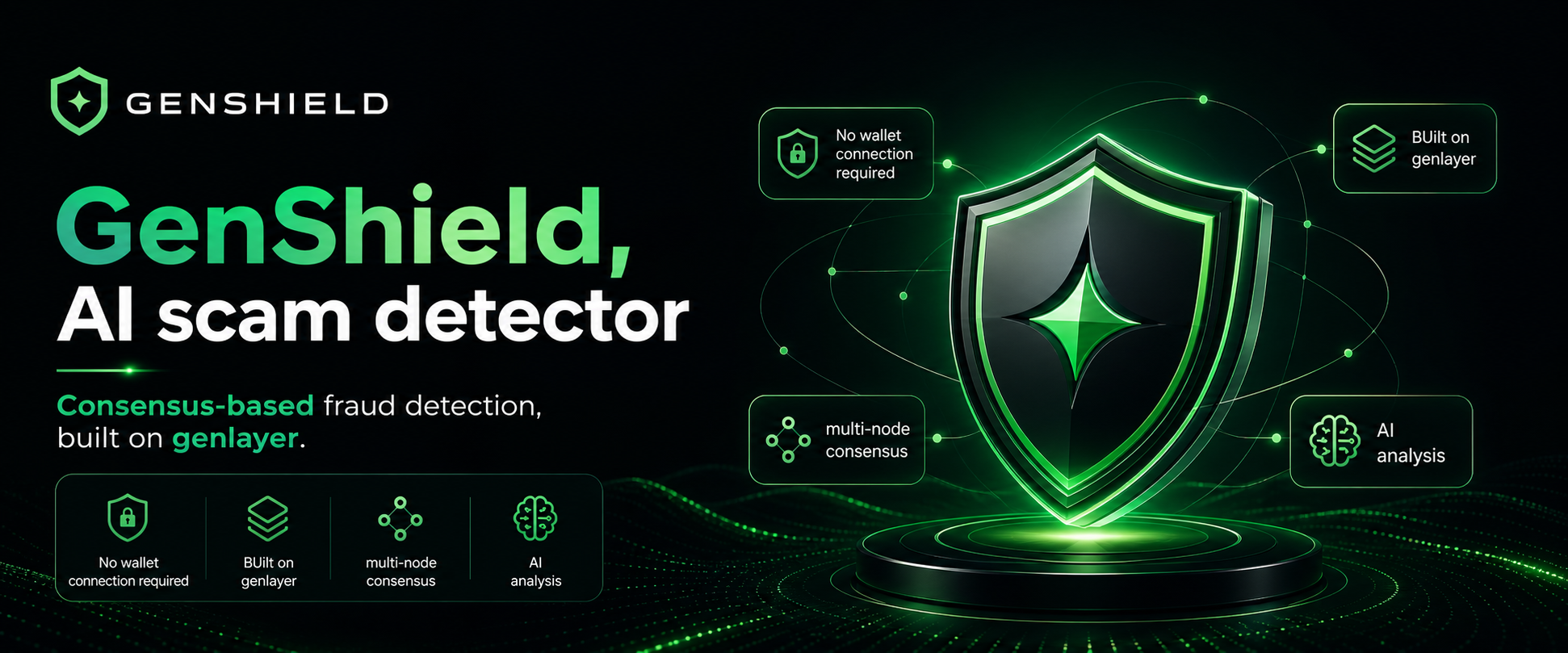
GenShield: a consensus-based scam detector built on GenLayer.
GenShield is built on GenLayer Intelligent Contracts. GenShield works by using GenLayer’s core idea: instead of trusting a single AI decision, it relies on multiple AI validators to analyse the same input. When a user submits a message, link, or screenshot, the system sends it to several independent AI judges (Validators) simultaneously rather than just one. Each validator reviews the content, looks for scam signals like urgency or impersonation, and gives a classification with reasoning and confidence. GenLayer then compares these outputs, and the final result is based on majority agreement. Each validator independently then returns one of three verdicts [SAFE, WARNING, or SCAM] along with a confidence score and plain-English reasoning. This makes GenShield more reliable. I built this because I was tired of telling people to ‘just be careful online.’ Careful isn’t a tool. This isn’t just for crypto users; anyone who receives a suspicious message, email, or screenshot has a place to check.
How Genshield works.
For text and link, the contract passes the text to the validators to reach a consensus. But for images, an AI vision layer first reads and extracts the content and interprets it before passing the description to the validator network.
For message, you can paste a suspicious text message and click “Run deep scan”
I tested with this sentence: “This is Coinbase customer service, to help and serve you better. Please send your 12 or 24-word seed phrase to your wallet.” The result gave a SCAM verdict with a confidence score of 100% and plain-English reasoning: “The message impersonates Coinbase and requests a seed phrase, which legitimate services never do. This is a clear phishing attempt using social engineering to steal funds.”
I also tested the URL scam detector, and this is the result. I used an unofficial Binance link, and I got a WARNING that this is likely a scam, as it is not an official Binance URL
For the image scam detector, I used Image analysis that uses an AI vision model on the backend. When you upload a screenshot from a scam dm or scam email, the AI vision layer first reads and extracts the content and passes the description to the validators. I tested it with this screenshot of an email:
I got this result:
Genshield Techstack: What I Built It With
The smart contract is written in Python and deployed on GenLayer studionet with GenLayer Studio. The frontend is React and TypeScript, deployed on Vercel. Image analysis uses an AI vision model from Mistral AI. The entire verdict history is on-chain and verifiable on the GenLayer network. This is an example of what goes on on the chain when a scam detector scan is initiated.
Every other scam detector gives you one answer from one source. GenShield gives you a verdict that required multiple independent AIs to agree. You’re not trusting one model; you’re trusting a consensus. That’s the same principle that makes blockchains a trustworthy system, applied to scam detection.
GenShield is live at: https://genshield.vercel.app/
Paste a message, drop a link, or upload a screenshot.
The verdict comes from consensus, not assumption.