How Two Non-Devs Took 1st with Vibe Coding in a Hackathon— A Recap
 Clara Ex Machina6 min read·Just now
--
A bit of a bold title, I know. But honestly, it was kind of surreal seeing people around me act even more proud of it than I was.
So — , this goes back about a week.
I was about to leave a company I’d poured three and a half years of my youth into, and I was feeling kind of… empty. I’d originally planned a camping trip with a friend from Friday to Saturday, but after checking out a few Korea BUIDL Week events out of curiosity, I started picking up on a noticeably different kind of atmosphere compared to a year ago.
With my last day coming up, it felt like a waste to just flip the switch and check out into full rest mode, so I canceled the camping trip on the spot and started looking at what events I could hit starting Friday.
Just then, a high school friend of mine in the industry (she does BD) texted me: “Hey, wanna do this hackathon together? Submission’s tomorrow though 🤪”
I hadn’t done one since 2023, so just hearing the word again? That alone already hooked me.
And wait, someone like me (a non-dev) can now build real stuff with Claude Code? Okay, now I’m really in.
And on top of that, the deadline was literally the next day, with today basically already gone. Something about that kind of constraint weirdly triggered my slightly twisted sense of achievement.
Once my heart’s in, I can’t just let it go until I actually do the thing. So without really thinking, I replied: “Yeah, I’m in.”
I’d been buried in work and hadn’t been able to join hackathons in forever, so it felt like a great opportunity.
We decided to actually get a full night’s sleep first (lol), meet up around 1 PM the next day, grab lunch, and then start talking about what to build. Looking back now, where did that confidence come from?
Imo, the most important thing in a hackathon is ideation. (You’re not really expected to ship a polished product. If you can get a working POC, you’ve basically nailed the dev side.) Beyond being practical, the idea also has to be flexible enough to submit across multiple tracks. Of course, stitching things together at random is meaningless. What matters is how well you can weave each sponsor’s strengths and tech into a coherent idea.
Anyway, after repeatedly feeding our directions into our respective Claudes, running agent teams over and over, and passing .md files back and forth, the idea and architecture for Bargo came together. If I’d been thinking alone, I probably would’ve gone way too nerdy, so having two human brains in the loop really helped push things in a more creative direction.
Side note: someone I recently helped get started with Claude asked me, “Do these .md files actually get read? The readability’s terrible, no?” At this point I’m so used to working and sharing ideas through .md files that I don’t even find them hard to read anymore. Maybe I’ve just gone numb to it (lol). Even at work, people share ideas and feedback as .md files now, so it’s become pretty normal.
Anyway, once the architecture was solid after a few rounds of back-and-forth with Claude, I handled frontend design and the overall implementation by running agent teams, while my friend pulled from the repo in real time as I pushed updates and started prepping the presentation deck for the next day.
The idea we landed on: a secondhand marketplace with confidential bid matching and natural-language input for buying and selling conditions, powered by NEAR AI Cloud and LLMs. Since Status Network was one of the sponsors, we baked in their gasless transactions to record matching results on-chain, and used their Karma system as a kind of “temperature” score, like Karrot’s. Since it’s all about bargaining, we named it Bargo. (Claude kept pushing “Haggle,” but I don’t know, it felt less intuitive and less cute to me.)
We actually got feedback that the design was cute. Someone at my company even went and checked out the repo after hearing we won, and asked how we pulled off the design. Honestly though, if you just let Claude Code handle design on its own, you’re not even hitting 50% satisfaction (even for POC). It always ends up looking obviously AI-generated.
Even with AI doing the design work, you have to inject some of your own taste to push it up to like 60–70%, even for a POC. This time, I first used Stitch to share a rough prompt describing the branding and vibe I wanted, then iterated a few times until I got an image that matched my taste. From there, I asked for a design system based on that image — color palette, fonts, the whole thing — again iterating until it felt right. Then I had it generate concept visuals and rough UI screens on top of that system.
Once I had images I liked, I took them to ChatGPT to tweak small details (like removing specific elements that bugged me). This step is optional, but personally I can’t stand even tiny things being off. Finally, I took those images , along with the PRD.md we’d refined with Claude and the design system, over to Google AI Studio and asked it to generate a frontend inspired by those references. Then I copied the resulting code and brought it back into Claude Code, telling it not to copy the code directly but to reflect the design sensibility in the actual implementation.
At that point, the frontend ended up looking quite a bit worse than the original Stitch images, but still plenty usable for real functionality. With more time I could’ve pushed it further, but that wasn’t the point of the hackathon.
Ended up using a bunch of different AI tools for design, right? Obviously it wasn’t at a “wow, this design is amazing” level, especially in about 10 hours while also building the actual functionality, but I do think we at least dodged the obvious AI-generated look.
During those 10 hours, outside of the ideation phase, my friend and I barely talked — we just trusted each other to do our parts. Finding a teammate you can operate with like that is honestly one of the most important parts of a hackathon.
We wrapped implementation around 11:15 PM, then dove straight into QA, debugging, and recording the demo video. It got pretty intense.
The worst issue was a critical bug where buyer and seller intents were matching on paper but weren’t actually matching in the system. Turned out it was just an env variable issue, which I didn’t even consider at first. (What an entry level mistake!) It was nerve-wracking toward the end because we couldn’t record the demo without fixing the found issues. My friend was waiting quietly, but I’m sure she was sweating.
Still, since I’d been vibe coding with Railway and Vercel for a while, deployment and debugging weren’t too rough. Near the end we were like, “Honestly, just submitting is enough, right?” and somehow we got the submission in right at midnight before heading home, completely wiped.
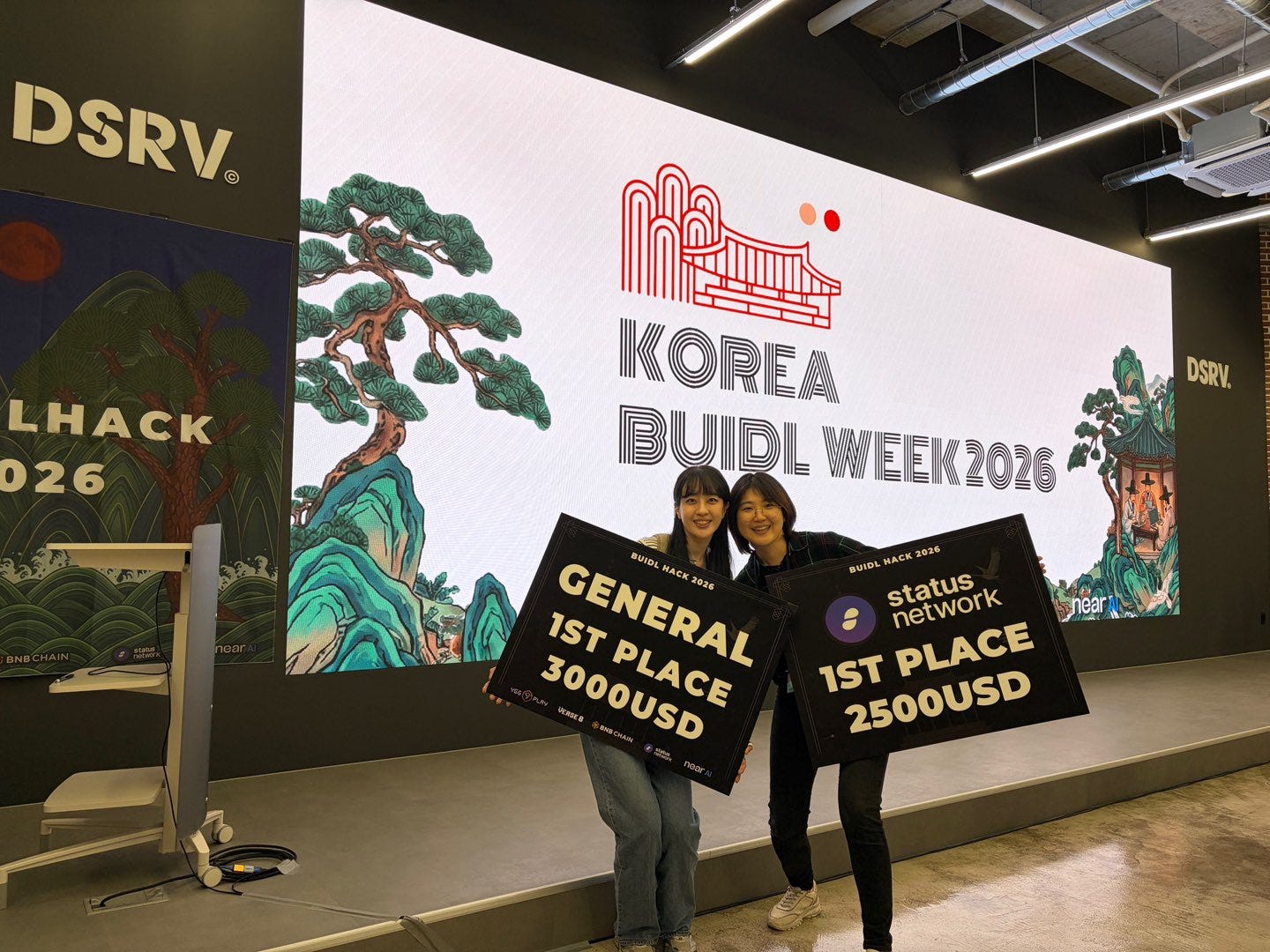
And my friend handled the pitch the next day at the DSRV onsite venue.
Honestly, I didn’t expect us to take the General Track at all. After winning the Status Network sponsor track, we were already packing up to leave because we were so exhausted, and then it turned out we’d also won overall 1st place! According to one of the judges, it was apparently a unanimous decision.
When our team name was called, I literally shouted, “Wait — what?!” out loud.
At the hackathon, whenever people asked what I do, I introduced myself with my current company’s name since I technically hadn’t left yet. It felt oddly meaningful to represent the company one last time. I even shared the results in our company Slack, and everyone congratulated me, and some of the engineers even asked whether it was really 100% vibe coding, which felt great.
I named our team Laugh Tale, after the mysterious uncharted island in the animation series One Piece that pirates ultimately chase. In that same spirit, we wanted to see how far two non-devs could push via vibe coding. It felt really fulfilling to actually scratch that itch.
So now, I’ve somehow placed in all three hackathons I’ve ever entered. 100% win rate. 😇 Hooray!
Hmm… how do I wrap this up? 🤔
Don’t put limits on yourself. Just try stuff. Learning by actually doing is the most fun and the most effective, cliché as that sounds.
If you’re curious about Bargo:
https://github.com/claraexmachina/bargo
If you’re curious about us:
Me (author) : https://x.com/claraexmachina
My friend: https://x.com/0xcryptosonny