How to Subscribe to Real-Time Crypto Data from Multiple Exchanges Using WebSocket
 kalos3 min read·Just now
--
A complete, production-ready implementation for low-latency market data
If you’ve ever built trading tools, data dashboards, or quantitative strategies for crypto, you know: relying on a single exchange’s data leaves you blind to the full market. Prices, liquidity, and signals vary wildly across platforms — and hundreds of milliseconds of latency can break your logic.
After building countless real-time data pipelines, I’ve found WebSocket is the only reliable way to stream live quotes from multiple exchanges at scale. In this guide, I’ll break down why it matters, how to structure your system, and share a full Python implementation you can deploy today.
Why WebSocket Beat HTTP for Real-Time Crypto Data
You might be tempted to use simple HTTP polling. It works for basic use cases — but fails badly in live markets.
- Latency: Polling waits for you to request data. WebSocket delivers updates the moment they happen.
- Resource waste: Constant requests drain bandwidth and trigger rate limits.
- Consistency: Long-lived connections keep data flowing without repeated handshakes.
WebSocket acts as a persistent pipe: once connected, market ticks flow continuously to your application. For multi‑exchange aggregation, this is non‑negotiable.
Two Ways to Subscribe Multiple Exchanges
You can handle multi-exchange WebSocket streams in two proven ways.
1. Separate Connection Per Exchange
- Create one WebSocket per exchange
- Clean isolation; easy to debug
- Risk: higher resource usage at scale
2. Unified API Connection (Recommended)
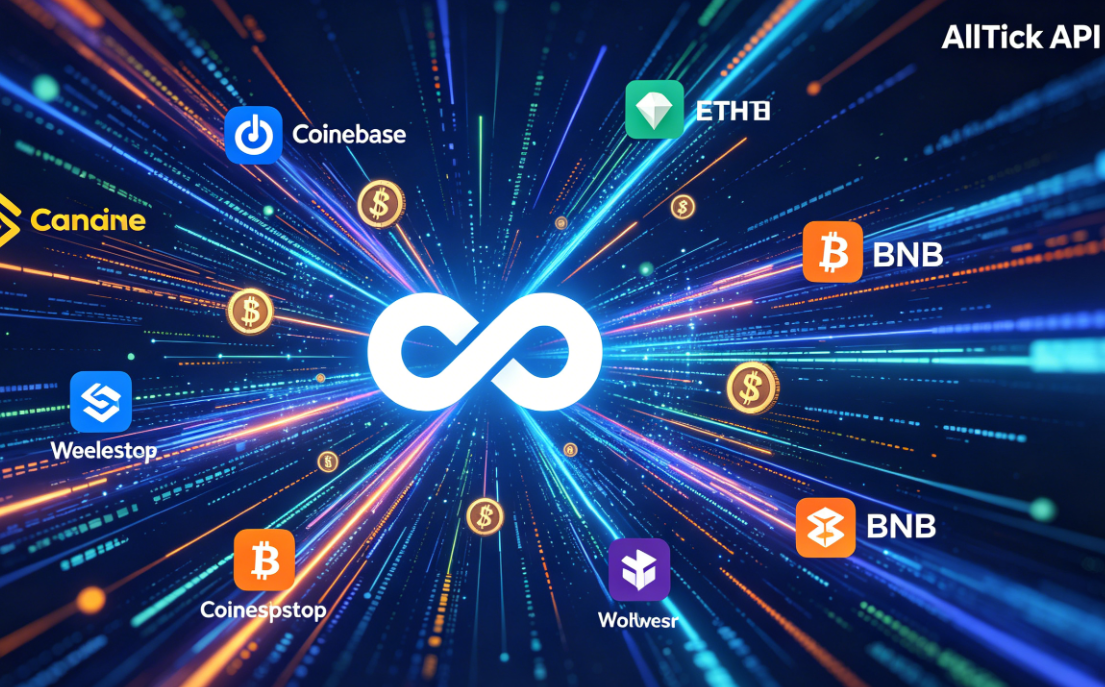
Use an aggregated API like AllTick API that lets you subscribe to dozens of exchanges over a single WebSocket.
- Less code
- Less infrastructure
- Pre-normalized data format
- Faster to build and test
In production, I wrap each connection in a class with heartbeat, reconnection, and parsing logic — then manage them with an async event loop.
The Hard Part: Processing Incoming Messages
Multi-exchange streaming isn’t just about connecting — it’s about handling data consistently.
Standardize Your Schema
Every exchange returns different JSON. Normalize every tick to:
{ symbol, price, volume, timestamp }Deduplicate & Merge
When the same pair updates across venues, filter duplicates or apply priority rules.
Go Async
Use asyncio (Python) or promises (Node.js) so one slow exchange doesn’t block your entire pipeline.
Full Production-Ready Code
This example uses a unified WebSocket API to stream live prices from Binance, OKX, and Huobi — simultaneously.
import asyncio
import websockets
import json
async def subscribe(exchange, symbol):
    url = "wss://ws.alltick.co/quote"
    async with websockets.connect(url) as ws:
        payload = json.dumps({
            "action": "subscribe",
            "exchange": exchange,
            "symbol": symbol
        })
        await ws.send(payload)
        while True:
            data = await ws.recv()
            tick = json.loads(data)
            print(f"{exchange} {symbol} latest: {tick['price']}")
async def main():
    tasks = [
        subscribe("binance", "BTCUSDT"),
        subscribe("okx", "BTCUSDT"),
        subscribe("huobi", "BTCUSDT")
    ]
    await asyncio.gather(*tasks)
asyncio.run(main())
Keep Connections Alive: Heartbeats & Reconnection
Public WebSocket connections drop. To maintain uptime:
- Send periodic
pingframes to stay active - Auto-reconnect on disconnect or exception
- Log reconnection attempts for observability
This is what separates scripts from production systems.
Performance Best Practices
When scaling to many symbols and exchanges:
- Don’t cache data infinitely — use queues or databases
- Process messages asynchronously to avoid bottlenecks
- Log errors and warnings to debug quickly
- Rate-limit reconnections to avoid self-DDoS
Final Thoughts
Building a real-time multi-exchange data feed used to be painful. You had to learn each exchange’s API, handle broken connections, normalize messy data, and optimize performance — all at once.
Today, WebSocket + unified APIs like AllTick let you build stable, low-latency pipelines in hours, not weeks.
Once your foundation is solid, you can focus on what matters:analysis, signals, strategies, and performance.
If you’re building trading systems, data dashboards, or quant tools, this architecture will serve you for years.