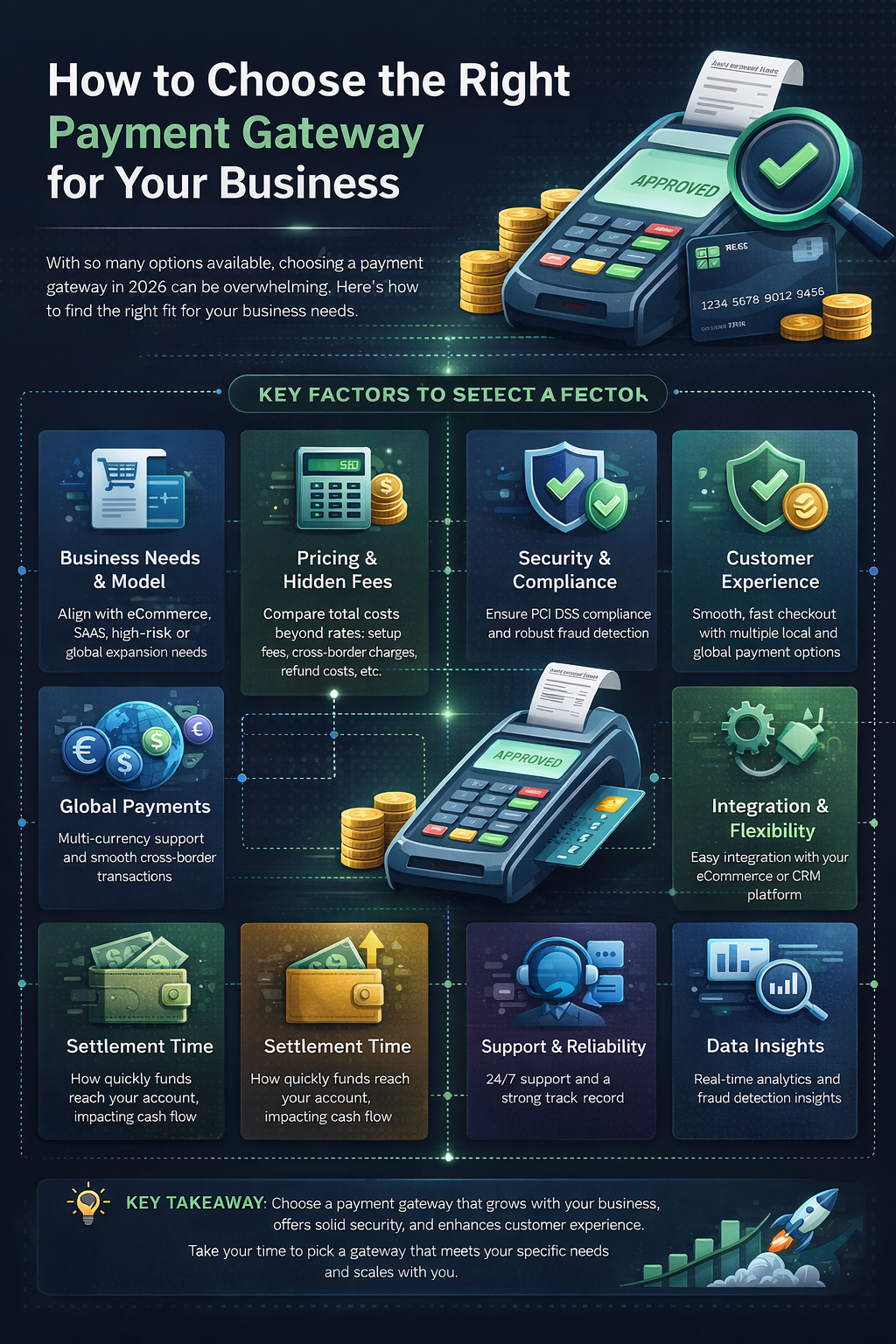
How to Choose the Right Payment Gateway for Your Business?
--
In today’s digital-first economy, choosing the right payment gateway is one of the most critical decisions a business can make. Whether you’re running an eCommerce store, a SaaS platform, or a service-based business, your payment gateway directly impacts customer experience, conversion rates, cash flow, and even your brand reputation. With countless options available in 2026, the challenge is no longer finding a gateway — it’s choosing the right one that aligns with your business model, growth plans, and risk profile.
Understanding What a Payment Gateway Really Does
A payment gateway is more than just a tool that processes transactions. It acts as the bridge between your customer, your business, and financial institutions. When a customer makes a payment, the gateway encrypts sensitive information, communicates with card networks and banks, and ensures the transaction is approved or declined in real time.
But beyond this technical function, modern payment gateways offer features like fraud detection, analytics, subscription billing, multi-currency support, and seamless integrations. This means your choice isn’t just about processing payments — it’s about building a reliable financial infrastructure for your business.
Start with Your Business Model
The first step in choosing the right payment gateway is understanding your business needs. Not all gateways are built for the same purpose. For example, an eCommerce business requires a gateway optimized for high transaction volumes and global payments, while a SaaS company may prioritize recurring billing and subscription management.
If you operate in a high-risk industry such as gaming, travel, or digital services, your requirements become even more specific. Many standard gateways may decline your application or impose strict limits. In such cases, you’ll need a provider that specializes in high-risk merchant accounts, offering higher approval rates and better chargeback management tools.
Choosing a gateway that aligns with your business model ensures smoother operations and fewer disruptions as you scale.
Evaluate Pricing Beyond the Surface
Pricing is often the most misunderstood aspect of payment gateways. Many providers advertise simple, flat rates, but the real cost includes multiple components such as interchange fees, markup, currency conversion charges, and additional service fees.
It’s important to look beyond the headline rate and understand the complete pricing structure. Ask questions like: Are there setup fees? What are the monthly charges? Are there additional costs for international transactions or refunds?
A gateway with slightly higher visible fees but better transparency and fewer hidden charges may actually be more cost-effective in the long run. Businesses that fail to evaluate total cost often end up paying significantly more than expected.
Focus on Security and Compliance
Security is non-negotiable when it comes to payment processing. A reliable payment gateway should be fully compliant with PCI DSS standards and equipped with advanced fraud detection mechanisms. Features like tokenization, encryption, and AI-driven fraud prevention are essential in 2026.
Customers today are highly sensitive to security issues. A single breach or fraudulent transaction can damage trust and lead to financial losses. By choosing a secure gateway, you not only protect your business but also enhance customer confidence, which directly impacts conversion rates.
Consider Customer Experience and Checkout Flow
The checkout experience plays a major role in whether a customer completes a purchase or abandons their cart. A good payment gateway should offer a smooth, fast, and user-friendly checkout process.
Look for features like one-click payments, mobile optimization, and support for multiple payment methods including cards, UPI, wallets, and buy-now-pay-later options. The more convenient the payment experience, the higher your chances of converting visitors into paying customers.
In markets like India, where digital payment preferences vary widely, offering localized options such as UPI can significantly improve conversion rates.
Global Capabilities and Scalability
If you plan to expand internationally, your payment gateway must support global transactions. This includes multi-currency processing, localized payment methods, and efficient cross-border capabilities.
A scalable gateway allows you to grow without constantly switching providers. It should handle increasing transaction volumes, support new markets, and adapt to changing business needs.
Choosing a gateway with strong global capabilities ensures that your payment infrastructure grows alongside your business rather than holding it back.
Integration and Technical Flexibility
Another key factor to consider is how easily the payment gateway integrates with your existing systems. Whether you’re using an eCommerce platform, CRM, or custom-built software, seamless integration is essential for efficient operations.
Modern gateways provide APIs, plugins, and developer tools that make integration straightforward. However, the level of flexibility varies between providers. Businesses with complex needs should prioritize gateways that offer customizable solutions and strong technical support.
A well-integrated payment system reduces manual work, minimizes errors, and improves overall efficiency.
Settlement Time and Cash Flow Impact
Settlement time — the duration it takes for funds to reach your account — is often overlooked but critically important. Some gateways offer instant or same-day settlements, while others may take several days.
Delayed settlements can disrupt cash flow, especially for small and growing businesses. Understanding the settlement cycle helps you plan finances more effectively and avoid liquidity issues.
Additionally, some providers hold rolling reserves or impose payout delays for high-risk businesses. It’s important to clarify these terms upfront to avoid surprises later.
Customer Support and Reliability
Even the best payment gateway can face occasional issues, from transaction failures to technical glitches. What matters is how quickly and effectively these issues are resolved.
Reliable customer support is a key differentiator. Look for providers that offer 24/7 support, dedicated account managers, and quick response times. Downtime or unresolved issues can lead to lost sales and frustrated customers.
A dependable gateway ensures that your payment system runs smoothly, even during peak traffic periods.
Reviews, Reputation, and Real-World Performance
Before making a final decision, it’s important to research the gateway’s reputation. Look at customer reviews, case studies, and industry feedback.
Pay attention to factors like approval rates, downtime frequency, dispute handling, and ease of use. Real-world performance often reveals insights that marketing materials don’t.
Choosing a well-reviewed and trusted provider reduces risk and gives you confidence in your decision.
The Role of Data and Insights
Modern payment gateways are not just transaction processors — they are powerful data tools. They provide insights into customer behavior, payment trends, and transaction performance.
These insights can help you optimize pricing strategies, identify fraud patterns, and improve customer experience. Businesses that leverage payment data effectively gain a competitive advantage.
When evaluating gateways, consider the quality of analytics and reporting features they offer.
Making the Final Decision
Choosing the right payment gateway is not about finding a one-size-fits-all solution. It’s about identifying what matters most to your business and selecting a provider that meets those needs.
Take the time to compare options, ask detailed questions, and even test multiple gateways if possible. Consider factors like cost, security, user experience, scalability, and support.
The right gateway will not only process payments efficiently but also contribute to your business growth by improving conversions, reducing risks, and enhancing customer trust.
Conclusion
In 2026, payment gateways are no longer just operational tools — they are strategic assets. The right choice can streamline operations, improve customer experience, and unlock new growth opportunities. The wrong choice, on the other hand, can lead to hidden costs, lost revenue, and operational challenges.
By approaching this decision with a clear understanding of your business needs and a focus on long-term value, you can build a payment system that supports your success today and scales with you into the future.
#PaymentGateway #DigitalPayments #Fintech #OnlineBusiness #Ecommerce #SaaS #BusinessGrowth #PaymentSolutions #StartupTips #Entrepreneurship #FintechInsights #CustomerExperience #SecurePayments #GlobalPayments #UPIPayments #OnlineTransactions #BusinessStrategy #ScalingBusiness #PaymentProcessing #TechForBusiness