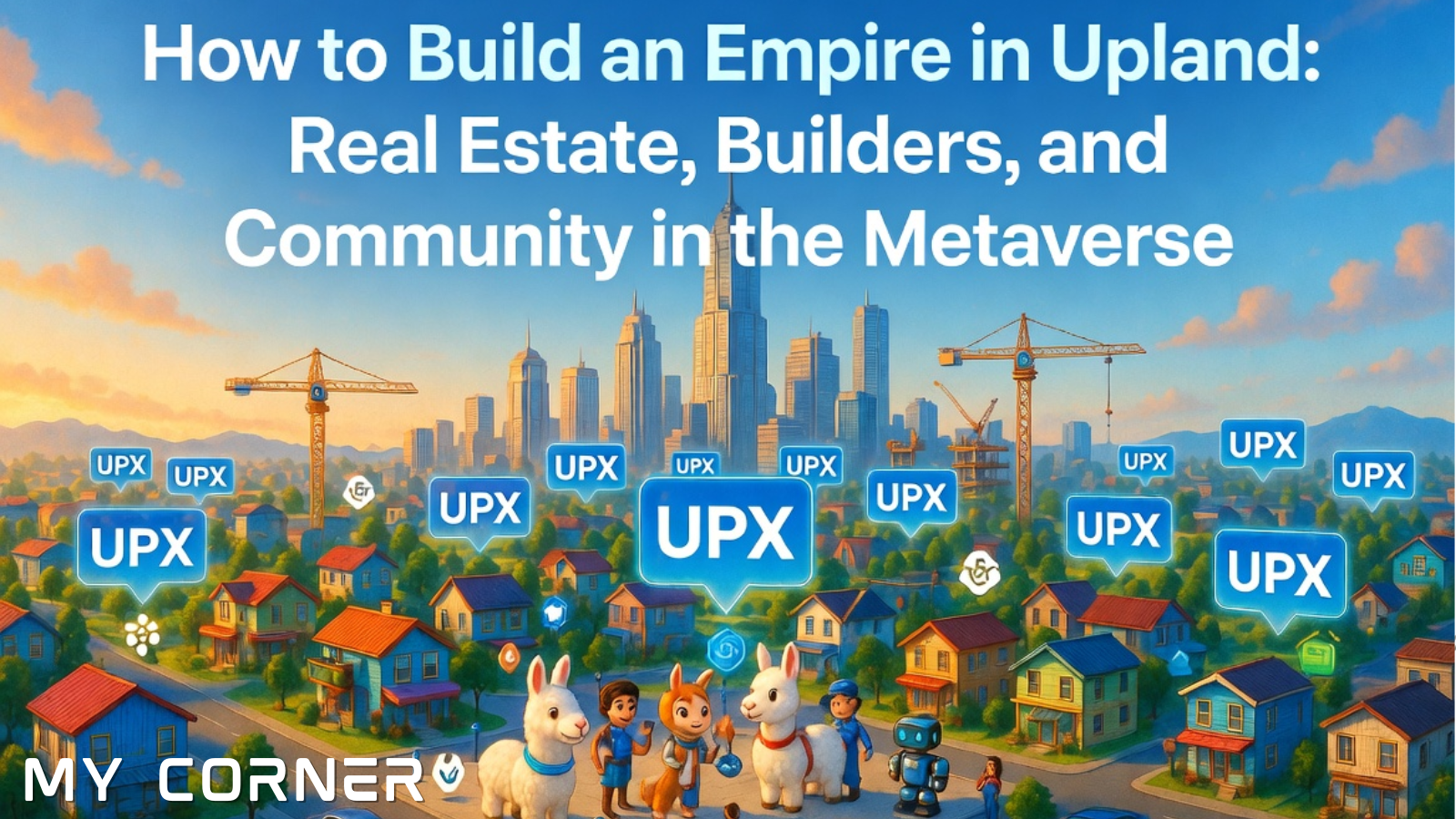
How to Build an Empire in Upland: Real Estate, Builders, and Community in Web3.
 ObiwanPR6 min read·Just now
--
In Upland, building an empire no longer means simply buying properties. Today, the game feels much more like a living city: you buy land, develop neighborhoods, open businesses, manufacture assets, collaborate with other players, and in some cases, sell eligible assets for USD in the marketplace.
For a long time, many players entered Upland thinking like property investors. And yes, land is still the foundation of the game. But the real empire in Upland is built when you understand something deeper: you are not just building a portfolio, you are building an ecosystem. An ecosystem where your value does not depend only on how many properties you own, but on how well you connect real estate, construction, the creator economy, and relationships with people from all around the world.
Real Estate Is Still the Foundation of the Empire
Every great strategy in Upland begins with well-selected properties. Land remains one of the core pillars of the game, and it is often the first step toward growth. But buying for the sake of buying is not enough. A player who truly wants to grow needs to think about location, utility, scarcity, neighborhood identity, and the future potential of an area.
This is where the first type of builder is born: the real estate strategist. This player does not look at a property only for its current price. They look at whether that property can become part of a larger vision, whether it sits inside a promising neighborhood, whether it can support a node in development, or whether it may later serve as the base for a structure, a showroom, or another key asset in a bigger strategy. In Upland, land is not the end of the game; it is the platform from which you begin to scale.
The New Builder: From Owner to Contractor
One of the most important changes in Upland’s recent evolution is that building is no longer only about what you unlock for yourself. With the rise of collaborative construction systems, players can increasingly monetize their knowledge, blueprints, planning, and operational capacity.
This is where another essential profile appears: the contractor builder. This player does not necessarily make their money by speculating on land. Instead, they become a specialist. They understand blueprints, timing, coordination, and logistics. They move where opportunity exists and turn their construction expertise into a source of income inside the game.
In other words, Upland increasingly rewards the player who develops a profession, not just the player who accumulates assets.
The Urbanist Who Builds for Residents
Another type of builder gaining importance is the service-minded urbanist. As Upland evolves, it becomes clearer that neighborhoods are no longer valuable only because they have structures, but because they are livable, attractive, and functional.
This changes the builder’s mindset completely. In the past, many players built simply to “have more.” Now, the smartest players build to attract activity, improve the quality of the neighborhood, and position themselves better inside the game’s future economy.
This kind of builder thinks beyond individual profit. They think in terms of experience, flow, and neighborhood design. They understand that when a district becomes stronger, everyone inside it becomes stronger as well.
The Creator: Manufacturing Assets, Building Identity, and Selling Value
If real estate gives you the foundation, the creator economy gives you multiplication. Upland is not just about buying and selling parcels. It also offers a much more sophisticated layer of production and commerce through digital assets, showrooms, and branded experiences.
This is where two key profiles emerge: the manufacturer and the merchant. The manufacturer creates inventory. The merchant creates visibility, branding, traffic, and distribution. One produces; the other converts attention into sales.
When both roles are combined inside one strategy, the player stops depending only on the appreciation of their properties and starts operating like a true company inside Upland.
This type of builder understands something fundamental: in the metaverse, not all value is stored in land. A significant amount of value lives in visual identity, asset utility, brand storytelling, and the ability to move inventory through a community. A well-designed map asset, a strong ornament, or a consistent product line can turn an ordinary player into an economic and creative reference point.
The Node Leader: Building Community Is Also Building Wealth
There is one kind of builder that many people underestimate, even though it is one of the most powerful of all: the community builder.
In Upland, a node is much more than a neighborhood with a name. A real node is a living vision. It is a place where people gather around a shared identity, shared goals, and shared momentum. Creating a node means building culture, attracting complementary players, coordinating development, and transforming a place on the map into a destination.
A node leader does not simply increase social activity. A strong node can concentrate development, visibility, traffic, creativity, and opportunities. It can create a sense of belonging that keeps players engaged and gives meaning to everything else being built around it.
This is why community is one of the most valuable currencies in Upland. A player can own many properties, but a leader who organizes people, inspires builders, and creates collaboration is building something far more powerful than a portfolio: they are building a world.
The Evolved Flipper: Selling Fully Developed Experiences
Another profile that is becoming more important is the upgraded property flipper. In the past, flipping was often seen as simply buying low and selling high. But in an evolving metaverse economy, flipping can become something much more refined.
Now the opportunity is not only in the land itself, but in how that land is curated, improved, themed, and presented. A player with a sense of aesthetics, branding, and marketability can transform an ordinary property into a much more desirable experience.
This changes the meaning of value creation. It is no longer only about price movement. It is about design, perception, and emotional appeal. In a game where neighborhoods are becoming increasingly alive and identity-driven, presentation itself becomes strategy.
Making Money, but with a Realistic Vision
Yes, Upland offers ways for players to create real economic opportunities. But building an empire in Upland should never be seen as a quick-money formula. It should be understood as building a position inside a living digital economy.
The players who tend to grow the most are usually those who combine multiple layers: properties, building knowledge, Sparklet strategy, community presence, branding, events, collaboration, and long-term vision. They do not depend on a single mechanic. They create a network of value.
That is what makes an empire durable. Not the size of one wallet, but the strength of the ecosystem behind it.
The Real Empire Is Not Made of Properties, but of Reputation
Perhaps the most important lesson Upland teaches is this: an empire is not built by the player who buys the most, but by the player who connects the most.
The one who connects land with vision.
The one who connects builders with opportunity.
The one who connects assets with market demand.
he one who connects neighborhoods with identity.
And above all, the one who connects people from different parts of the world around a common idea.
In a Web3 game like Upland, building an empire means much more than accumulating parcels. It means becoming a developer, an urbanist, a merchant, a creator, and a leader. It means understanding that value does not live only in the wallet, but in the human network you build around your project.
And when that happens, you are no longer just playing a property game.