How Much Can You Earn with AI Trading Bots?
 AI Trading Bots - The Future of Trading6 min read·Just now
--
The honest answer to this question depends more on how a bot is deployed than on what any headline return figure promises. AI trading bots can generate real profits — but the earnings range is wide, shaped by capital size, strategy quality, market conditions, risk management, and whether the system has been verified in live trading rather than backtests. For investors trying to set realistic expectations before committing capital, the most useful framework is to understand what different categories of AI bots typically deliver, why the numbers vary so dramatically, and what distinguishes systems that produce consistent earnings from those that simply look good in marketing materials.
The Earnings Range: What Verified Data Shows
The spectrum of reported AI trading bot returns is broad enough to cause real confusion. At the top end, platform-specific data from Tickeron shows annualized returns of up to +48% on certain stock strategies using Financial Learning Models (FLMs), with profit factors exceeding 4.4 on defense sector ETFs. These are audited, publicly accessible figures — not anonymous testimonials.
At the more typical end, well-regarded crypto bot platforms report that top users achieve 12–25% annualized returns in favorable market conditions, according to comparative data published by WunderTrading. Grid trading bots in crypto markets — which profit from sideways price action — have produced returns of roughly 9–22% during downtrend periods in one documented independent test, depending on the asset and configuration.
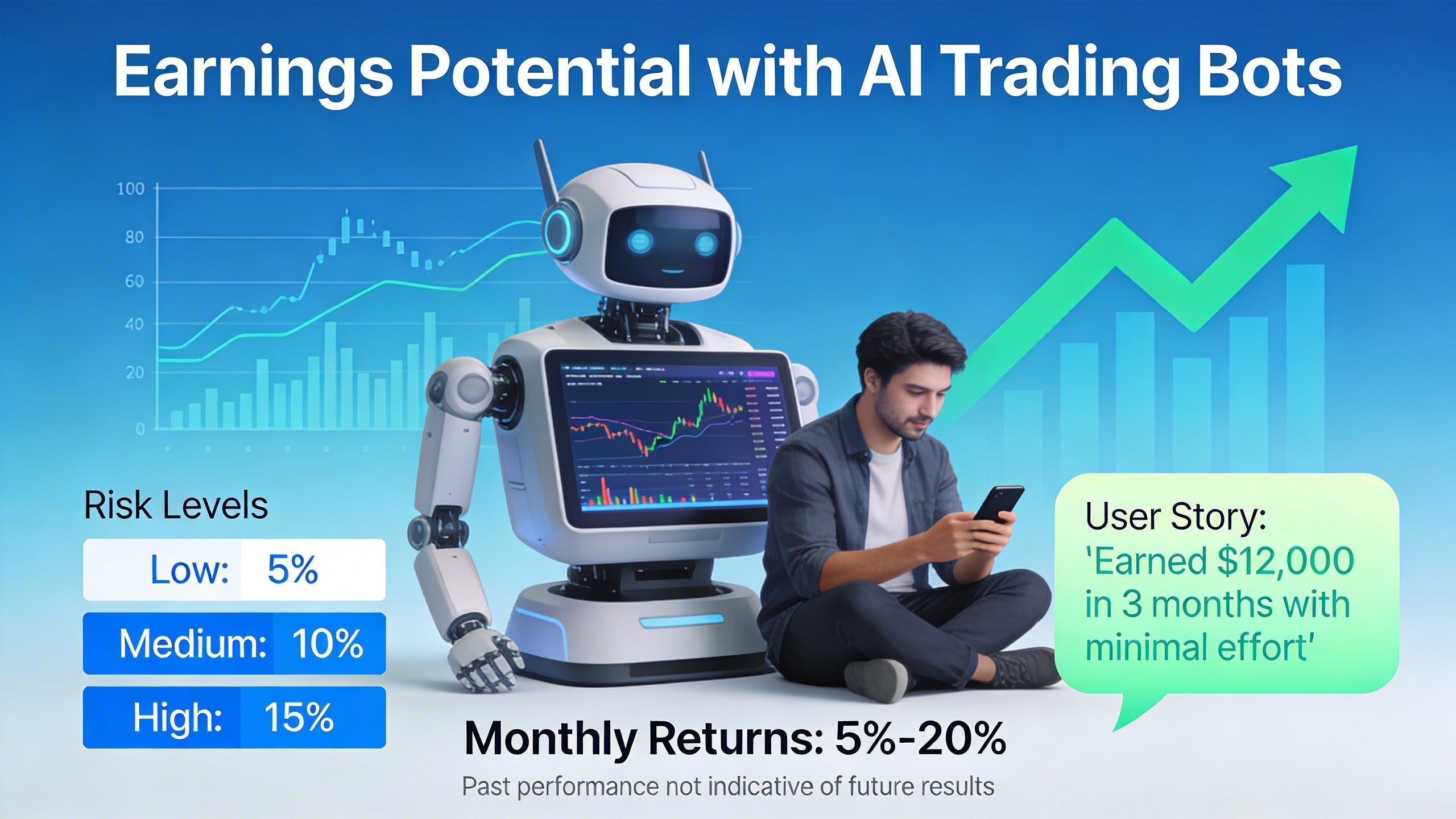
For forex-focused automated systems, managed services with verified live track records generally target monthly returns in the mid-single-digit percentage range — typically 5–8% per month when conditions are favorable. Compounded over 12 months, even a conservative 5% monthly return produces returns far exceeding typical equity benchmark indices, though sustaining that level through all market conditions is the central challenge.
At the other end of the spectrum, the same independent analysis sources are clear: more than 90% of retail bots are not profitable over the long term due to fees, latency, overfitting, and competition from institutional algorithms. Backtested returns — the kind most bot marketplaces advertise — frequently look impressive precisely because they have been optimized against historical data rather than tested against future unknown conditions. When the same strategies go live, the numbers routinely collapse.
What Determines Your Actual Earnings
Several factors directly determine how much a specific investor earns from AI trading bots, and most of them are within the investor’s control to evaluate before choosing a system.
Account size and fee drag. Small accounts face a serious structural disadvantage with subscription-based bot platforms. A $200 monthly subscription on a $5,000 account represents a 4% annual cost baseline that must be overcome before the account shows any net gain. On a $50,000 account, the same fee is less than 0.5% — an entirely different equation. According to WunderTrading, annual bot subscriptions represent 1.8–13.3% of capital on a $10,000 account, and high-frequency strategies can generate an additional 3–5% in exchange fees annually. Understanding total cost of ownership — not just subscription price — is essential for accurately projecting net returns.
Strategy quality and market conditions. No AI bot strategy works equally well in all market environments. Trend-following bots underperform in sideways markets; mean-reversion bots struggle in strongly trending ones; grid bots excel in oscillating markets but can suffer significant losses if prices break out of their configured range and don’t recover. The documented independent test data showing 9–22% grid bot returns in down markets came alongside DCA bot results that underperformed simple buy-and-hold for Bitcoin during the same period. Strategy fit to market regime is a primary driver of earnings — and it shifts over time.
Verified live results vs. backtests. This is the single most important distinction when projecting earnings. Backtested performance uses historical data, which means the system can be (intentionally or accidentally) optimized for periods that are no longer representative. A bot claiming 80% annual returns in backtests with no live verification should be treated as unverified. Only platforms that publish third-party verified live trading data — via services like Myfxbook or FX Blue for forex, or audited strategy records for equities — provide a reliable basis for earnings projections.
Risk controls and drawdown management. A bot that earns 30% annually but experiences a 50% maximum drawdown during that period is not a reliable earnings vehicle — it requires the investor to survive losing half their capital at some point. Systems with profit factors above 3.0 and maximum drawdowns below 15–20% are the standard for sustainable automated earnings. Without these controls, headline return figures are misleading.
Managed AI Services: Earnings With Professional Oversight
For investors who want bot-driven earnings without building or managing a system themselves, professionally managed automated trading services offer a direct path. These services deploy proprietary algorithms on behalf of clients, handling strategy selection, execution, and risk management — and provide third-party verified performance data that gives investors a realistic earnings baseline.
Cypher Pro Trading is one such service, focused specifically on automated forex trading. The platform reports monthly returns in the 5–8% range, backed by third-party verified performance data rather than backtested projections. The team behind the platform has over 14 years of combined industry experience and holds a 4.6/5 Trustpilot rating from verified user reviews.
Service access is structured in two tiers. The Lite Package serves accounts between $10,000 and $50,000 with the flagship algorithm, lifetime updates, course access, and 24/5 dedicated support. The Pro Package extends access to the full algorithm suite, a dedicated account manager, and first access to new algorithm releases for accounts from $10,000 to $200,000 and above. Capital remains in the client’s own account at a regulated broker, not held by the service provider — an important structural protection.
For context on what these figures mean in earnings terms: at 5% monthly returns on a $10,000 account, that represents $500 per month, or $6,000 annually, before compounding. At 8%, the same account generates $800 per month before compounding. These are not guaranteed outcomes — actual results will vary with market conditions, and past performance does not guarantee future returns. But they represent verified historical performance rather than speculative projections.
What You Should Not Expect
Setting realistic expectations is as important as understanding the upside. Several categories of earnings claims made in the AI trading bot space are not supported by verified evidence:
Daily dollar guarantees are not credible. Claims that AI bots will consistently earn $500 or $2,000 per day regardless of account size or market conditions are marketing, not finance. No verified, independently audited bot system produces guaranteed daily dollar outcomes with the consistency that these claims imply.
Astronomical annual returns from retail bots are almost always backtested. Returns above 50% annually from retail-accessible bot systems, without third-party verified live trading data, should be approached with extreme skepticism. As noted across multiple industry sources, sustainable live gains above 20–30% annually from algorithmic retail trading systems are uncommon — and those are typically from well-funded, professionally managed strategies, not off-the-shelf platforms.
Crypto bot performance is highly regime-dependent. The 9–22% grid bot returns documented in independent testing reflect specific market conditions during that period. In different regimes — strongly trending or illiquid markets — those same bots can produce losses. Any earnings estimate from a crypto bot should be understood as conditional on market environment, not guaranteed.
Earnings Match Expectations When Expectations Match Reality
AI trading bots can earn meaningful returns — but the achievable earnings range for a retail investor is defined by capital size, strategy quality, market conditions, and whether the system chosen has been independently verified in live trading. The top of the range, represented by professionally managed services with audited track records, offers monthly returns of 5–8% with controlled risk. The middle, represented by well-configured DIY platforms, realistically targets 12–25% annually under favorable conditions. Below that sits the majority of retail bot deployments — which, by most independent analyses, fail to generate consistent net profits after fees and costs. The investor’s job is to identify which category any specific system genuinely belongs to, and to verify that answer with live performance data before committing capital.
Disclaimer: This article is for informational purposes only and does not constitute financial or investment advice. AI trading bots and automated trading involve significant risk, including the possible loss of principal. Past performance of any trading bot, platform, or managed service is not indicative of future results. All earnings figures referenced are historical and should not be interpreted as guarantees. Always conduct independent research and consult a licensed financial professional before making any investment decisions.