How Liquidity Pools Power Decentralized Trading and Why Cross-Chain Changes Everything
 Divyesh Patel5 min read·Just now
--
The majority of individuals that engage in a decentralized exchange platform do not even imagine what is being transpired beneath the surface. They link a wallet, input a token pair, verify the transaction and get their output. The exchange is easy since something really complex is occurring in the background of the exchange.
The idea is that infrastructure is constructed on liquidity pools and the explanation of how such pools operate is why decentralized trading has been able to scale to the extent it has, and why the shift to cross-chain was inevitable.
The Liquidity Pool in a Nutshell
A standard exchange matches purchasers and vendors. When nobody wants to sell at your price, then the trade is not made. The model is applicable to assets that have high trading volume but fails with less popular tokens where it is not easy to find a buyer and a seller in real-time.
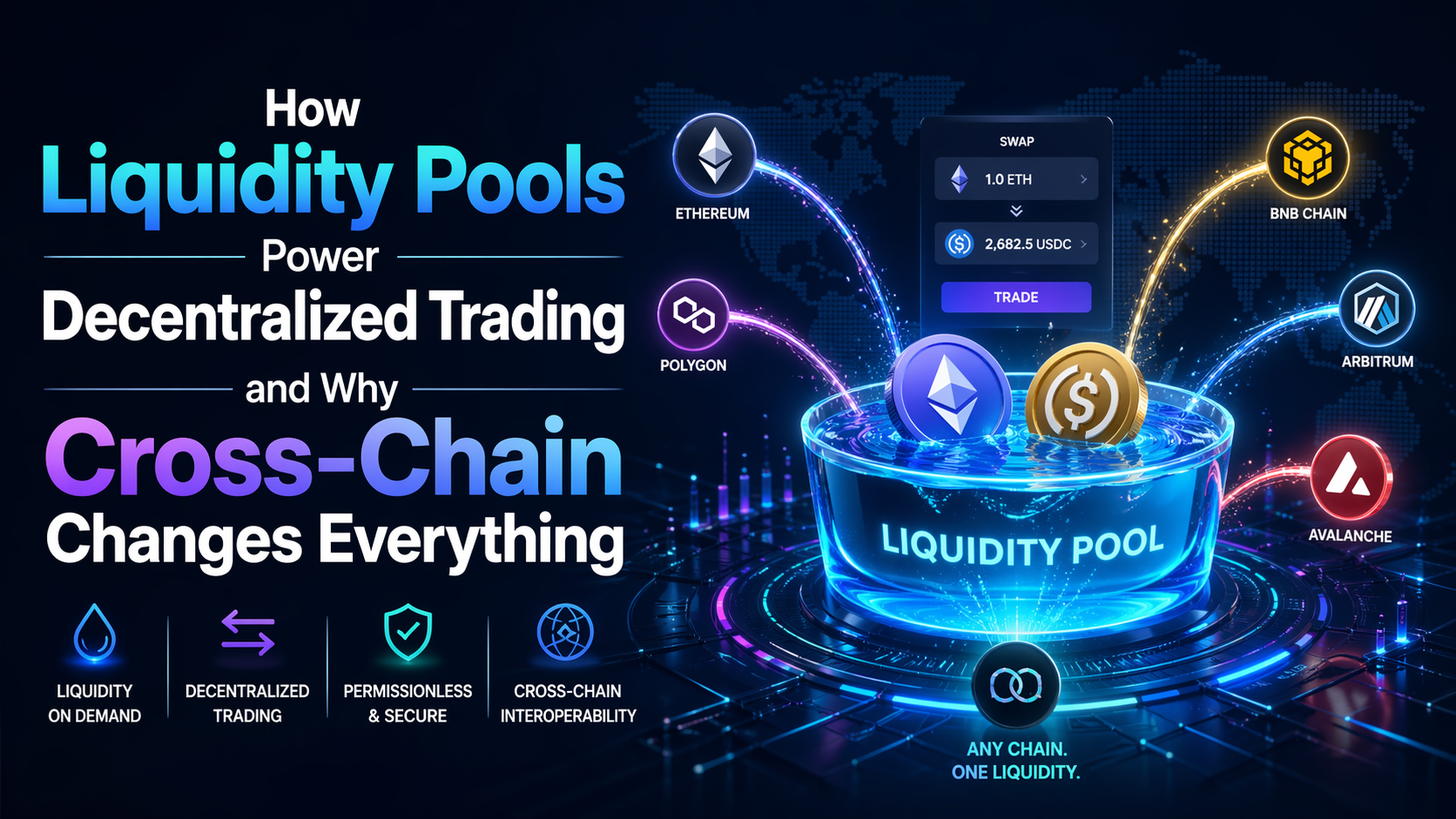
This is solved by a decentralized crypto exchange in a different way. It does not pair individual parties but operates on liquidity pools; liquidity pools are smart contracts where two or more tokens are stored. In a swap, you do not trade with another individual. You are selling against the pool. There is always inventory available in the pool and the price is automatically determined using a mathematical formula, which depends on the ratio of assets in the pool.
This is known as an Automated Market Maker or AMM. It is a very simple formula: the more you purchase Token A in a pool, the fewer there will be in the pool, and the higher the price of the A. The pool balances itself, forming a self-sustaining pricing mechanism, which does not need human intervention or an order book.
This creates a dex trading platform that is open 24/7, there are no identity checks, and the token pairing can be any pair provided that someone is willing to provide the initial liquidity.
Why Liquidity Depth Matters More Than It Seems
The amount of slippage to a trader is dictated by the size of the liquidity pool. Slippage is defined as the difference between your expected price and the price you actually receive and occurs because each trade will cause a change in the ratio of assets in the pool.
Even small trades cause a shallow pool to move greatly. Large trades that have a small price impact are absorbed by a deep pool. This is why the depth of liquidity is the one and the only important value when assessing any decentralized trading platform, not the number of listed tokens or interface or the marketing.
Pool depth is of great concern to large-scale traders and DeFi protocols when performing large swaps. An effective decentralized exchange system will show you the anticipated price move before you take the confirmation, allowing you to view precisely how much your trade will shift the market prior to making a trade.
The Cross-Chain Liquidity Problem
This is where liquidity pools collide with a structural challenge. An Ethereum-based pool contains Ethereum-based tokens. On Solana, there is a pool containing Solana-based tokens. There is no inherent relation between these pools. By default, liquidity is fragmented across all blockchains operating their own DEX ecosystems.
This disintegration has practical implications. A well-liquid token on one chain may trade poorly on another, merely due to the isolation of the pools. An asset holder on Arbitrum wishing to take advantage of an opportunity that exists on BNB Chain is unable to do so using a typical, single-chain exchange.
This is addressed by a cross-chain decentralized exchange, which constructs the bridge between blockchains into the trading flow. Instead of having traders bridging assets, transferring them and swapping them on a destination chain, the platform does all of the routing routing in a single transaction. You have what you have and you want what you want. The protocol works out the route.
The need to have this ability is quantifiable. In 2025, cross-chain transactions increased by 40% compared to the previous year, and the amount locked up in cross-chain bridge infrastructure hit 19.5 billion by the beginning of the same year. This is not marginal activity in the fringes of DeFi. It is a trading mainstream behavior.
The real mechanism of Cross-Chain Crypto Exchange Routing
When you change tokens between blockchains on a properly constructed platform, a number of things unfold sequentially. The platform will test the liquidity of various supported chains, find the most optimal route that includes all bridge and swap fees and then they will present you with an estimated output before you can sign anything.
It can be based on bridging protocols such as LayerZero or Wormhole to transfer assets between chains, or it can consist of native cross-chain AMM pools that store assets across chains at once. An example is THORChain, which is a cross chain decentralized exchange, and its liquidity pools hold native assets, as opposed to wrapped ones, eliminating a layer of counterparty risk.
Both strategies have various trust assumptions, speed properties and fee structures. The point is that the bridge between blockchains in any cross chain crypto exchange must be audited, transparent and well documented. The most commonly abused element in DeFi has been bridge contracts, and the selection of a platform in which bridge security is a first-class issue is no trifle.
Providing Liquidity Across Chains
In addition to trading, liquidity pools provide an additional aspect: anybody can be a liquidity provider. You can receive a portion of the trading fees incurred by all swaps that utilize the same pool by depositing a pair of tokens in that pool. The more trading is done on DeFi, the higher the returns to liquidity providers.
This is taken to the next level by cross-chain platforms. Other protocols enable liquidity providers to make a single deposit and have their capital flow in several different chains where it can yield the most profit. It is capital efficiency at scale — the same assets operating in multiple ecosystems instead of lying on a single chain.
The danger aspect of liquidity provision, specifically impermanent loss the unrealised cost of holding tokens in a pool when their prices are not matching is real and something to be acquainted with before investing capital. However, to traders who intend to hold two assets in the long run, liquidity provision in a decentralized trading platform can be an effective way of using otherwise idle holdings.
Liquidity pools and cross-chain routing are now a part of the core knowledge of anyone interested in DeFi, and not just developers. It is the platforms that have proven reliable at scale to make these systems work that define the future of decentralized finance.