How Financial Markets Work: Simple Beginner’s Guide to Stocks, Forex & Crypto
 TraderX4 min read·Just now
--
The global economy is based on financial markets. They enable individuals, businesses and governments to trade in assets such as stocks, currencies, commodities and cryptocurrencies.
Markets, at a glance, may seem complex — full of charts, numbers, and moving prices. However, in the real sense, the essence of it is very simple:
Markets are efficient since buyers and sellers meet to buy and sell at specific prices.
We will deconstruct it in a simple manner.
What is a Financial Market?
Any market where financial assets are exchanged is termed as a financial market.
This may be a physical place, such as a stock exchange or an online site, where much of contemporary trading occurs.
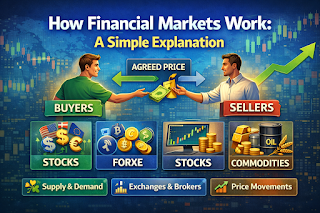
The most common financial markets would be:
Stock Market: Buying and selling company shares.
Forex Market: Currencies such as USD, EUR, and JPY are exchanged in this market.
Cryptocurrency Market: This is where one can trade in such digital assets as Bitcoin and Ethereum.
Commodities Market: This is where raw materials such as gold, oil and wheat are exchanged.
These markets are daily and deal with millions of people worldwide.
The Heart of any Market is Buyers and Sellers.
Any market operates on the basis of two important players: sellers and buyers.
The buyers think that the price will increase.
Sellers think the price will decrease — or they wish to secure profits.
The trade only occurs when there is an agreement between both parties on a price.
For example:
When one is willing to sell a stock at a price of $100 and the other person is willing to buy the stock at the same price, then the transaction will be made.
It is this continuous buyer-seloler interaction that makes the market dynamic.
Demand and Supply: What Moves Prices.
Supply and demand dictate the changes in prices in financial markets.
More people wish to buy than sell → prices increase 📈
As the number of people interested in selling increases relative to the number of people interested in buying, then the prices decrease 📉
For example:
When a company issues good earnings, then more investors will need to purchase its stocks. This enhances demand- and it normally drives the price up.
Supply and demand are determined by a number of factors and they include:
Economic news
Market sentiment
Global events
Financial reports
The play of Exchange and Brokers.
Financial markets depend on exchanges and brokers to enable trading.
Exchanges
Exchanges are the venues of exchanging assets. They offer a secure and organized atmosphere of transactions.
Brokers
Brokers represent the market and you. They offer the means and avenues where you can trade.
Majority of the trading today occurs online where brokers are involved, and anyone can access the markets.
The Reason Why Prices are Changing.
Financial markets are dynamic due to the constant entry of new information in the system.
The price movement is sometimes affected by some common factors which include:
Economic news and publications.
Interest rate decisions
Company earnings reports
Political events
Global economic conditions
The traders consider these factors in order to predict a rise or fall in prices.
What Is Liquidity and Why It Matters.
Liquidity is the ease at which you can purchase or sell an asset without much influence on its price.
A very liquid market typically has:
Numerous buyers and sellers.
Fast trade execution
Reduced price discrepancies (spreads).
Examples of such liquid markets include the forex market which is among the liquid markets world over.
The transformation in the financial markets through technology.
Trading used to be conducted on crowded exchange floors. Nowadays, all is largely digital.
Modern traders can enter markets by means of:
Trading platforms
Mobile apps
Online brokers
This has transformed the trading process into an easy, fast and accessible process than ever.
Final Thoughts
Although financial markets might appear a little difficult to understand initially, they are built on simple basis:
Individuals are buying and selling on what they think will occur next.
This is the simplest concept to be understood to be a confident trader or investor.
As time, education and experience goes by, anyone can start developing more effective navigation of the markets.
You will learn more about such concepts as trends, volatility or risk management in the following steps of your trip, which are crucial to make more intelligent trading decisions.