How does a BTC transaction actually work?
 💫 MR. CIP 💫3 min read·Just now
--
Imagine you want to send money to a friend who lives in another country. Normally, you would use a bank or a payment app, and both would rely on a central authority to correctly record the transaction. With Bitcoin, the same process happens without a central authority, thanks to the blockchain: a technology that works like a large public digital ledger.
🌐 What is the blockchain, in simple terms?
Think of a shared spreadsheet distributed across thousands of computers around the world. Every time someone makes a transaction, that spreadsheet updates simultaneously for everyone.
There is no single “official” copy: all copies are identical, and if someone tries to modify a row, the rest of the system immediately detects it and rejects the change.
That shared spreadsheet is the blockchain (literally “chain of blocks”): a database that stores all transactions made since Bitcoin was created.
🔐 Keys: public and private
To use Bitcoin, each person has a pair of cryptographic keys:
- Public key: like your IBAN. You can share it to receive funds.
- Private key: like a secret password that allows you to spend your bitcoins.
⚠️ Anyone who gains access to your private key can control your funds. That’s why it must never be shared.
💸 What happens when you send Bitcoin
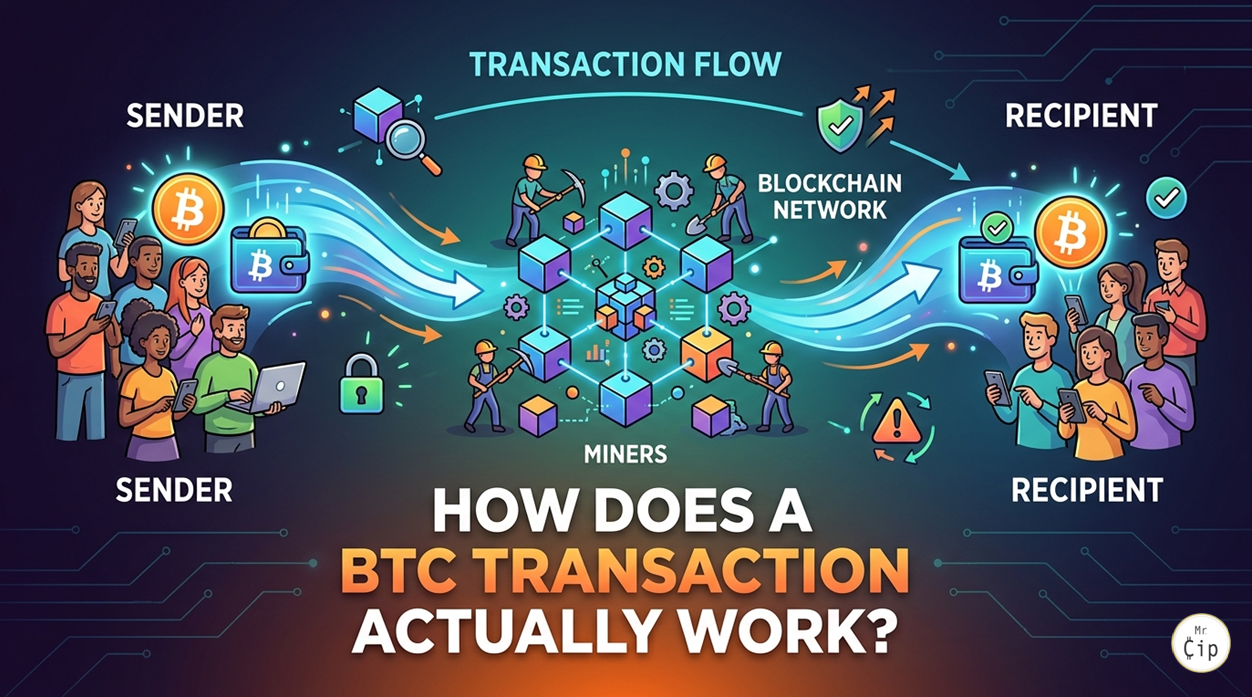
- You open your digital wallet and enter the recipient’s address
- The wallet creates a message such as: “Giovanni sends 0.01 BTC to Maria”
- The message is digitally signed using your private key (proof that it’s really you)
- The transaction is broadcast to the Bitcoin network
- Hundreds of nodes (computers) verify it
- Once validated, it enters a sort of “waiting list”
- A miner includes it in a block
⛏️ The role of miners and confirmations
Miners are computers that group transactions into blocks and add them to the blockchain. To do this, they must solve a very complex mathematical problem. This process is called Proof of Work.
When a miner finds the solution, they publish the new block and then they receive a Bitcoin reward.
Each new block added confirms your transaction. For example, if your wallet shows “3 confirmations,” it means that three blocks have been added after yours, making the transaction practically irreversible.
🧠 Why it is secure
Bitcoin’s security is not based on trust in a company, but on mathematics and transparency:
- Each block is linked to the previous one through a cryptographic hash (a kind of digital fingerprint)
- Changing a past transaction would require rewriting all subsequent blocks, which is computationally impossible
- Since all nodes verify the same history, there cannot be a “fake” version of the ledger
🚀 Conclusion: what makes Bitcoin special
The blockchain allows people around the world to exchange value without intermediaries, in a verifiable and censorship-resistant way. No permission is needed: just an internet connection and a digital wallet. Understanding how a transaction works helps explain why Bitcoin is not just digital money, but a new trust system built on open-source code.