GUIDEWIRE DEVTRIALS HACKATHON 2026
 CHAKRADHAR SUTHAPALLI5 min read·Just now
--
GigShield AI — AI-Powered Parametric Insurance for Gig Workers
Introduction
The gig economy has transformed the way millions of people earn their livelihood. Gig delivery workers working with platforms like Blinkit, Zepto, and Swiggy Instamart depend heavily on daily orders for their income. However, their earnings are highly affected by environmental conditions such as heavy rain, floods, extreme heat, and high pollution levels. These disruptions reduce delivery demand and result in sudden income loss — even when workers are available and active.
To address this real-world problem, we developed GigShield AI, an AI-powered parametric micro-insurance platform that automatically compensates gig workers when environmental disruptions impact their earnings.
Problem Statement
Gig workers face income instability due to factors beyond their control, especially environmental disruptions. Traditional insurance models require manual claim submissions, long verification processes, and delayed payouts, which are not suitable for gig workers who rely on daily income.
There is a need for a smart, automated insurance system that:
- Detects environmental disruptions in real time
- Determines whether income loss occurred due to these disruptions
- Automatically processes claims
- Provides quick compensation
GigShield AI was designed to solve this problem using AI and parametric insurance.
What is GigShield AI?
GigShield AI is an AI-powered parametric micro-insurance platform that monitors environmental conditions and worker activity to determine income loss risk. When predefined environmental thresholds and income loss conditions are met, the system automatically triggers insurance payouts without requiring manual claims.
This makes the insurance process fast, transparent, and reliable for gig workers.
Key Features of GigShield AI
1. Real-Time Environmental Monitoring
The system continuously monitors environmental data such as:
- Rainfall
- Temperature
- Air Quality Index (AQI)
This data is collected using Weather APIs and Air Quality APIs.
2. Worker Activity Tracking
GigShield AI tracks worker activity and delivery performance to understand whether the worker was active during the disruption period.
3. AI-Based Income Loss Prediction
Machine Learning models analyze historical environmental data and delivery data to predict the risk of income loss.
4. Automated Claim Processing
Unlike traditional insurance, GigShield AI uses a parametric insurance model, where payouts are triggered automatically when certain conditions are met.
5. Fraud Detection System
The platform uses Machine Learning models to detect fraudulent claims by analyzing worker behavior patterns and data anomalies.
6. Instant Compensation Payouts
Once the system verifies that environmental conditions caused income loss, compensation is automatically processed and credited.
Technology Stack
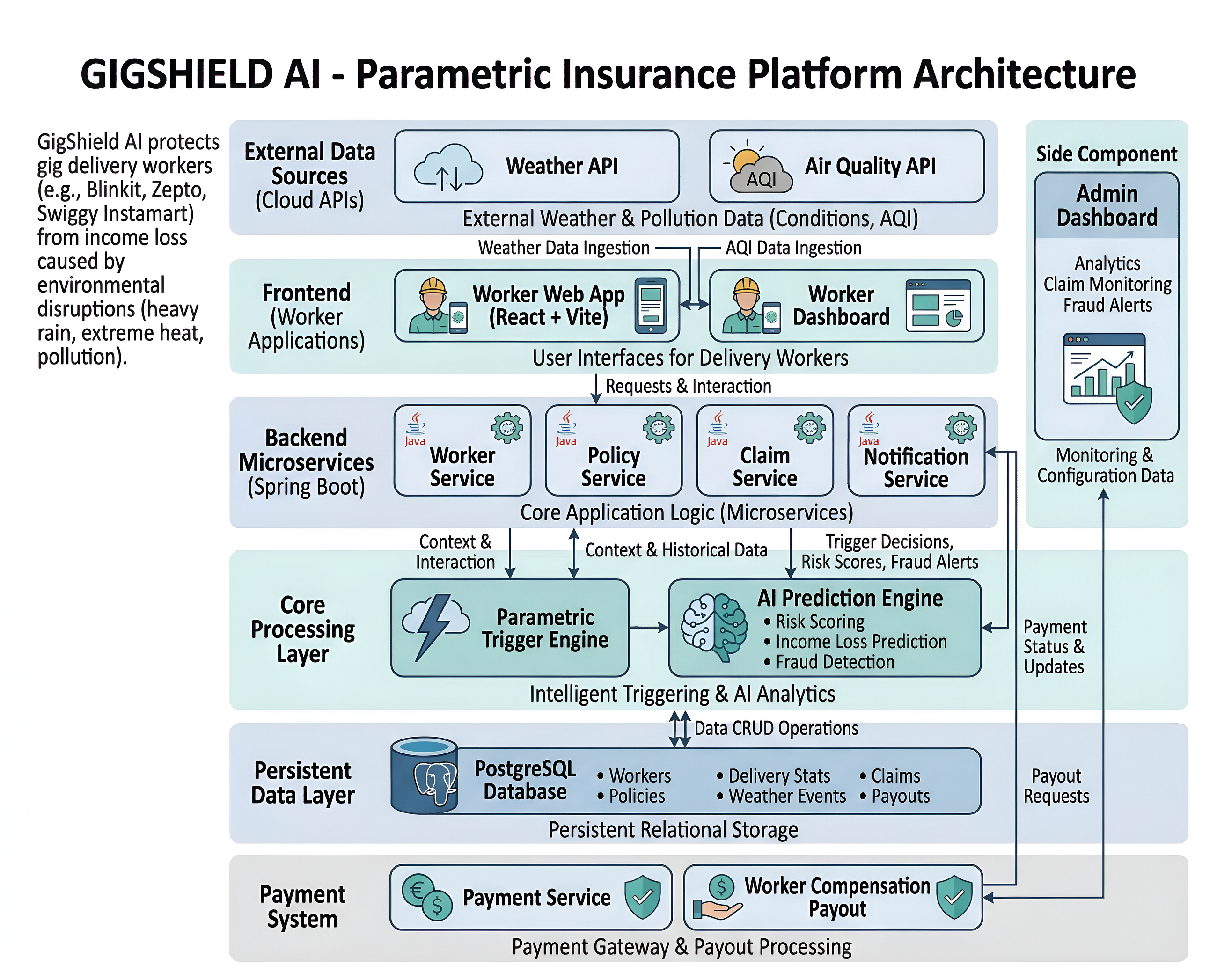
GigShield AI was built using modern full-stack and AI technologies:
Frontend
- React.js
- Vite
Backend
- Spring Boot Microservices (Java)
Database
- PostgreSQL
AI/ML
- Python
- Scikit-learn
APIs
- Weather API
- Air Quality (AQI) API
Architecture
- Microservices Architecture
- REST APIs for communication between services
AI Components and Machine Learning Models Used
GigShield AI is not just an insurance platform — it is a complete AI-driven risk analysis and decision-making system. The platform uses multiple Machine Learning models, where each model is responsible for solving a specific problem in the insurance workflow such as predicting income loss, detecting fraud, forecasting delivery demand, and calculating risk scores.
Below are the AI components used in GigShield AI:
1. Income Loss Prediction Service — XGBoost
This model predicts whether a gig worker is likely to face income loss due to environmental disruptions such as heavy rain, extreme heat, or high AQI.
XGBoost was chosen because it performs very well on structured/tabular data and provides high prediction accuracy.
2. Delivery Demand Forecasting Service — LSTM
This model forecasts delivery demand based on historical order data, weather conditions, time, and location.
LSTM (Long Short-Term Memory) is used because it is very effective for time-series forecasting and sequence data such as daily orders over time.
3. Dynamic Insurance Premium Service — Gradient Boosting
This model calculates dynamic insurance premiums based on worker risk level, environmental risk, and historical claim data.
Gradient Boosting helps in accurate risk-based pricing.
4. Fraud Detection Service — Isolation Forest
This model detects unusual or suspicious worker activity and prevents fraudulent claims.
Isolation Forest is used because it is very effective for anomaly detection.
5. Worker Risk Scoring Service — Random Forest
This model assigns a risk score to each worker based on:
- Location risk
- Weather risk
- Delivery consistency
- Claim history
Random Forest is used because it handles classification and risk scoring problems very well.
6. Weather Impact Prediction Service — Gradient Boosting
This model predicts how much weather conditions will impact delivery demand and worker income.
7. Claim Approval Recommendation Service — Logistic Regression
This model recommends whether a claim should be approved or rejected based on:
- Environmental data
- Worker activity
- Income drop
- Fraud risk score
Logistic Regression is used because it is simple, interpretable, and effective for binary classification (Approve / Reject).
8. Hyperlocal Risk Prediction Service — K-Means Clustering
This model groups locations into high-risk, medium-risk, and low-risk zones based on environmental and historical disruption data.
K-Means is used for clustering similar risk regions.
9. Early Disruption Detection Service — LSTM
This model detects early signs of disruption (like sudden demand drop due to weather changes) before major income loss occurs.
10. AI Explainability Service — SHAP
SHAP (SHapley Additive exPlanations) is used to explain AI model decisions.
This helps in:
- Explaining why a claim was approved or rejected
- Building trust with users
- Providing transparency in insurance decisions
Why Multiple AI Models?
Instead of using a single Machine Learning model, GigShield AI uses multiple specialized models where each model solves a specific problem. This makes the system:
- More accurate
- More scalable
- More reliable
- More transparent
- Better at fraud detection
- Better at risk prediction
This architecture is similar to real-world AI systems used in fintech, insurance tech, and large-scale platforms.
Key Innovation: Parametric Insurance Model
Traditional insurance works on manual claims and verification.
Parametric insurance, on the other hand, works based on predefined parameters.
In GigShield AI:
- If rainfall > threshold
- And delivery orders drop below threshold
- And worker is active
→ Then payout is automatically triggered.
This removes paperwork, reduces fraud, and ensures faster payouts.
Target Users
GigShield AI is designed for:
- Gig delivery workers
- Hyperlocal logistics workers
- Last-mile delivery partners
- Workers dependent on daily order-based income
Future Scope
GigShield AI can be expanded with the following features:
- Hyperlocal risk prediction using advanced AI models
- Dynamic insurance pricing based on risk levels
- Mobile application for workers
- Blockchain-based claim transparency
- Integration with real delivery platforms like Blinkit, Zepto, and Swiggy
Conclusion
GigShield AI aims to bring financial stability to gig workers by protecting them from income loss caused by environmental disruptions. By combining AI, real-time environmental data, and parametric insurance, the platform creates a smart, automated, and transparent insurance system tailored specifically for the gig economy.
This project demonstrates how technology can be used to solve real-world financial problems and create social impact through innovation.
Team
This project was developed by Team KLU DEV 2327 as part of the Guidewire DevTrails Hackathon.
Team Members:
- Suthapalli Chakradhar
- Sri Ram Saketh Surubhotla
- Bandaru Charan