Global Instability Triggers Crypto Sell-Off: Tracking Bitcoin’s Path to the $65k Level
--
Bitcoin faces a critical test at the $65,000 support level as geopolitical tensions and trade policy remarks spark market volatility. Discover why analysts see this as a pivotal inflection point for crypto in 2026.
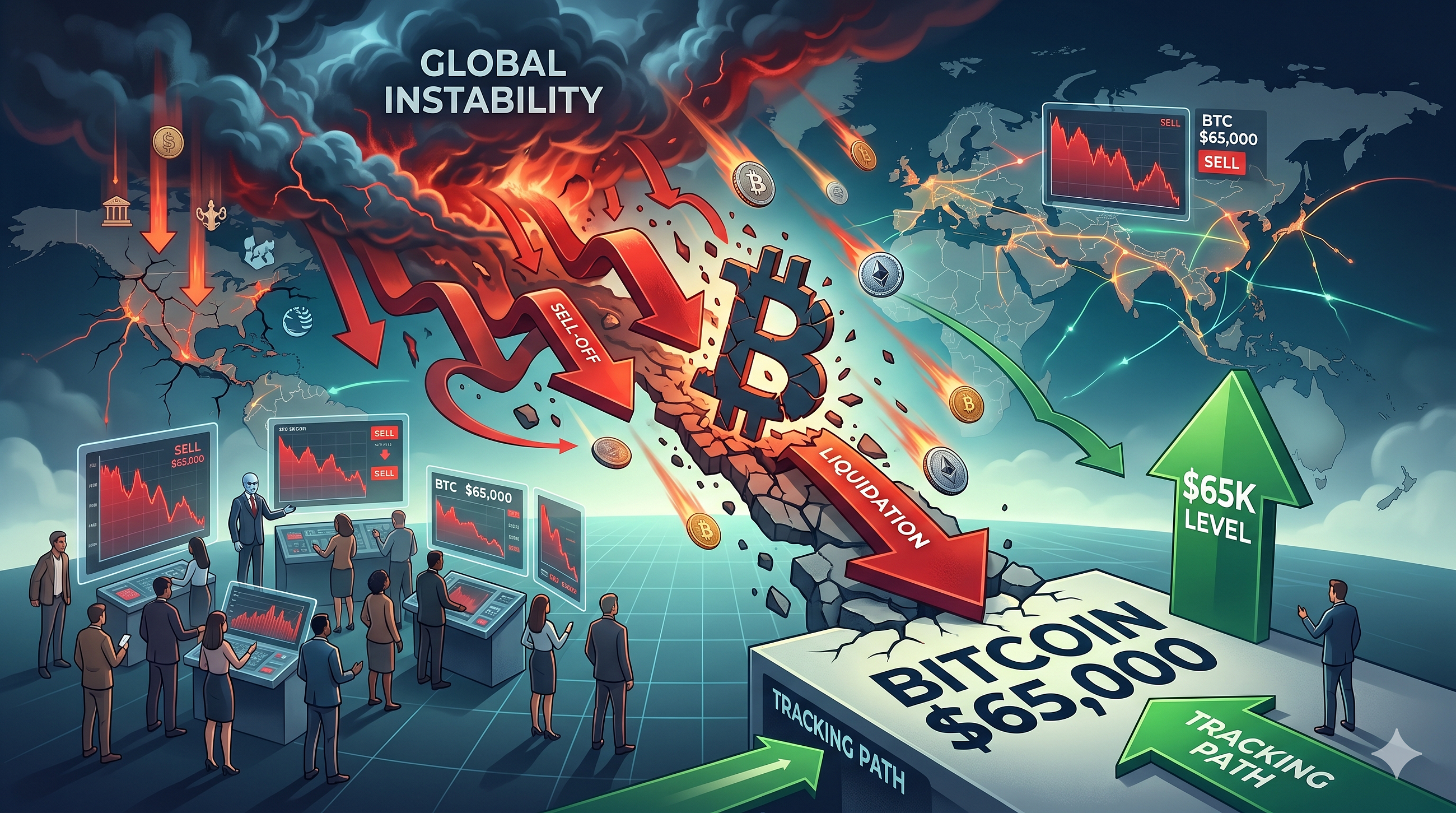
Geopolitics is shaking the crypto markets once again. Following official U.S. statements on rising tensions and new tariffs, Bitcoin tumbled below $68k as traders rushed to price in new macro risks. All eyes are now on the $65,000 support level — a “make or break” zone that could determine Bitcoin’s next major move. Navigating this volatility requires a deep dive into how global headlines intersect with technical price action.
The Trigger: Geopolitical Remarks and Market Reaction
The latest market shock was sparked by a combination of factors:
- Renewed rhetoric around potential U.S. actions in the Middle East, raising concerns about oil supply disruptions and broader regional instability.
- Comments on trade policy and tariffs that heightened fears of renewed inflation and delayed Federal Reserve rate cuts.
- A stronger U.S. dollar and rising Treasury yields, which typically pressure risk assets including Bitcoin.
Bitcoin reacted swiftly, falling from recent highs near $72,000 toward the $66,000–$67,000 zone. The move was amplified by leveraged liquidations and stop-loss cascades, a common occurrence when geopolitical headlines hit crypto markets. Gold, by contrast, rose as a traditional safe-haven, highlighting the divergent behavior between Bitcoin and classic defensive assets during periods of heightened uncertainty.
Bitcoin Price Analysis: The $65k Support Level
From a technical perspective, the $65,000 level stands out as a major support zone for several reasons:
- It aligns with previous swing lows from late 2025 and early 2026.
- On-chain data shows significant accumulation by large holders (whales) around the $64,000–$66,000 range during previous dips.
- The level coincides with a key Fibonacci retracement (0.618) from the rally off the 2025 lows.
- Psychological importance: $65k represents a round number that has acted as both support and resistance in past cycles.
If negative geopolitical sentiment persists, a retest of $65k is considered likely by many technical analysts. A decisive break below this level could open the door to deeper corrections toward $60,000–$62,000. Conversely, a strong defense of $65k — supported by increased buying volume and positive on-chain flows — could signal the start of a recovery toward $70,000 and beyond.
Current Bitcoin price analysis suggests the market is at a pivotal inflection point. The interplay between geopolitical headlines and technical levels will likely dictate short-term direction.
Crypto Geopolitical Impact: Why Headlines Move Bitcoin So Strongly
The crypto geopolitical impact has become increasingly pronounced in 2026 for several structural reasons:
- Bitcoin as High-Beta Risk Asset: Bitcoin often amplifies broader risk sentiment. When geopolitical remarks increase uncertainty, capital flows out of risk assets (including BTC) and into traditional safe-havens like gold and the U.S. dollar.
- 24/7 Market Nature: Unlike traditional equity markets, crypto trades continuously. Geopolitical news can trigger immediate reactions at any hour, often leading to exaggerated moves due to lower liquidity during off-peak times.
- Leverage and Liquidation Dynamics: High leverage in crypto futures markets means that even moderate headline-driven moves can trigger cascading liquidations, amplifying volatility.
- Institutional Sensitivity: As institutional participation grows, Bitcoin’s correlation with traditional risk assets has increased, making it more responsive to macro and geopolitical developments.
Historical examples — including earlier Middle East tensions and trade war escalations — show that Bitcoin tends to sell off sharply on negative geopolitical news but can recover quickly on de-escalation. The current environment follows this pattern, with the latest remarks creating short-term downside pressure while longer-term holders appear to be viewing dips as accumulation opportunities.
Market Volatility and Trading Insights
The recent geopolitical remarks have once again highlighted the elevated market volatility inherent in cryptocurrency trading:
- Short-Term Volatility Spikes: Expect continued sharp swings as new headlines emerge. Traders should prepare for rapid moves in both directions.
- Support Defense at $65k: Watch volume and on-chain accumulation metrics closely around the $65,000 level. Strong buying interest and declining exchange inflows would support a bullish defense.
- Risk Management: Reduce leverage during periods of high geopolitical uncertainty. Use wider stops or scale into positions gradually to manage slippage.
- Opportunity Identification: Dips driven by headline risk rather than fundamental deterioration can offer attractive entry points for longer-term investors, especially if whale accumulation continues.
- Macro Overlay: Monitor oil prices, DXY (U.S. Dollar Index), and Treasury yields alongside geopolitical developments. These remain the primary drivers of risk sentiment and Bitcoin price action.
For active traders, the current setup favors a tactical approach: respect technical levels, monitor geopolitical headlines closely, and maintain strict risk controls. Longer-term investors may view volatility around key supports as opportunities to add to positions in fundamentally strong assets like Bitcoin.
Conclusion
We’ve seen firsthand how sensitive Bitcoin is to global political remarks. As the market eyes the $65,000 level, the path forward rests on two things: geopolitical cooling and improved macro stability. For those trading these swings, the $65k mark is the ultimate line in the sand. Success in this volatile 2026 climate requires a sharp eye on the news, a solid grasp of technicals, and — most importantly — rigorous risk management.
Further Reading:
Geopolitical Conflicts with Bitcoin and Risk Assets: A Transitioning Narrative
Geopolitical Risk and Oil Price Fluctuations: How They Test Bitcoin’s Safe-Haven Property in 2026