Gas Fees in Blockchain
 Abban Nasra3 min read·Just now
--
The Hidden Fuel Behind Every Transaction
There is a moment every newcomer to crypto experiences.
Did you ever experience it?
You click confirm on a transaction, it could be a simple transfer, a token swap, or minting a digital asset. Then it shows a fee.
Not small. Not always predictable. And often confusing.
You ask yourself, Why should moving your own assets cost anything at all?
To understand this, you have to stop thinking of blockchain as just a ledger and start seeing it as a living system.
The World Behind the Screen.
Imagine a digital realm where every action becomes part of an eternal story.
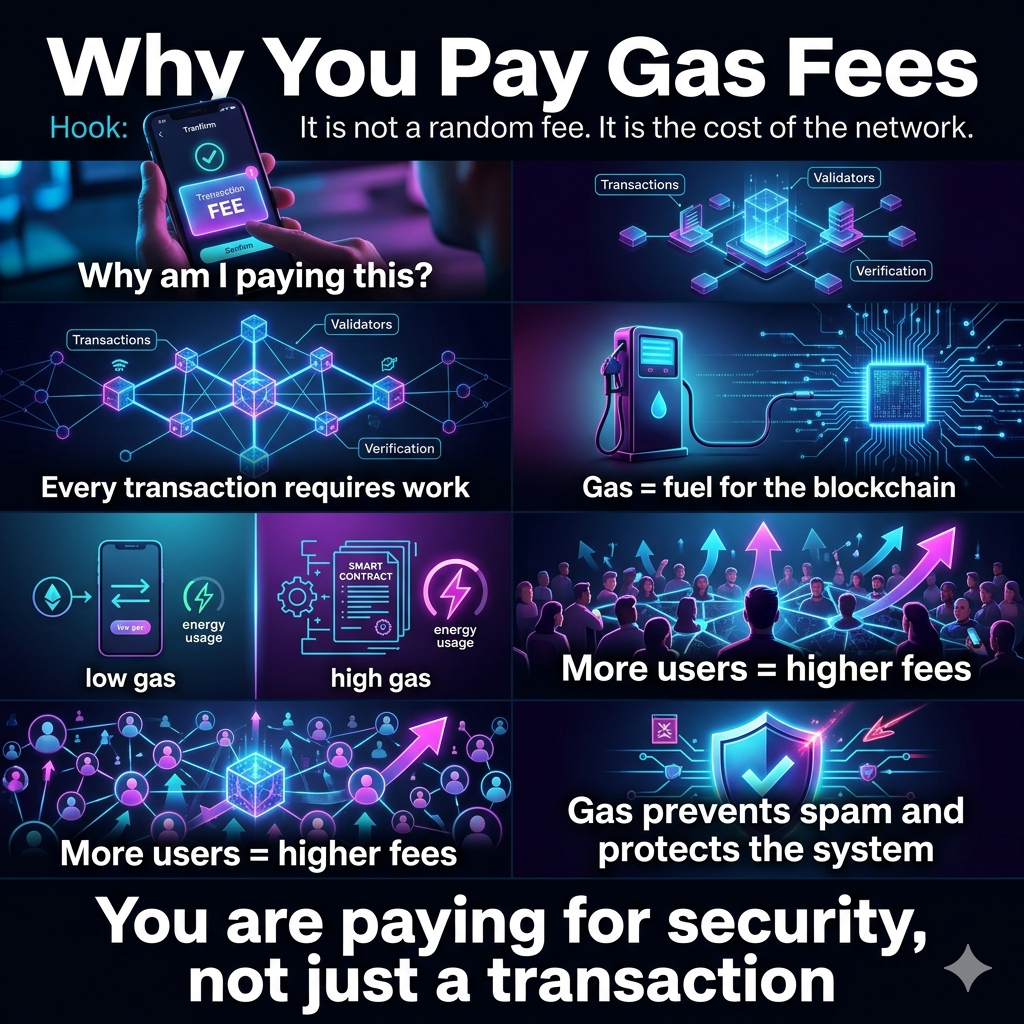
Every transfer, every contract, every interaction is recorded forever on a shared chain. This chain is maintained not by a single authority, but by a distributed network of validators. These are independent actors who verify, secure, and record every action.
They are not volunteers. They expend real computational power, infrastructure, and energy to keep the system running.
Gas is what compensates them.
The Cost of Writing History.
Think of every transaction as a story that must be written into a permanent record.
That writing requires effort.
A simple transfer is a short sentence. It requires minimal resources.
A complex smart contract interaction is an entire chapter. It demands more computation, more verification, and more space in the system.
Gas is the unit that measures this effort.
When you submit a transaction, you are effectively saying that
you are willing to pay for the resources required to include my action in the blockchain.
How Gas Fees Work.
Every transaction involves two key parameters.
- The gas limit, which represents how much computational effort your transaction may require.
- The gas price, which determines how much you are willing to pay per unit of that effort.
The total fee is calculated based on how much gas is actually used and the current network conditions.
Part of this fee is distributed to validators as a reward for processing transactions. Another portion, known as the base fee, may be permanently removed from circulation to maintain economic balance.
What happens when the Network Gets Busy?
On a quiet day, transactions move easily. Fees remain low because demand is limited.
But when activity increases, something changes.
More users compete to have their transactions processed. There is limited space in each block. Not every transaction can be included immediately.
This creates a market.
Users who want faster confirmation offer higher fees. Validators prioritize those transactions. As demand rises, so do costs.
It is no different from a busy city during rush hour. More traffic leads to higher prices for faster movement.
Why do Gas Exists?
Without gas fees, the system would not function.
There would be no incentive for validators to process transactions.
More importantly, there would be no protection against abuse.
Malicious actors could flood the network with meaningless transactions, overwhelming the system and bringing it to a halt.
Gas serves two critical roles.
-It rewards the participants who secure the network.
-It prevents spam by attaching a real cost to every action.
A Simpler Way to Understand It
You can think of gas in three ways.
-It is the fuel that powers your transaction.
-It is the toll paid to use a secure and decentralized network.
-It is the price of ensuring your action is recorded permanently and cannot be altered.
As blockchain technology evolves, new solutions are emerging to reduce these costs.
Layer two networks, scaling improvements, and more efficient designs are expanding capacity and lowering fees.
But the principle remains unchanged.
Every action on a decentralized system carries a cost, because every action requires real resources.
Finally.
Gas fees are often seen as a barrier.
In reality, they are what make the system possible.
They ensure that every transaction is verified, secured, and permanently recorded without relying on trust.
The next time you confirm a transaction, remember what you are paying for.
You are not just moving assets.
You are writing your action into a system that no one can control, censor, or erase.
And that permanence comes at a price.