Future DeFi Lending Competition: Stable Protocols vs. High-Efficiency Infrastructure
 Shelly7 min read·Just now
--
Future DeFi Lending Competition: Stable Protocols vs. High-Efficiency Infrastructure
TL;DR
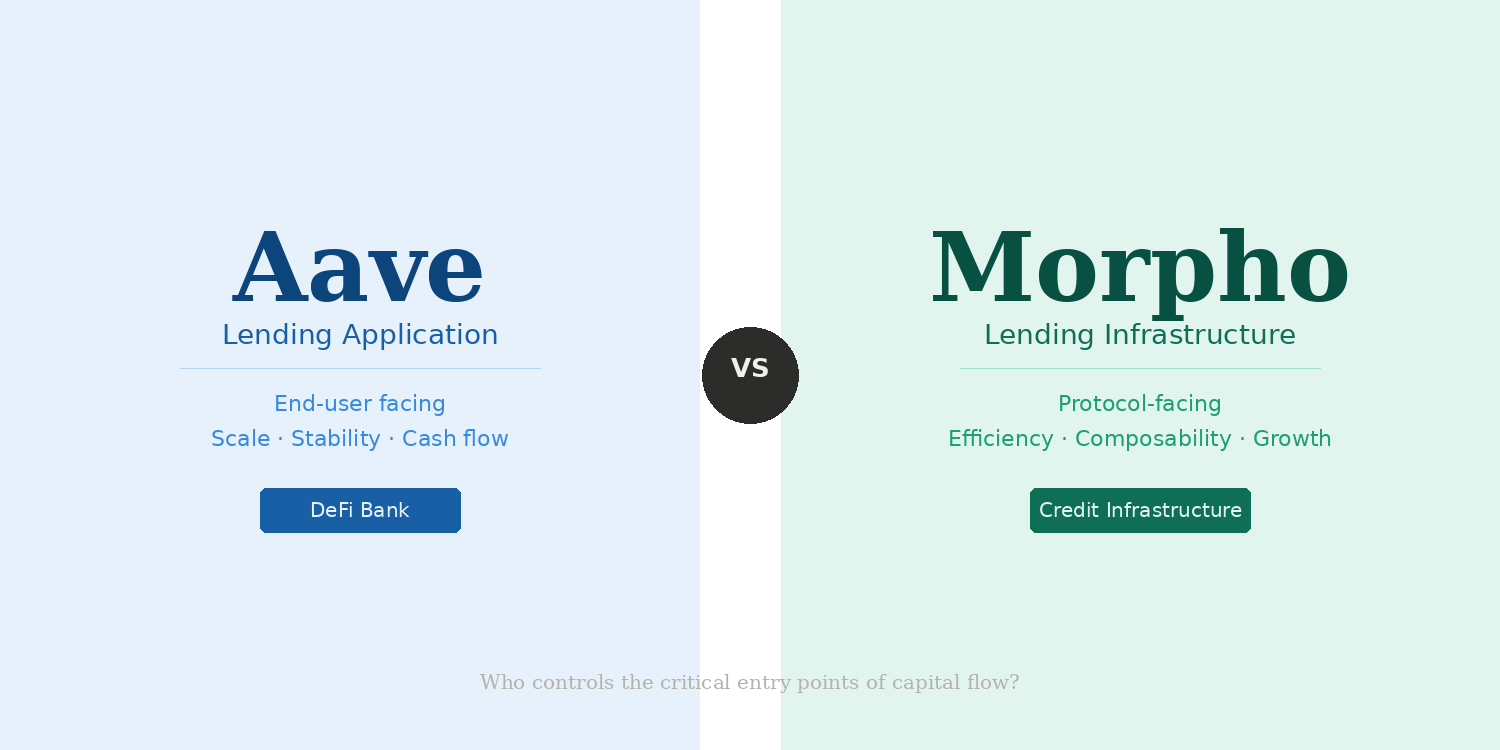
Aave and Morpho are both in the lending space — but they’ve chosen to occupy fundamentally different positions in the value chain, and that’s where the real competition lies.
- Aave serves as the entry point for end users, trading scale for stable cash flow (Take Rate 13.6%, annual net income +$99M)
- Morpho operates as the underlying infrastructure for other protocols, trading a 0% fee rate for network effects — capturing market share first, monetizing later
These represent two fundamentally different Go-to-Market strategies: one defending a proven moat, the other using subsidies to buy future pricing power.
The real competition isn’t about features — it’s about who controls the critical entry points of capital flow first.
The market is shifting from integrated products to modular finance, and the core battleground of the next cycle will be capital efficiency, not user experience.
Why did I choose this topic?
In the 2025–2026 DeFi development landscape, I’m particularly focused on the lending sector because it is one of the few areas that has already validated both real demand and stable revenue. Unlike many narratives still searching for product-market fit (PMF), lending protocols have begun generating substantial cash flow and have become a core component of DeFi’s capital ecosystem.
What’s interesting is that a protocol that is already profitable and dominates the market, and another that charges almost no fees yet rapidly attracts liquidity, are both growing simultaneously. Aave and Morpho are typical examples of this contrast. This made me wonder: in a market that has already been validated, is competition still just about the product itself? Or is it shifting toward capital efficiency, structural design, and even deeper protocol mechanisms?
What I Observed?
1. Product Positioning
Although both Aave and Morpho are part of the decentralized lending space, they exhibit clear structural differences in their product positioning. Their core distinction is not functionality but their role in the DeFi financial value chain.
Aave is positioned as a Lending Application, primarily targeting end-users (retail/DeFi users). It provides an integrated platform for deposits, borrowing, and interest rate mechanisms — a one-stop lending market. Users interact directly with the protocol to deposit and borrow assets, making Aave essentially a “full-service DeFi bank” that emphasizes liquidity integration, ease of use, and instant accessibility.
Morpho, in contrast, is positioned as Lending Infrastructure. Its core is not to build an end-user lending market but to provide composable lending primitives (e.g., P2P matching, Vault structures) for other protocols, asset managers, or institutions to create customized lending strategies and products. Morpho functions as “credit rails” or a “prime brokerage layer” in DeFi, emphasizing modular design, strategy flexibility, and composability.
2. Capital Efficiency
Aave ($6.1B Market Cap) maintains its position as a leading DeFi lending protocol, with $24.5B in TVL (~3.6x Morpho). This demonstrates a strong safety premium, with substantial idle capital under a 71.4% utilization rate as a buffer against shocks.
Morpho ($1.0B Market Cap), on the other hand, reflects market expectations for high growth from technological innovation. Through P2P matching, it boosts APY to 1.66% (significantly higher than Aave’s 0.66%). This “light-asset model” currently has a utilization of ~60.2%, and with a Market Cap/TVL ratio of only ~0.15, opening a fee switch in the future could unlock massive valuation upside by leveraging technical efficiency over idle capital.
3. Risk Architecture & Governance
Aave and Morpho differ significantly in risk design.
Aave uses a shared liquidity pool, with asset listing governed by the DAO and liquidation managed by the protocol. Risk is primarily implicit at the market level, with lower transparency. Users can only manage risk by choosing markets. Its liquidity risk is moderate, liquidation risk is stable, and asset allocation is conservative.
Morpho adopts a modular, isolated market and Vault strategy. Assets can be permissionlessly listed, and liquidation is handled at the market or Vault level. Risk is explicit and transparent, allowing strategy-level management. Liquidity and liquidation risks are higher, and asset allocation is more flexible.
4. Revenue Model
Both Aave and Morpho generate revenue mainly from lending. Aave’s Borrow Interest accounts for ~92% of revenue, with other minor sources making its income diversified. Morpho relies almost entirely on Borrow Interest and Liquidation Fees, with a single-source revenue structure.
- Aave: Take Rate ~13.6%, leaving revenue for token buybacks, holder dividends, or reinvestment. Token holder net income ~$42M, profitability +$99.34M — a mature, sustainable business model.
- Morpho: Take Rate 0%; revenue is pass-through; token holders cannot benefit directly; currently operating at a loss of approximately $32M, relying on incentives for growth.
My Insights
1. The Nature of Competition: It’s Not About the Product, but the “Position in the Value Chain.”
The difference between Aave and Morpho lies not in their features, but in the layers they occupy: Aave targets end users and generates revenue through scale and usage; Morpho, as underlying infrastructure, is integrated by other protocols and will profit through network capture in the future. This illustrates that the focus of competition is not on the product itself, but on who controls the capital inflow and value capture.
2. The Market Is Moving Toward “Unbundling.”
Traditional lending protocols (such as Aave) integrate liquidity, risk, interest rates, and user experience into a single product; Morpho breaks down lending capabilities into P2P matching, vaults, and strategy modules, creating composable financial building blocks. This indicates that the market is shifting from integrated products to modular finance, with value being redistributed across different layers.
3. Capital Efficiency Becomes the Core of the New Round of Competition
Aave’s strategy prioritizes security and liquidity, resulting in idle capital; Morpho optimizes efficiency but assumes greater risk and complexity. This is not a matter of superiority or inferiority, but a trade-off. It reflects that the market is increasingly willing to accept complexity in exchange for efficiency, and the competitive focus is shifting from “usability” to “efficiency optimization.”
4. Market Penetration Strategy: Trading Subsidies for Growth
Morpho currently has a 0% take rate, with revenue passed through, and remains unprofitable. However, this is a deliberate go-to-market strategy: first capture liquidity and establish network effects, then enable monetization (fee switch). In other words, the competition today is not about the product, but about “buying market share.”
5. Moat: Balancing Liquidity Scale and Efficiency
The core advantage lies in TVL and liquidity depth, which deliver low slippage and a stable trading experience, thereby creating a network effect. However, this also entails accepting inefficiency (idle capital), reflecting a strategic difference between defense and offense: a stable moat versus opportunities to attack efficiency.
As the PM of Those Products, How Would I Approach Their Development?
Aave
Phase 1: Consolidate Banking Position & Initial GHO Penetration
With lending market demand already validated and competition intensifying, Aave first focuses on consolidating its core advantage as a “one-stop DeFi bank” to prevent capital outflows. By optimizing user interaction and maintaining a stable take rate, while promoting the lending use cases of the native stablecoin GHO, Aave aims to establish liquidity and utility within its ecosystem, further increasing and stabilizing TVL.
Phase 2: Architecture & Efficiency Optimization
As the market sees protocols competing on capital efficiency, Aave seeks to reduce idle capital to maintain its competitive edge. Through architecture upgrades, introducing hybrid lending models, and integrating external strategies, capital utilization and yield are improved. Modular design and strategy separation are applied to address competitive pressures, prevent capital migration to higher-efficiency protocols, and further strengthen overall returns and capital efficiency.
Phase 3: Evolve into an Open Liquidity Hub
As the lending market matures, competition shifts from product features to control over capital inflows. Aave transitions from a standalone application to an underlying platform, opening its liquidity and GHO minting capabilities for use by other protocols and strategies. This evolution positions Aave as a liquidity hub within the DeFi ecosystem, expanding capital inflows, creating ecosystem dependency, and reinforcing long-term profitability and market leadership.
Morpho
Phase 1: Low-Fee Market Expansion & Liquidity Capture
With DeFi lending demand validated, the key competitive factor is which protocol can accumulate liquidity and usage more rapidly. Morpho maintains a low take rate, leveraging the high-yield advantages of P2P matching to attract capital. Its lending primitives are integrated across multiple protocol layers, quickly establishing network effects, expanding market share, and fostering user adoption.
Phase 2: Vault Ecosystem Development & Risk Transparency
As liquidity scales, the market increasingly values capital allocation efficiency and risk management. Morpho develops a Vault architecture, allowing strategy managers to compose markets and make risk explicit. P2P matching and automatic conversion with underlying pools are optimized, providing more flexible and transparent asset allocation compared to traditional pooled models, further enhancing Morpho’s appeal and scalability as a lending infrastructure.
Phase 3: RWA Integration & Ecosystem Expansion
As the on-chain lending market matures, new growth drivers come from off-chain assets and institutional capital. Morpho integrates traditional banking RWAs and off-chain credit assets, collaborating with institutions like Coinbase, Gemini, and Crypto.com, bringing these assets into its efficient matching engine. This expands the total addressable market (TAM) and strengthens Morpho’s role as a globally composable lending infrastructure, supporting continued ecosystem growth and long-term sustainability.
#Web3 #DeFi #Aave #Morpho #Blockchain #Fintech #Ethereum