From Statutes to Software: How Virtual Communities Will Rewire Governance
 Kevin Brazell9 min read·Just now
--
Author: Kevin Brazell
Date: September 2025
0. Abstract
As more of human life shifts into metaverses and virtual communities, the foundations of governance are being contested. For centuries, governments derived legitimacy from geography: people bound by territory accepted shared authority. But digital spaces (organized around values, identities, and code) are reshaping that foundation. This paper examines how the “governance stack” (identity, payments, infrastructure, standards, dispute resolution, and security) is being redistributed. The focus is not on governments disappearing, but on their primacy no longer being guaranteed. States, corporations, and virtual communities now compete to configure the rules, enforce norms, and deliver services once monopolized by states.
1. Introduction
For centuries, governments anchored human societies. Their authority was tied to land: people who lived together, traded together, and defended territory together accepted a common authority. That geographic basis is now under pressure. As more of daily life moves into virtual communities, metaverses, and digital platforms, the central functions of governance are migrating with it. These communities operate on shared values and digital identities rather than physical proximity. They already provide forms of identity, dispute resolution, and enforcement once monopolized by states.
The key question for the future is not whether governments vanish, but how power is contested across overlapping systems of governance. Who controls identity, payments, and infrastructure? Who sets standards and resolves disputes? The answers will increasingly come from corporations and virtual communities as much as from states. This paper explores that contest, using the governance stack framework to show where authority is shifting, how it is being challenged, and why the outcome will shape political order in the digital age.
2. The Governance Stack
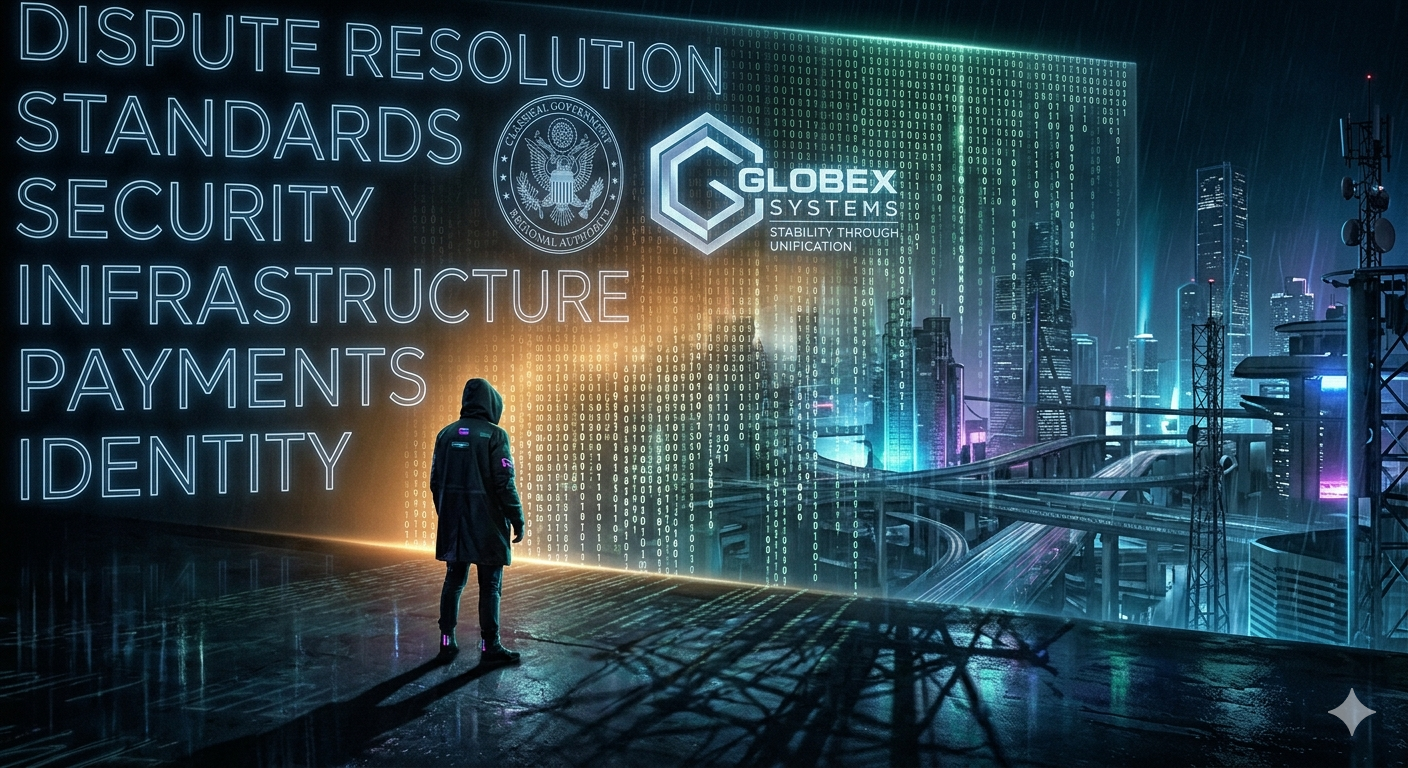
Governance is best understood as a stack of interlocking layers. Today, states dominate some layers, but others are already shifting to corporations and digital networks:
- Identity — passports, logins, digital credentials.
- Payments — fiat rails, stablecoins, crypto.
- Compute & Communications — ISPs, cloud, app stores, satellites.
- Standards & Compliance — regulations, app store rules, platform TOS.
- Dispute Resolution — courts, arbitration, platform bans.
- Coercion & Security — police, sanctions, account deactivation.
Every section that follows asks: who controls this layer now, and how can others capture it? This is where disruption comes from.
3. Fiction and Prototypes of Private Control
Snow Crash: Private Governance Imagined
In Neal Stephenson’s Snow Crash (1992), governments give way to corporations and franchise-nations, or burbclaves, that provide services like policing and zoning. Citizens become customers. The Metaverse functions as a global commons where contracts and code enforce order. Whoever controls identity, payments, dispute resolution, and security effectively governs, regardless of the state’s legal presence.
The Network State: A Digital Blueprint
Balaji Srinivasan’s The Network State (2022) provides a roadmap for building new polities digitally first: begin with a moral imperative, organize online, pool resources, and eventually negotiate recognition. Tools like cryptographic identity, crypto-finance, and DAOs already perform governance at scale. Projects like Praxis experiment with extending digital-first governance into the physical world.
Both fiction and theory highlight how communities not bound by geography can capture layers of the governance stack.
4. Privatization: Corporations Already Provide Governance
What once sounded like science fiction is already fact. Corporations control many governance functions today:
- Security: Studies reviewed by the Bureau of Justice Statistics show the private security workforce has rivaled, and in some years exceeded, the size of public police forces ([BJS, 2010]).
- Prisons: Roughly 90,873 U.S. prisoners (about 8% of the state and federal total) were in for-profit facilities in 2022 ([Sentencing Project, 2024]).
- Arbitration: About 55% of U.S. private-sector, nonunion workers were covered by mandatory arbitration clauses as of 2017–2018 ([EPI/Colvin, 2018]).
- Infrastructure: PPPs manage airports, toll roads, and utilities ([Brookings, 2019]; [OECD, 2020]).
- Policy influence: Corporate lobbying exceeded $4 billion in 2024, shaping law as much as legislatures. ([OpenSecrets, 2025]).
The state’s role as sole provider of governance is already fractured. Authority is distributed, contested, and shifting.
5. Virtual Communities as Lawgivers
Platforms govern billions of people daily:
- Identity: Single-sign-on systems like Apple ID and Google Sign-In function as de-facto digital identity for billions of user sessions monthly.
- Payments: Payment networks and processors can block transactions at policy speed, exerting immediate global control. Stablecoins such as USDC have reported multi-trillion-dollar annual throughput, with daily on-chain volumes in the billions ([Visa, 2025]).
- Dispute resolution: Content moderation decisions remove speech for billions instantly. Account bans can cut off livelihoods.
Lawrence Lessig’s phrase “code is law” (1999) describes this: software enforces rules automatically. Danah Boyd describes “networked publics” bound by shared norms online. Castells’ “network society” shows power shifting from territories to flows.
The core functions of governance (identity, enforcement, legitimacy) are already migrating into virtual and corporate domains.
6. State Levers: Still Potent, But Intermediated
States retain power, but their levers are intermediated:
- Infrastructure: ISPs, cloud, app stores. Example: Apple App Store rules enforce policy globally within hours.
- Law: On April 23, 2025, the EU fined Apple €500M and Meta €200M for DMA violations, forcing product changes worldwide ([European Commission, 2025]).
- Finance: FATF’s June 2025 update pressed countries to implement the Travel Rule, requiring exchanges to collect and transmit sender/recipient identity ([FATF, 2025]).
- Sovereignty: On Jan 17, 2025, the U.S. Supreme Court (№24–656) upheld a law requiring TikTok to divest or face a nationwide ban ([SCOTUS, 2025]). China has banned most cryptocurrency transactions while promoting its e-CNY ([CFR, 2024]).
These tools matter, but enforcement runs through intermediaries. Whoever owns the intermediaries owns practical power. And intermediaries can be captured.
7. Mechanisms of Capture by Virtual Communities
Virtual communities and corporate alliances are already taking over stack layers:
- Standard-setting: WebAuthn and W3C Verifiable Credentials set identity standards outside governments which are used in applications supporting hundreds of millions of users today ([The Verge, 2024]; [Descope, 2023]).
- Procurement/privatization: Amazon and Microsoft operate GovCloud environments that host critical state workloads.
- Compliance wrappers: In the Blockchain realm, Zero-knowledge proofs allow AML compliance without revealing identity.
- Intermediary dominance: Cloudflare’s Project Galileo protects 2,900+ public-interest sites and its election-security program shields state and campaign sites ([Cloudflare, 2025]).
- Mutual recognition: Arbitration rulings under the New York Convention enforce private law across borders.
- Communications sovereignty: As of April 2025, Ukraine had received 50,000+ Starlink terminals; outages showed the country’s reliance on a private network for wartime communication ([Reuters, 2025]).
These are not hypotheticals. They are working examples of how virtual communities and corporations already configure governance.
7. Cryptocurrencies and the Monetary Challenge
Cryptocurrencies offer more than just new payment rails. They enableopt-outs from government-controlled money in a way that was never possible before. Tools like Tornado Cash show that people can obscure their money flows, maintain privacy, and conduct financial actions outside state gazes. Tornado Cash, created in 2019, lets users “mix” crypto via smart contracts: funds deposited by many people are pooled, then withdrawn by different addresses using cryptographic proofs so that origins cannot be traced.
Governments respond by sanctioning protocols or their founders: in 2022, the U.S. Treasury’s OFAC sanctioned Tornado Cash for allegedly laundering over $7 billion, including hacks and state-sponsored thefts. But in a legal check, a U.S. court later ruled that OFAC had gone beyond its authority by sanctioning immutable smart contracts, since they do not qualify as “property” under existing law. These events show a tug-of-war: crypto technologies inherently weaken monetary control, but legal and infrastructural countermeasures are rising in parallel.
If people can control their money without depending on state-issued currency (or convert in and out without identity-gating), then one of the core levers of governance (taxation, capital control, and monetary policy) is attenuated. The control plane of payments is shifting, and this shift has consequences for state power, legitimacy, and coercion.
8. Exit Creates Substitution, Not Freedom
Opting out of the state does not mean opting out of governance. The vacuum is quickly filled by platforms, protocols, and corporations that impose their own rules. Leaving behind state taxation may only mean accepting fees and conditions baked into smart contracts. Exiting speech regulation by governments often means living under the stricter reach of platform moderation and algorithmic enforcement. Even security is not absent. Those who leave state protection often rely on private security firms or digital intermediaries like Cloudflare.
The result is substitution rather than freedom. Users trade one form of governance for another, often less accountable one. Inequality emerges because not everyone has equal ability to choose their governance system. Wealthy individuals and organizations can design or select the regimes that suit them, while others are subject to whichever corporate or community system dominates their digital life. Governance is therefore stratified, not absent: exit reconfigures the power map but does not erase it.
9. Resilience of States: Counterweights to Corporate and Virtual Power
States are not fading quietly. No digital nation or network state gains recognition without negotiating with traditional powers. In moments of crisis, governments remain unmatched in mobilizing people and resources, drafting soldiers, or imposing sanctions. Regulation also reminds corporations that the state’s authority endures: the U.S. Supreme Court compelled TikTok to divest, China banned most crypto while promoting its e-CNY, and the EU forced Apple and Meta into compliance under the Digital Markets Act.
Even infrastructure ties back to states. Ukraine’s reliance on Starlink during war showed both the utility of private systems and the vulnerability of depending on them. Likewise, U.S. and allied governments contract with Amazon and Microsoft for GovCloud, ensuring that even corporate systems remain embedded in sovereign oversight.
The balance is shifting, but governments still matter. Through sovereignty, coercion, regulation, and infrastructure, they remain formidable actors that corporations and virtual communities cannot ignore.
10. From Local Geographies to Virtual Values
Historically, states formed around geography. Tilly argued “war made the state, and the state made war” ([Tilly, 1985]). Scott showed states sought to render land and people legible ([Scott, 1998]). Anderson called nations “imagined communities” created by shared narratives ([Anderson, 1983]).
Today, digital networks extend Anderson’s logic. Shared values and constant interaction online allow communities to imagine themselves as a people without land. AI and blockchain provide the trust infrastructure to sustain these identities.
The basis of political order is shifting from shared land to shared values, and the control plane is gearing up to follow as technology enables it.
11. Conclusion: Governance as a Contest
Governance is no longer a settled order defined by geography. It is a contested space where states, corporations, and virtual communities compete for authority. States still wield sovereignty, law, and coercive force, but they no longer hold an uncontested monopoly over identity, payments, and infrastructure. Corporations and virtual platforms increasingly set rules, enforce norms, and resolve disputes for billions of people, while digital communities experiment with entirely new models of governance.
Governance is no longer something that happens “out there” in Washington or Brussels. It is happening inside platforms, protocols, and contracts you already depend on. For business leaders, policymakers, and citizens alike, the challenge is recognizing that governance is no longer anchored solely in statutes. It is being rewritten in software.
References (Selected)
· Anderson, B. (1983). Imagined Communities. Verso.
· boyd, d. (2010). “Social Network Sites as Networked Publics.” In Networked Self. Routledge.
· Brookings Institution (2019). “Public-Private Partnerships: Lessons Learned.”
· Bureau of Justice Statistics (2010). The Private Security Industry: A Review of the Definitions, Available Data Sources, and Paths Moving Forward.
· Bureau of Justice Statistics (2023). “Prisoners in 2022.”
· Castells, M. (1996). The Rise of the Network Society. Blackwell.
· CFR (2024). “China and Cryptocurrency Regulation.” Council on Foreign Relations brief.
· Cloudflare (2025). Project Galileo and Election Security program materials.
· Colvin, A. (2018). “The Growing Use of Mandatory Arbitration.” Economic Policy Institute.
· DeFiLlama (2025). DAO Treasury trackers.
· Descope (2023). “WebAuthn vs FIDO2: What’s the Difference?” Descope blog.
· European Commission (2025). DMA non-compliance decisions regarding Apple and Meta.
· FATF (2025). Targeted Update on Implementation of the FATF Standards on Virtual Assets and VASPs (Travel Rule guidance).
· Gilens, M. & Page, B. (2014). “Testing Theories of American Politics.” Perspectives on Politics.
· ITU (2023). Facts and Figures 2023: Measuring Digital Development.
· Lessig, L. (1999). Code and Other Laws of Cyberspace. Basic Books.
· OECD (2020). “Privatization and Public-Private Partnerships.”
· OpenSecrets (2025). “Lobbying Totals by Year.”
· Pew Research (2024). “Internet/Broadband Fact Sheet.”
· Reuters (2025). Coverage of Starlink deployment and outages in Ukraine.
· Scott, J. (1998). Seeing Like a State. Yale University Press.
· SCOTUS (2025). TikTok Inc. v. Garland, №24–656 (Jan 17, 2025).
· Shultz, J. (2003). Cochabamba Water War: The Resource Struggle of the 21st Century.
· Srinivasan, B. (2022). The Network State.
· Stephenson, N. (1992). Snow Crash. Bantam.
· The Verge (2024). “Google says 400 million accounts have used passkeys.” The Verge, May 2, 2024.
· Tilly, C. (1985). “War Making and State Making as Organized Crime.” In Bringing the State Back In.
· Visa (2025). On-chain analytics dashboards and issuer disclosures on stablecoin throughput.