Five data sources say the same thing about bitcoin market. It's thinning from the inside
CryptoQuant data shows overall bitcoin demand is contracting at -63,000 BTC per month even as institutional buyers accelerate purchases, with large holders distributing nearly 188,000 BTC over the past year.
By Shaurya Malwa|Edited by Omkar Godbole Apr 4, 2026, 11:30 a.m. Make preferred on
What to know:
- Institutional buyers, including ETFs and Strategy, are accumulating bitcoin near record levels, but broader market selling from whales, miners and other holders is overwhelming that demand.
- Multiple on-chain and sentiment indicators show a thinning demand structure, with large holders aggressively distributing, U.S. institutional appetite muted and bitcoin trading only about 21 percent above its realized price.
- Analysts say bitcoin's smaller, roughly 50 percent drawdown from its 2025 peak suggests a maturing market that may avoid a classic capitulation bottom, leaving prices dependent on whether ETF and advisory channels can keep absorbing ongoing supply.
The most visible bitcoin buyers in the world are buying at near-record pace. It is not enough.
A CryptoQuant weekly report showed overall 30-day apparent demand at negative 63,000 BTC as of late March, meaning the broader market is selling far faster than institutions can absorb. ETF purchases hit approximately 50,000 BTC in the rolling 30-day window, the highest since October 2025. Strategy's accumulation held steady at roughly 44,000 BTC. Together, the two largest institutional channels absorbed about 94,000 BTC in March.
If institutions bought 94,000 BTC and net demand is still negative 63,000, the rest of the market — such as retail, older whales, miners, funds — sold approximately 157,000 BTC in the same period.
At least four other independent indicators are pointing in the same direction.
The whale reversal
Large holders, wallets with 1,000 to 10,000 BTC, have turned from the market's biggest buyers into its biggest sellers on a scale CryptoQuant describes as one of the most aggressive distribution cycles on record.
A year ago, these wallets were collectively adding 200,000 bitcoin to their holdings. Today they are collectively removing 188,000. That is a nearly 400,000 BTC swing from accumulation to distribution in roughly 18 months.
Mid-tier holders, wallets with 100 to 1,000 BTC, are still technically accumulating but the pace has collapsed more than 60% since October 2025, from nearly 1 million BTC in annual additions to 429,000. They haven't stopped buying. They've dramatically slowed down.

The realized price compression
Bitcoin's spot price at in the $67,000-$68000 range sits 21% above its realized price of $54,286, the average cost basis of every coin on the network weighted by its last transaction. That means the average holder is still in profit, which historically means the market has not bottomed, as CoinDesk noted earlier in the week.
In 2022, the signal that marked the actual cycle low was spot falling below realized price. Bitcoin traded under its aggregate cost basis from June through October of that year, and the deepest point, roughly 15% below realized, coincided almost exactly with the low near $15,500.
The current setup is not that. But the gap is closing fast. In late 2024, when bitcoin traded above $119,000, the premium to realized price was roughly 120%. That has compressed to 21% in about 15 months, one of the fastest approaches to the realized price line outside of outright crashes.
The sentiment disconnect
The Fear and Greed Index has been stuck between 8 and 14 for the past month, deep in extreme fear territory. Yet bitcoin ETFs drew over $1 billion in net inflows in March.
That combination of extreme fear alongside strong institutional buying is unusual. It means the flows are not translating into broader confidence, but that institutions are buying into a market that the rest of the participants do not want to be in.
The widely-followed Coinbase Premium Index reinforces this. The metric, which measures whether bitcoin trades at a premium or discount on Coinbase relative to other exchanges and serves as a proxy for U.S. institutional appetite, has been persistently negative since bitcoin's all-time high above $126,000 in early October 2025. Even with prices in the $65,000 to $70,000 range, American buyers have not stepped back in at scale.

The war pattern
The behavioral explanation for the demand drain is visible in the price action of the past five weeks. Bitcoin has spent the entire Iran conflict grinding between $65,000 and $73,000, selling on every escalation headline, rallying on every de-escalation headline, and ending up roughly where it started. Monday's 4% equity rally on ceasefire optimism gave back by Wednesday after Trump's address promised to hit Iran "extremely hard."
The pattern of hope, headline, reversal repeats with such regularity that the dominant strategy has become not to have a position at all. That shows up in the demand data as gradual withdrawal rather than panic selling.
The drawdown is compressing, not ending
The current drawdown from October's all-time high above $126,000 is roughly 47%, significantly less severe than the 84% to 87% crashes that followed the 2013 and 2017 peaks. Fidelity Digital Assets analyst Zack Wainwright noted in late March that bitcoin's growth is becoming "less impulsive," with a reduced probability of extreme downside events as the asset matures.
"Bitcoin's drawdowns compressing to about 50% is a sign of a maturing market structure," said Jason Fernandes, co-founder and market analyst at AdLunam. "As liquidity deepens and institutional participation increases, volatility naturally compresses on both the upside and the downside.
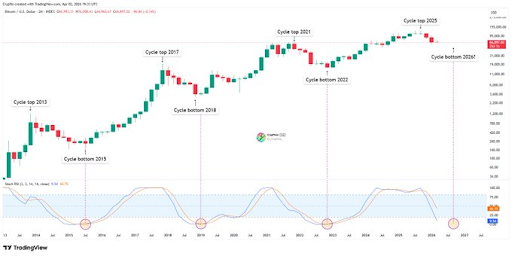
The drawdown compression framing matters for the demand data. If bitcoin is maturing into an asset where 50% corrections replace 85% crashes, then the current contraction may not resolve with the violent capitulation flush that marked previous cycle bottoms.
What could change this
Two catalysts sit on the near-term horizon.
Morgan Stanley received approval this week for a bitcoin ETF charging just 14 basis points, 11 below the category average. The product opens access to 16,000 financial advisors managing $6.2 trillion, a channel that has not previously had direct bitcoin ETF exposure.
Strategy's STRC preferred equity product saw hundreds of millions in inflows around its recent ex-dividend date, providing the funding mechanism for its 44,000 BTC monthly accumulation. If that repeats and accelerates each month, it adds a new source of sustained buying pressure.
However, it would remain a single company running a leveraged bitcoin strategy.
CryptoQuant's own report identifies a potential short-term bounce toward $71,500 to $81,200 if the Iran conflict de-escalates, corresponding to the Lower Band and Trader On-chain Realized Price resistance zones.
These two metrics track the average cost basis of short-term and active traders respectively, and that have historically acted as ceilings during bear market rallies. Bitcoin currently trades below both.
The read across all five data sources is that bitcoin's demand structure is thinning from the inside.
That does not mean the current range floor breaks, but that the floor depends entirely on whether ETFs, Strategy, and the new Morgan Stanley channel can continue absorbing what the rest of the market is trying to get rid of.
More For You
Encryption Supremacy: Zcash and Privacy in the Age of Scale
By CoinDesk ResearchMar 31, 2026 Commissioned byGenZcash
Most crypto privacy models weaken as blockchain data grows. Encryption-based models like Zcash strengthen. CoinDesk Research maps the five privacy approaches and examines the widening gap.
Why it matters:
As blockchain adoption scales, the metadata available to machine learning models scales with it. Obfuscation-based privacy approaches are structurally degrading as a result. This report provides a comprehensive comparison of all five major crypto privacy architectures and a framework for evaluating which models remain durable as AI capabilities improve.
View Full ReportMore For You
What next as XRP rises to $1.33 but fails to break out
By Shaurya Malwa19 hours ago
Price tracks broader crypto flows, with range-bound structure intact until $1.35 breaks.
What to know:
- XRP is trading around $1.33 in a tight range, with price action closely tracking the broader crypto market and showing little independent strength.
- Trading volume is about 23 percent above its weekly average, but the lack of a breakout suggests traders are positioning rather than committing.
- The token remains range-bound...

Judge continues Nevada ban on Kalshi sports markets
4 hours ago
Here's what 'cracking' bitcoin in 9 minutes by quantum computers actually means
9 hours ago
Schwab plans spot bitcoin, ether trading launch in first half of 2026
16 hours ago
Circle under fire after $285 million Drift hack over inaction to freeze stolen USDC
16 hours ago
What next as XRP rises to $1.33 but fails to break out
19 hours ago
CoinDesk 20 performance update: Bitcoin (BTC) trades flat while altcoins rise
22 hours agoTop Stories
U.S. March jobs smash expectations, with 178,000 added
23 hours ago
The 'time pain' trap: why bitcoin’s bear market might need a few more months of ‘boring’ to hit a true floor
Apr 2, 2026
Ethereum Foundation stakes another $93 million ether, reaching its 70,000 ETH target
Apr 3, 2026
CFTC sues Illinois, Arizona, Connecticut over states' sports prediction market efforts
Apr 2, 2026
Coinbase wins initial bank regulator nod for trust charter, boosting custody push
Apr 2, 2026