Fighting Synthetic Fraud: How AI-Driven Digital Identity is Saving High-Risk Onboarding in 2026
--
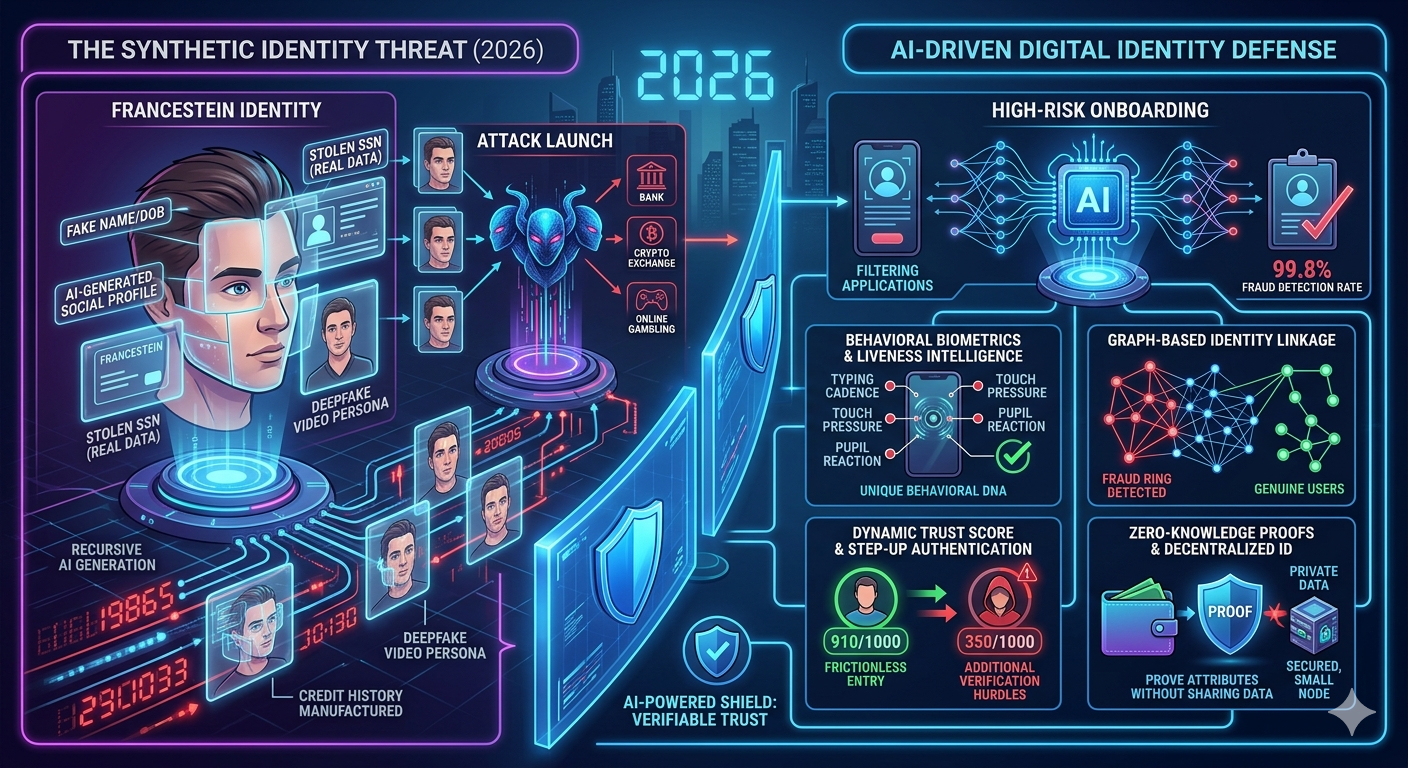
The digital landscape of 2026 is a far cry from the early 2020s. As we move deeper into the “AI Identity Era,” the line between human and machine has blurred, creating a playground for a new breed of criminal: the synthetic identity. Synthetic fraud — the process of combining real and fake information to create entirely new, “Frankenstein” identities — has become the weapon of choice for global crime syndicates. In 2026, these actors use Generative AI to craft credit histories, social media footprints, and even deepfake video personas that can bypass traditional KYC (Know Your Customer) checks with ease. For high-risk sectors like fintech, online gambling, and crypto exchanges, the stakes have never been higher. Yet, in this arms race, the same technology used to attack is being harnessed to defend.
The Rise of the “Frankenstein” Identity
The evolution of synthetic fraud has moved past simple data manipulation. In 2026, fraudsters use “Recursive Identity Generation,” where AI models learn from rejected applications to create more “authentic” fake personas. Traditional verification methods, which relied on static data points like credit scores or utility bills, are largely obsolete because these data points can now be manufactured over a three-year period by automated bots. High-risk onboarding — where the volume of transactions and the speed of approval are critical — is the most vulnerable. If a crypto platform takes three days to verify a user, they lose the customer; if they take three seconds using old methods, they risk onboarding a synthetic bot that will eventually “bust out,” stealing thousands in credit or laundering illicit funds.
Behavioral Biometrics: The New Human Signature
To combat this, the industry has shifted toward “Behavioral Biometrics and Liveness Intelligence.” In 2026, identity is no longer about what you know (passwords) or what you have (an ID card), but how you interact with the digital world. AI-driven onboarding systems now analyze micro-gestures during the registration process. This includes the angle at which a user holds their phone, their typing cadence, and how their pupils react to light during a video selfie. Because synthetic identities are often managed by scripts or human operators managing hundreds of accounts, their “behavioral DNA” is distinct from a genuine user. These AI systems can detect the subtle lag of a deepfake injection or the robotic precision of an automated form-filler, stopping fraud at the front door without human intervention.
Graph-Based Linkage and Global Immunity
Another cornerstone of the 2026 defense strategy is “Graph-Based Identity Linkage.” Fraudsters often reuse certain “clean” data points — like a specific IP range, a modified physical address, or a common device fingerprint — across multiple synthetic identities. Advanced AI models now map these connections in real-time, visualizing a web of related accounts that would appear independent to a human auditor. When a new user attempts to onboard, the AI instantly runs a graph analysis across trillions of global data points. If the “new” user shares a digital heartbeat with a known fraud ring in another country, the system triggers an immediate block. This collective intelligence allows high-risk platforms to benefit from a “global immunity” effect, where a fraud attempt on one platform strengthens the defenses of all others.
Dynamic Trust Scores and Step-Up Authentication
The “Trust Score” has also undergone a radical transformation. In the past, a trust score was a rigid number based on financial history. In 2026, it is a dynamic, AI-calculated metric that evolves every second. During the onboarding flow, the AI gathers “alternative data” — ranging from the age of a user’s email account to the consistency of their digital footprint across various platforms. For high-risk onboarding, this allows for “Step-Up Authentication.” A user with a high-trust score might enjoy a “frictionless” entry, while a suspicious profile is funneled through additional layers of AI-led questioning or document verification. This creates a balanced ecosystem where legitimate users are welcomed instantly, but synthetic entities are trapped in a maze of verification hurdles.
Zero-Knowledge Proofs and the Privacy Paradox
Privacy, however, remains the elephant in the room. As AI systems become more invasive to detect fraud, the industry has turned to “Zero-Knowledge Proofs” (ZKPs) and decentralized identity (DeID). In 2026, high-risk platforms are increasingly moving away from storing sensitive user data. Instead, AI-driven digital wallets allow users to prove their identity without sharing the underlying data. For example, a user can prove they are over 18 and have no credit defaults without revealing their exact birth date or bank balance. The AI verifies the “proof” rather than the “data,” significantly reducing the risk of data breaches. This shift is crucial because the very data stolen in yesterday’s breaches is the raw material for today’s synthetic fraud.
Predictive Onboarding: Stopping Fraud Before It Starts
Looking ahead, the battle for digital identity will only intensify. We are entering an era of “Autonomous Identity Management,” where AI agents act as intermediaries for human users, managing their digital credentials and protecting them from identity theft in real-time. For high-risk businesses, the goal is no longer just to “detect” fraud, but to “predict” it. Predictive AI models are now being trained to identify the early stages of a synthetic identity’s lifecycle — often months before they even attempt to onboard. By analyzing the patterns of how these fake identities are “nurtured” on social media and credit forums, AI can blacklist them before they ever reach a checkout or a registration page.
Conclusion: Survival in the AI Era
The AI Identity Era is defined by a paradox: AI is the greatest threat to identity security, and yet it is the only tool capable of saving it. For high-risk sectors, the transition to AI-driven digital identity isn’t just an upgrade; it is a matter of survival. By moving away from static checks and toward behavioral intelligence, graph analysis, and decentralized proofs, we are finally building a digital world where trust is verifiable and synthetic fraud has nowhere to hide. As we navigate 2026, the victory in this war won’t be won by the side with the most data, but by the side with the most intelligent way to interpret it.
#AIIdentity #SyntheticFraud #DigitalIdentity #Fintech2026 #CyberSecurity #KYC #Biometrics #DeepfakeDefense #BlockchainIdentity #FutureOfTech