Every Social Media Algorithm Is Optimizing Something. Most People Don’t Realize What.
And the difference between them quietly shapes what we see, create, and believe
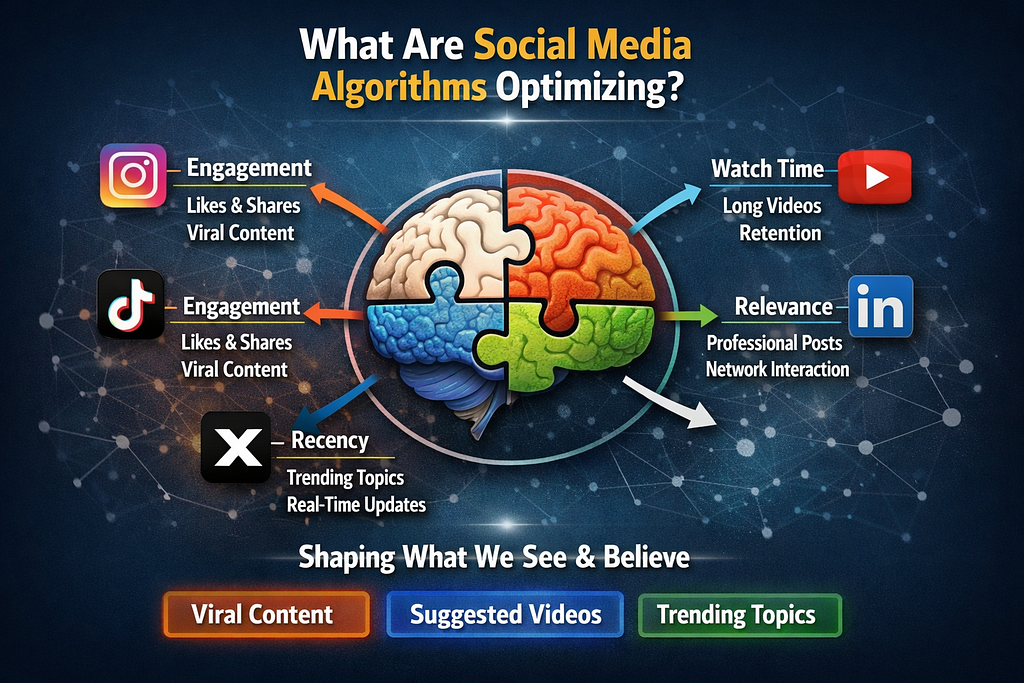
For most users, social media algorithms feel unpredictable. Some posts receive attention almost instantly, while others disappear without explanation. It is easy to assume that visibility is random, or worse, unfair. But underneath that perception lies a system that is not random at all.
Every major platform is driven by an algorithm that is doing exactly what it was designed to do. The problem is not that these systems are unclear. The problem is that most people misunderstand what they are optimizing for.
Once that becomes clear, the behavior of each platform — whether it is Instagram, TikTok, YouTube, LinkedIn, or Twitter (X) — begins to make sense.
There was a time when social media feeds were chronological. Content appeared in the order it was posted, and visibility was largely a function of timing. That model was simple, but it did not scale with the explosion of content.
As platforms grew, they introduced ranking algorithms — systems designed to decide what content users should see first. These algorithms rely on signals such as engagement, relevance, watch time, and user behavior patterns.
At first glance, these signals seem similar across platforms. But the way they are prioritized differs in subtle ways, and those differences define the identity of each platform.
On platforms like Instagram and TikTok, the algorithm is heavily optimized for engagement. It tracks how users interact with content — likes, shares, watch time, replays — and uses these signals to predict what will keep attention for longer periods.
The result is a system that favors content capable of triggering immediate reactions. Short-form videos, emotionally charged posts, and visually striking content tend to perform well because they align with the objective of maximizing engagement.
This does not necessarily mean the content is better. It means it is more effective at holding attention.
YouTube’s algorithm, on the other hand, is optimized for watch time and session duration. It is not only interested in whether a user clicks on a video, but whether they continue watching and what they watch next.
This creates a system that rewards depth over immediacy. Content that sustains interest — storytelling, tutorials, long-form analysis — performs better because it keeps users within the platform for extended periods.
The algorithm is not just ranking videos. It is shaping viewing behavior.
On LinkedIn, the algorithm introduces a different layer: contextual relevance. While engagement still matters, the system prioritizes content that generates meaningful interaction within a user’s professional network.
This leads to a platform where posts that appear thoughtful, reflective, or professionally aligned tend to perform better. The algorithm rewards not just attention, but perceived value within a specific context.
Twitter (X) operates in a more dynamic space, blending recency with engagement. Content can gain rapid visibility through interaction, but it can also fade just as quickly.
This creates an environment that feels fast, reactive, and often unpredictable. Visibility is influenced not only by what is said, but by when and how it is said.
At a surface level, these platforms appear different. But at a deeper level, they share a common structure. Each social media algorithm is optimizing for a specific metric, and everything else follows from that choice.
- If the goal is engagement, content becomes reactive.
- If the goal is retention, content becomes immersive.
- If the goal is relevance, content becomes contextual.
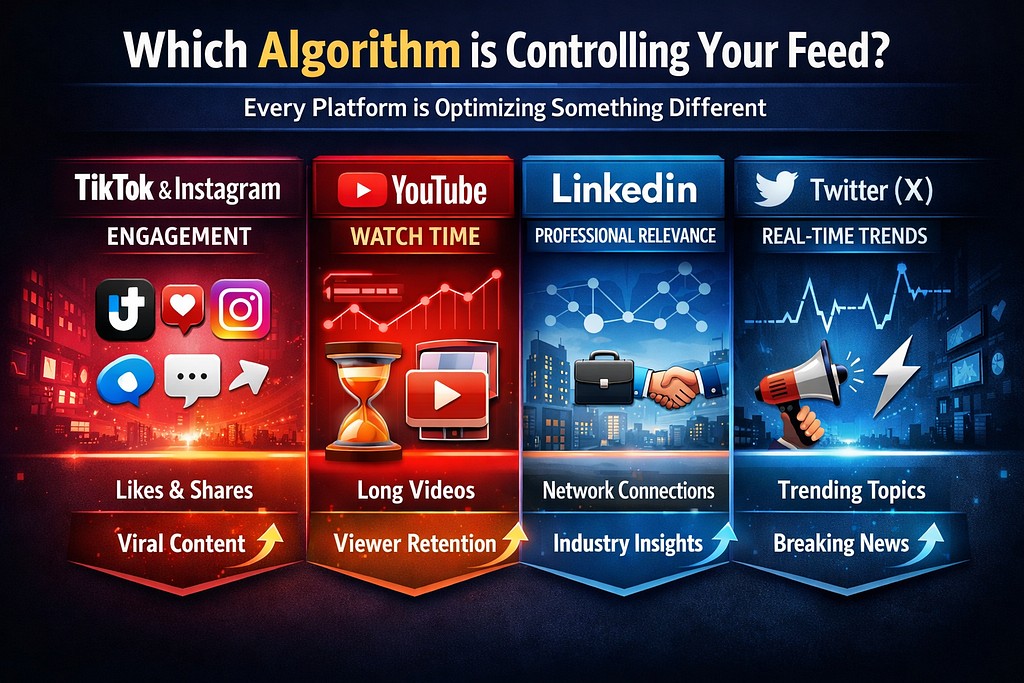
The algorithm does not decide what is meaningful. It decides what is effective according to its objective.
This leads to a more important question — one that is often overlooked.
Which algorithm is better?
The answer is not straightforward, because “better” depends entirely on what is being optimized. An algorithm that maximizes engagement may be highly effective for platform growth, but it may also amplify content that prioritizes reaction over substance. An algorithm that emphasizes retention may encourage deeper consumption, but also create patterns that are difficult to escape.
From a user perspective, the quality of the experience is shaped not just by the content, but by the objective of the system itself.
There is a familiar pattern here in machine learning systems. When a model is optimized for a single metric, it performs exceptionally well on that metric — but may behave unpredictably outside it.
Social media algorithms follow the same principle.
They are not flawed. They are precisely optimized.
Over time, this optimization begins to influence behavior. Creators adapt to what the algorithm rewards. Content evolves to match what performs well. And gradually, the system begins to shape not just what is seen, but what is created.
This is the feedback loop most people experience without realizing it.
Final Thought
Social media algorithms are often described as mysterious or opaque. In reality, they are predictable once their objective is understood.
They do not decide what is important. They decide what is effective.
And in doing so, they shape not just our feeds, but the behavior of everyone who participates in them.
Every Social Media Algorithm Is Optimizing You — Just Not in the Way You Think was originally published in DataDrivenInvestor on Medium, where people are continuing the conversation by highlighting and responding to this story.