The European Union’s latest Russia sanctions package, its twentieth so far, brings crypto settlement squarely into an already fractured geopolitical spotlight.
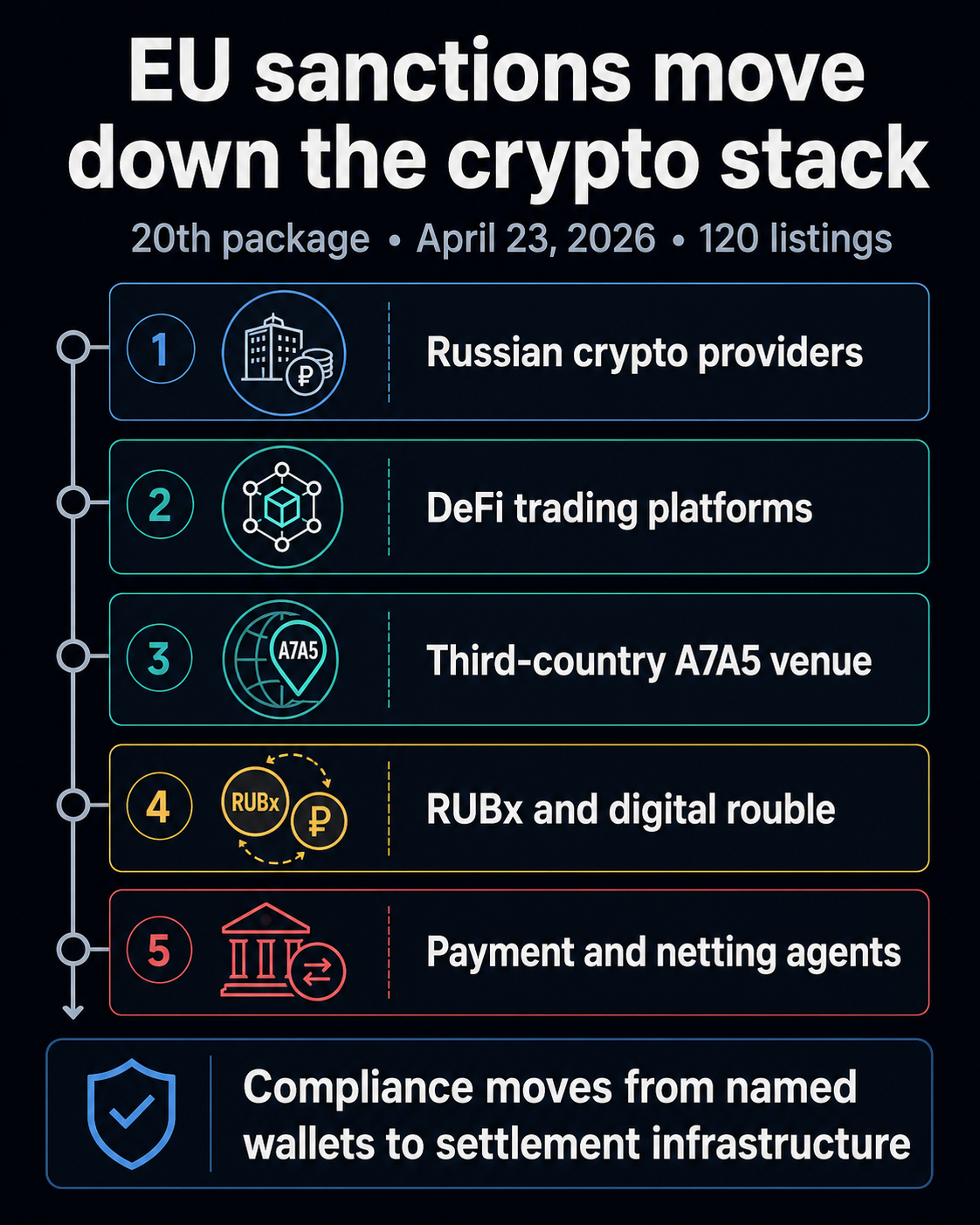
Adopted on April 23, the package adds 120 new listings and rolls out financial measures that touch just about every corner of Russia’s crypto scene. That includes service providers, decentralized trading platforms, ruble-backed tokens, payment agents, and even support for the digital rouble.
Earlier rounds of restrictions mostly went after specific exchanges, wallets, or operators. This time, the EU is aiming higher up the stack, targeting the service layer that keeps Russia-linked crypto settlement running. That means third-country platforms and tools that can keep money moving globally, even if a particular exchange gets shut down.
 Related Reading
Sanctions risk is forcing a rethink of reserve safety — and Bitcoin is now in the debate
Reserve managers are starting to ask not just what is safe, but what stays usable when politics, sanctions, or conflict hit. Apr 2, 2026 · Gino MatosThe EU frames these new rules as a way to close loopholes. According to Council materials, Russia is leaning more and more on crypto for international payments as traditional finance routes get squeezed by sanctions.
The package is the bloc's largest move to sanction Russia in years, with crypto restrictions among its most specific measures.
The real test now is whether Europe can actually measure crypto settlement risk at the infrastructure level. That means platforms have to dig deeper than exchange names and look at where a provider is based, which tokens are in play, which settlement agents are involved, and whether the route relies on a state-backed digital currency.
The Ban Moves Down The Stack
The Commission says this package brings a blanket ban on doing business with any Russian crypto asset service provider. It also covers decentralized platforms if they’re being used to get around sanctions. Now, where a provider is based and how it operates matter just as much as whether it’s been named on a sanctions list.
TRM Labs ties the measure to platform succession risk after Garantex was disrupted. Its analysis of the package points to the Garantex-to-Grinex migration and the role of A7A5 as the bridge between those systems.
Chainalysis reaches a similar conclusion from a compliance angle. Its 20th package analysis describes the measure as a move against categories of evasion infrastructure rather than single named entities.
 Related Reading
EU sanctions Russian crypto exchange Garantex over Ukraine conflict ties
The EU aims to close financial loopholes by directly sanctioning a Russian crypto exchange for the first time. Feb 25, 2025 · Oluwapelumi AdejumoIt’s one thing to screen a wallet address or exchange name. It’s a whole different challenge to spot a service provider set up in Russia, a third-country platform with Russian liquidity, or a settlement route built around a sanctioned token.
The Financial Times had already reported that EU officials were weighing a broad ban on Russian crypto transactions.
Prior CryptoSlate coverage of that proposal shows the continuity: Brussels was already testing a broader enforcement perimeter before the package was adopted.
 Related Reading
New crypto ban targets Russia rails but one chokepoint decides whether flows die or just relocate offshore
If stablecoin issuers block redemption and the EU squeezes third country intermediaries, evasion costs spike in unexpected places. Feb 11, 2026 · Gino MatosThe new rules reach into five different parts of the crypto settlement process.
| Targeted layer | Role in the route | Compliance implication |
|---|---|---|
| Russian crypto asset service providers | Exchange and transfer access | Counterparty screening has to include establishment and operating nexus |
| Decentralized platforms enabling trading | Alternative access when centralized venues are blocked | Front-end, service, and platform exposure become relevant |
| TengriCoin / Meer.kg | Third-country venue where A7A5 is traded | Russia-linked stablecoin liquidity can create designation exposure outside Russia |
| RUBx and digital rouble support | State-linked token and CBDC settlement rails | Issuers, service providers, and infrastructure firms face instrument-level controls |
| Russian payment and netting agents | Settlement mechanics that can mask gross flows | Monitoring has to examine the route and the final address |
Stablecoins Become Enforcement Infrastructure
A7A5 gives the policy a concrete example. Chainalysis identifies TengriCoin, doing business as Meer.kg, as the Kyrgyz venue where significant amounts of the government-backed stablecoin are traded.
The Council language is broader, pointing to a Kyrgyz entity operating an exchange where significant A7A5 volumes move.
The venue turns A7A5 from background context into a named enforcement path. TRM says A7A5 served as the financial bridge between Garantex and Grinex after Garantex was disrupted, while Chainalysis describes the token as a Russia-linked stablecoin rail for sanctioned businesses seeking access to the global financial system.
A 2025 U.S. sanctions report linked the Garantex, Grinex, and A7A5 network to earlier enforcement pressure. The EU package now codifies that route-level concern in its own sanctions framework.
 Related Reading
OFAC targets Kyrgyzstan-based firms, stablecoins over Russian sanctions violations
Kyrgyzstan-based firms under scrutiny for facilitating Russian sanctions breaches via stablecoins. Aug 14, 2025 · Assad JafriRUBx gives the package a second stablecoin layer. Russian state-owned conglomerate Rostec planned RUBx as a ruble-pegged token on Tron alongside a payment platform called RT-Pay.
The Commission now says the EU is prohibiting the use of and support for RUBx, as well as support for the digital rouble, a central bank digital currency under development by the Bank of Russia.
The policy signal is direct. The EU is treating a stablecoin, a CBDC project, and the service providers around them as parts of a sanctions-relevant payment architecture.
The role of the instrument carries more weight than the token ticker. If a ruble-backed asset can connect sanctioned businesses to liquidity, its issuer, venue, service provider, and supporting infrastructure all become part of the risk map.
Live market data shows these instruments are active across a huge global market. The focus here is on who can actually settle transactions.
Compliance Moves To The Whole Route
The netting ban shows how far the package reaches into settlement mechanics. The Commission says the package prohibits transactions with agents in Russia and other third countries that offer to facilitate international transactions from Russia to bypass EU sanctions. It also bars netting transactions with Russian agents.
Chainalysis describes this as significant for crypto compliance because netting can obscure the underlying counterparties of Russia-linked flows.
For crypto firms, risk can show up in the service provider behind the scenes, the country where an intermediary is based, the token used to settle, or the payment agent moving the money. Screening now means looking at the whole route, not just searching for familiar names.
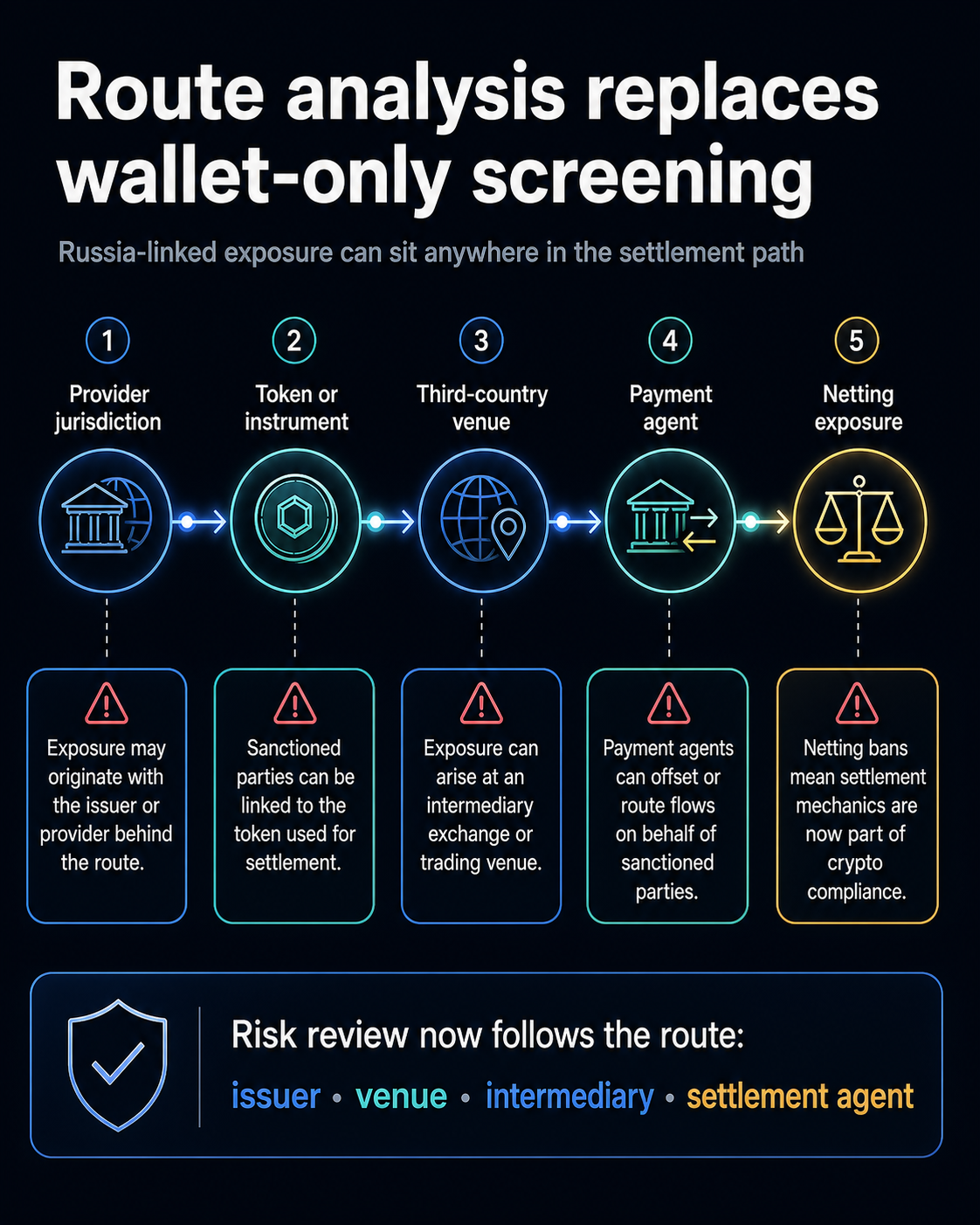
For stablecoin issuers, custodians, exchanges, payment processors, and infrastructure providers, this means stepping up checks on any Russia-linked activity. TRM points out that the package moves the focus from just screening names to figuring out if a counterparty is actually based in Russia, even if it’s a brand-new service that hasn’t been listed yet. individual designation.
 Related Reading
Russian-linked crypto wallets channel $8B to skirt sanctions using Tether's USDT
Stablecoins used to bypass global banking restrictions highlight the growing concern over cryptocurrency's role in sanctions evasion. Sep 26, 2025 · Oluwapelumi AdejumoChainalysis flags third-country platforms and intermediaries as sanctions-evasion risks when Russian settlement links are detected.
One likely result is more friction. If issuers, exchanges, and service providers really enforce these rules, settling Russia-linked crypto could get pricier and less dependable. The real squeeze is on the route itself; redemption, platform access, liquidity, custody, and payment-agent relationships all come under pressure.
Another outcome is migration. Successor platforms, nested services, and third-country brokers can push activity into less transparent venues. The EU's answer is to target the architecture that lets those routes keep functioning, pairing crypto restrictions with measures against third-country financial institutions and anti-circumvention channels.
Stablecoins and the digital rouble are now firmly inside the EU’s sanctions playbook, not just sitting on the sidelines. The EU has called out crypto rails as real financial infrastructure and built restrictions around the providers, tokens, platforms, and settlement mechanics that make them work. The big question now is whether enforcement can keep up as these routes keep shifting.
The post EU sanctions Russian crypto usage for 20th time adding bans on digital rubles and anyone using Russian crypto services appeared first on CryptoSlate.