
Engineering Trust in the African Gig Economy: A Data-Driven Approach to Service Exchange Platforms
--
Subtitle: Bridging the Trust Gap: Alleviating Information Poverty through a Scalable, Localized SPA Framework for Emerging Economies.
By Tiani Pekins Ebika
M.Sc. Candidate in Software Engineering, University of Buea
Introduction
The digital revolution has transformed global economies, but I found that in local service sectors in developing regions like Cameroon, the effect is not the same. While the global North luxuriates in the unbroken ease of TaskRabbit or Uber, the African informal economy, a lively ecosystem of artisans and technicians, languishes in a frustrating loop of Information Poverty.
In my research, I have defined Information Poverty not only as lack of internet access, but also a lack of high-quality, verifiable data. When a client cannot verify a plumber’s history and a provider has no platform to display their craftsmanship, an economic vacuum arises. Now, filling this gap, we have unreliable word-of-mouth, posters and fragmented social media posts, creating a profound Trust Gap.
In my Under-graduate research in Software Engineering, I tried to address this systemic failure. This journey ended with the design and implementation of LocalHands, a sophisticated service exchange platform to formalize and digitize the local service economy.
The proof: Why Local Directories Are not Working
I had to get away from assumptions before I wrote any code. I have conducted a mixed-method study, which consisted of a survey with 381 clients and in-depth interviews with 154 local artisan and labourers across Cameroon. I wanted to find the exact technical and social bottlenecks that stop people from transacting.
The results were a wake-up call to any developer:
• Information Poverty: 92% of providers have no digital way to showcase portfolios or collect verifiable reviews.
• The Efficiency Drain: Clients reported spending an average of 5–13 days vetting providers through informal networks.
• The Anxiety of the Handshake: 78% of clients reported high anxiety around upfront deposits in informal transactions.
• The Payment Mismatch: Global platforms like credit cards, but 85% of these local labourers transact via Direct cash or Mobile Money (MTN MoMo/Orange Money).
System Architecture: Emphasis on Scalability and Responsiveness
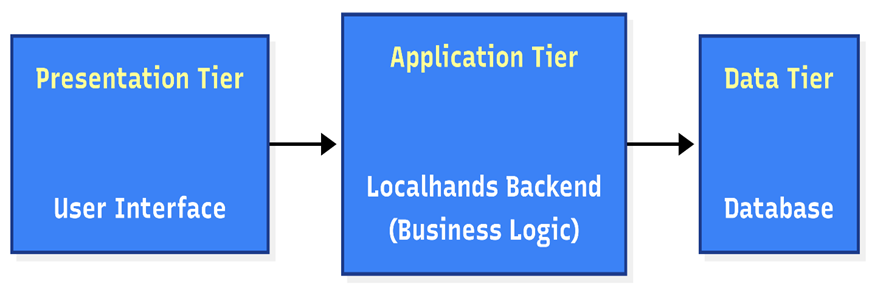
To address these challenges, I built LocalHands, a Single-Page Application (SPA). It was not only a technical decision, it was a strategic one.
SPA gives users the high responsiveness and fluid user experience they need when working in environments where internet speed is often unpredictable and variable.
I built the platform on a solid, modern stack for the future:
• Frontend Ecosystem: Built with Next.js and React v18, with Tailwind CSS for mobile-first, responsive design that respects user data and time.
• Data Layer: I built a PostgreSQL database using the Prisma ORM to handle relational data in a type-safe and efficient way with complex entity relationships (Users, Services, Contracts, and Reviews).
• Backend Logic: For the serverless business logic I used Nest.js API Routes, which allowed me to reduce infrastructure overhead while still achieving high performance.
Trust Crisis Solutions: Logic of Escrow & Contracts
The heart of LocalHands engineering is the Contract and Escrow Algorithm. I understood that to close the Trust Gap, the system needed to do more than bring people together; it needed to protect their livelihoods. I installed the system to be an impartial intermediary.
The workflow operates on a strict logic of building trust:
1. Negotiation & Proposal: Verified providers respond to client job postings with custom proposals.
2. The system creates a binding digital contract without ambiguity by accepting automated contract formation.
3. Secure Escrow: The client’s Mobile Money payment is held in escrow via the Fapshi gateway integration.
4. Validation-Based Release: The provider’s account is credited only after a validated completion signal from the client
This architectural decision is a direct response to the 78% anxiety rate that my research revealed. It offers a secure, digital “handshake” that secures both sides.
UX Strategy: Making the User a Reality
I think a high-caliber system is only useful if it’s usable. I built three different role-based interfaces: Client, Provider and Admin to guide the user journey and eliminate friction.
“Information Poverty” and the provider dashboard is designed to help mitigate this. It gives each artisan their professional profile, their digital resume. It arms the worker with the tools to showcase their worth in a competitive market, combining star ratings, past portfolios, and clear earning analytics.
The Client interface is designed to replace the usual 5-day search with a simplified discovery engine. It’s a one-stop shop where users can see active service orders, compare incoming proposals side-by-side, and browse verified profiles, turning the hunt for labor from a risky gamble into an informed choice.
Integrity is ensured by having an Admin panel that gives a high-level overview of the health of the system. It is the gatekeeper of trust, enabling administrators to monitor transaction volumes, resolve potential disputes, and manage the essential provider verification process. It’s this oversight that makes the “Technical Source of Truth” both accurate and secure.
Conclusion and the way forward
LocalHands is proof of my conviction that Software Engineering in emerging economies must be sociotechnical. We can’t just ‘copy-paste’ Western models; we have to architect for the local payment systems, local trust issues, and the local lack of data.
As I progress in my Master’s candidacy, I am expanding this research to include AI-driven matching algorithms and decentralized dispute resolution. The goal remains clear: to bridge the gap between local talent and digital opportunity by providing a robust, secure engineering framework that formalizes the informal service sector.
About the Author
Tiani Pekins Ebika is a Software Engineer and M.Sc. candidate in the Faculty of Engineering and Technology at the University of Buea, Cameroon. As the founder of LocalHands, his work and research focus on leveraging scalable technology to alleviate Information Poverty and bridge the critical Trust Gap within African service economies. He is dedicated to architecting digital infrastructures that empower local talent and formalize the informal sector.
