Designing Payments: What Integrating Stripe Taught Me About Product Decisions
Thinking through trust, flow, and failure in real systems
 Babenaiyaa S3 min read·Just now
--
When I first approached payments in a project, I thought of it as a technical task.
Pick a provider.
Connect the API.
Handle success and failure.
Done.
That assumption didn’t last very long.
Integrating Stripe wasn’t just about making transactions work. It forced me to think about something I hadn’t considered deeply before:
Payments are not just a backend feature.
They are a product experience.
And once I started seeing it that way, the decisions became less about code and more about people.
1. Payments Are About Trust Before They Are About Technology
From a system perspective, Stripe is straightforward:
1. create a checkout session
2. collect payment details
3. confirm the transaction
But from a user’s perspective, something very different is happening.
They’re being asked to:
- trust your platform
- enter sensitive information
- and complete an irreversible action
That changes how every part of the flow needs to feel.
Small details started to matter more than I expected:
- clear pricing before checkout
- familiar UI patterns (Stripe’s hosted pages help here)
- visible confirmation after payment
The technical integration worked early on.
The trust layer took more thought.
2. Designing the Flow Matters More Than Connecting the API
A payment system isn’t a single action. It’s a sequence.
For example:
- Where does the user initiate payment?
- Do they select a product first, or enter an amount?
- What happens immediately after they pay?
In my case, supporting a “donation-style” flow raised additional questions:
- Should amounts be fixed or flexible?
- How do you communicate where the money is going?
- What does success look like to the user?
None of these are Stripe problems.
They’re product decisions that Stripe simply enables.
3. Failure Is Not an Edge Case — It’s Part of the System
One of the biggest shifts for me was realizing:
Payments don’t always succeed — and that’s normal.
Cards fail.
Users close the tab.
Network issues happen.
Initially, I treated failure as something to “handle.”
But in practice, it needs to be designed for.
Many questions came up.
- What does the user see if payment fails?
- Can they retry easily?
- Does the system stay consistent if something breaks mid-flow?
Ignoring these leads to confusion.
Designing for them builds reliability.
4. Asynchronous Systems Change How You Think About State
Stripe relies heavily on asynchronous events (webhooks).
Which means,
1. payment confirmation doesn’t always happen immediately in your UI
2. your system needs to react to events, not just direct responses
This introduced a subtle but important shift.
The system’s “source of truth” is not always what the user sees in the moment.
Handling that properly required
- listening to webhook events
- updating the database based on confirmed payments
- ensuring consistency between UI and backend
It wasn’t difficult technically. But it required careful thinking.
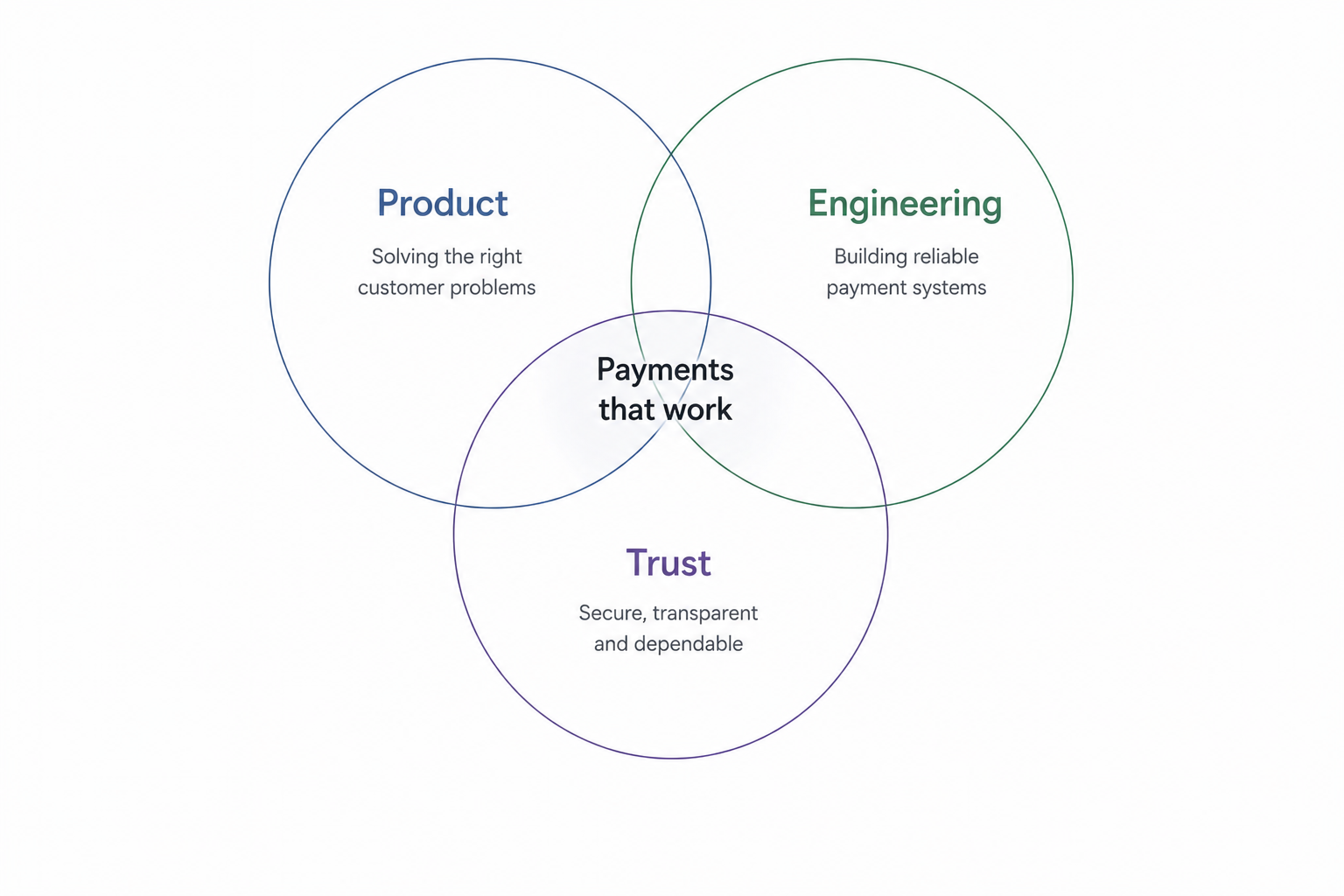
5. Payments Sit at the Intersection of Product and Engineering
What stood out most through this process wasn’t the complexity of Stripe itself.
It was how many different concerns come together in one feature. Such as,
- user trust
- experience design
- system reliability
- data consistency
- and business logic
Payments expose gaps quickly.
If something is unclear, users hesitate.
If something breaks, it’s immediately visible.
Which makes it a surprisingly good place to learn how systems really work.
Going into this, I expected to “integrate payments.”
What I ended up doing was learning how to design a flow that people trust, understand, and can rely on.
Stripe made the technical side easier.
But the real work was in the decisions around it.
And that’s where the learning happened.