
A Mobile Architect’s System-Design Perspective
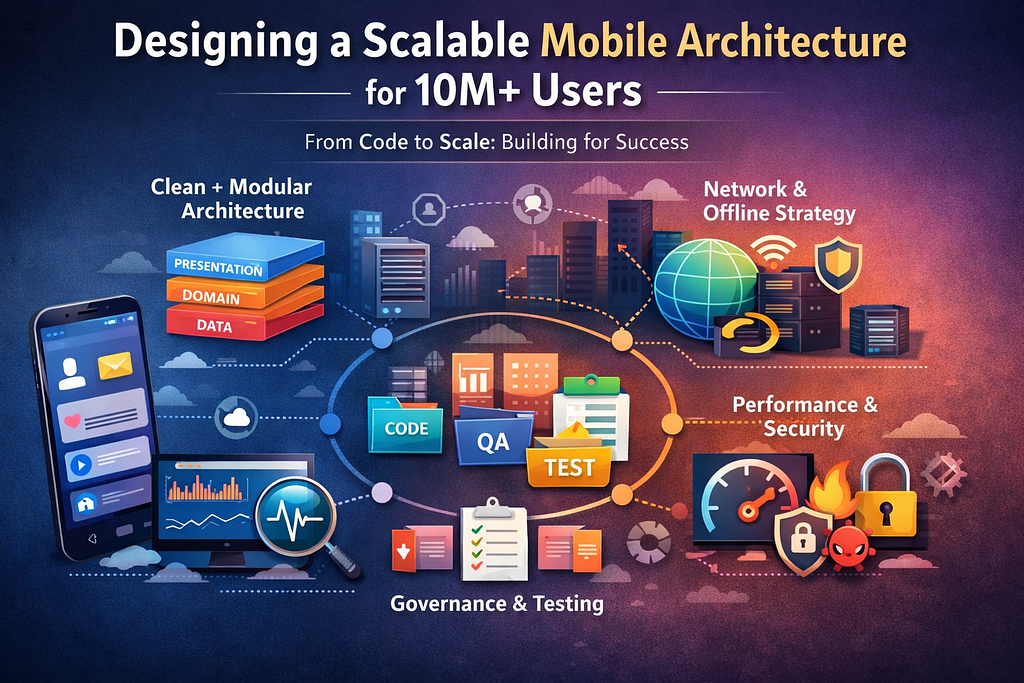
“Design a scalable mobile architecture for 10M+ users.”
- ✅ System thinking
- ✅ Scalability mindset
- ✅ Governance capability
- ✅ Reliability engineering
- ✅ Enterprise delivery maturity
At 10M+ users, failures are not edge cases — they are normal operating conditions.
This article structures the answer exactly how you should present it in a Mobile Architect round.
1️⃣ Architecture Foundation: Clean + MVVM-C + Modular
For large-scale iOS systems, I recommend:
- ✅ Clean Architecture
- ✅ MVVM-C (Coordinator Pattern)
- ✅ Feature-Based Modular Architecture
Why This Combination?
PatternWhy It Matters at 10M+Clean ArchitectureBusiness logic isolated from frameworksMVVM-CScalable navigation & flow controlModularizationParallel team ownership & faster builds
📐 Layered Structure (Clean Architecture)
Presentation Layer
    - View
    - ViewModel
    - Coordinator

Domain Layer
    - UseCases
    - Entities
    - Protocols

Data Layer
    - Repository
    - API Service
    - Persistence
    - Cache
2️⃣ Feature-Based Modular Architecture
At scale, a monolithic app becomes unmanageable.
App
├── Core
│   ├── Networking
│   ├── Analytics
│   ├── Logging
│   ├── DesignSystem
│   └── Utilities
│
├── Features
│   ├── Login
│   ├── Dashboard
│   ├── Payments
│   ├── Profile
│   └── Notifications
Benefits
- Independent team ownership
- Clear boundaries
- Faster CI builds
- Feature flags per module
- Reduced merge conflicts
This mirrors micro-frontend thinking — but on mobile.
3️⃣ Network Layer Abstraction (Preventing Self-DDoS)
At 10M users, improper retry logic can accidentally DDoS your own backend.
🔌 Design Principles
- Protocol-oriented networking
- Request Builder pattern
- Response parsing abstraction
- Interceptors
- Retry policies
- Rate limiting
- Request deduplicati
Core Flow
APIClient (Protocol)
     ↓
NetworkManager (URLSession)
     ↓
RequestBuilder
     ↓
ResponseParser
🔐 Token Refresh Handling
- 401 → Trigger refresh token flow
- Queue failed requests
- Replay after successful refresh
- Use mutex/lock to avoid multiple refresh calls
🔁 Retry Policy
5xx - - - - - - - - - - Exponential backoff
429 - - - - - - - - - - Respect Retry-After
401 - - - - - - - - - - Refresh token
Network loss - - - - - -Wait for connectivity
4️⃣ Offline-First Strategy (Critical at Scale)
At 10M users:
- Users are on 2G
- Switching networks
- In rural areas
- In roaming conditions
Offline-first is not optional.
Strategy
Local Database
- CoreData
- SQLite
- Realm
- SwiftData (modern apps)
Cache-First Read Strategy
UI → Local DB → Network → Update DB → UI refresh
Write-Behind Strategy
- Queue offline transactions
- Sync when network returns
- Conflict resolution rules
5️⃣ Multi-Level Caching Strategy
Caching reduces backend load and improves UX.
LayerTechnologyPurposeMemoryNSCacheImages, lightweight modelsDiskFileManagerMedia & JSON blobsDBCoreDataStructured data
Cache Policy
- TTL-based expiration
- ETag / If-Modified-Since
- LRU eviction
- Background cleanup
6️⃣ Rate Limiting & DDoS Prevention
Client-side rate limiting protects backend systems.
Client Strategies
- Debounce search
- Avoid duplicate requests
- Retry cap limit
- Request coalescing
Server Coordination
- Handle 429 properly
- Exponential backoff
- Circuit breaker pattern
7️⃣ Performance Engineering
At 10M users, performance = revenue.
UI Performance
- Diffable Data Sources
- Lazy image loading
- Prefetching
- Avoid main-thread blocking
Memory
- Avoid retain cycles
- Profile using Instruments
- Monitor memory warnings
Launch Optimization
- Lazy dependency injection
- Defer heavy services
- Async initialization
8️⃣ CI/CD Strategy (Enterprise-Grade)
Manual releases do not scale.
CI Pipeline
- Fastlane
- GitHub Actions / Azure DevOps
- SwiftLint
- SonarQube
- Minimum test coverage %
CD Pipeline
- Automated TestFlight
- Staged rollout
- Phased App Store release
- Feature-flag rollout
9️⃣ Observability: Crash & Performance Monitoring
At 10M scale:
Observability is more important than feature velocity.
Crash Reporting
- Firebase Crashlytics
- Sentry
Performance Monitoring
- New Relic
- Firebase Performance Monitoring
What to Track?
- API latency
- Crash-free sessions (Target: 99.5%+)
- App startup time
- Memory spikes
- Battery usage
🔟 Security Governance (Especially for Fintech)
Security is architectural, not implementation-level.
- Certificate pinning
- Encrypted database
- Secure storage (Keychain)
- Jailbreak detection
- App attestation
- Dependency vulnerability scanning
- OWASP compliance
1️⃣1️⃣ Beyond Mobile: Backend Coordination
Mobile architecture must align with backend scalability.
API Gateway
Acts as a single entry point:
- Authentication
- Rate limiting
- Aggregation
- Logging
CDN Usage
Used for:
- Static assets
- Images
- Config files
Examples:
- Cloudflare
- Akamai Technologies
Load Balancing
Distributes traffic across microservices to ensure:
- High availability
- Fault tolerance
- Auto-scaling support
1️⃣2️⃣ Testing Strategy at Scale
Test Type -------------------------- Purpose
Unit Tests ------------------------- Business logic validation
Integration Tests ------------------ Repository & API
UI Tests --------------------------- Critical flows
Snapshot Tests --------------------- UI stability
Load Testing ----------------------- Backend validation
“At 10M+ users, mobile architecture is not about patterns — it’s about reliability under failure, governance across teams, and long-term sustainability. My design ensures scalability technically, organizationally, and operationally.”
You can explore the source code for another case study on my GitHub, or visit my portfolio site to see more of my work in action.
If you have any thoughts, questions, or feedback, feel free to drop a comment below — I’d love to hear from you!
🚀 Designing a Scalable Mobile Architecture for 10M+ Users was originally published in Level Up Coding on Medium, where people are continuing the conversation by highlighting and responding to this story.