
DeFi Isn’t Trustless — It Just Hides Where Trust Lives (A Simple Explanation)
--
You’ve probably heard this before: “DeFi is trustless.”
Meaning:
- no banks
- no middlemen
- no need to trust anyone
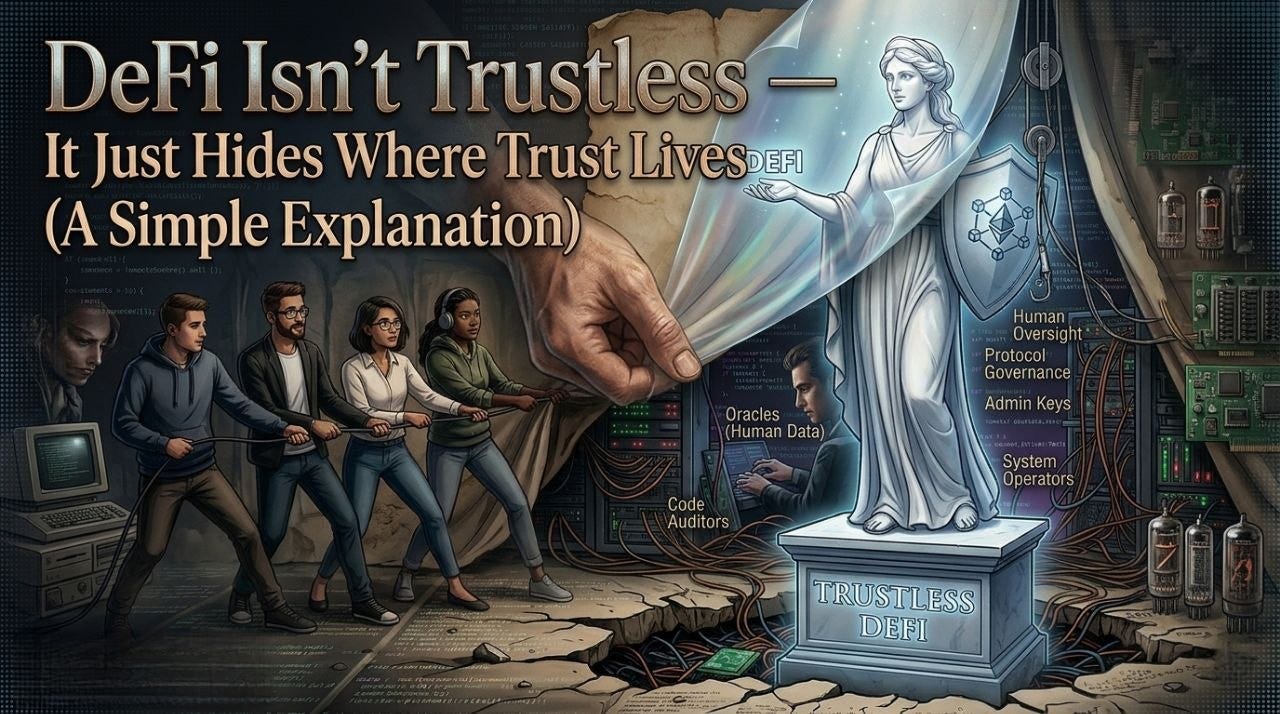
Just code. Sounds perfect, right? But here’s the reality: DeFi doesn’t remove trust. It just moves it somewhere else.
The Simple Truth Most People Miss
When you use DeFi, you are trusting something. Even if you don’t realize it.
For example, you trust:
- the smart contract won’t break
- the price data (oracle) is correct
- the protocol rules won’t suddenly change
- the system will work when you need it
So the question isn’t: 👉 “Is this trustless?”
The real question is: 👉 “What am I trusting right now?”
Why This Matters
Most people don’t think about this. They just:
- connect their wallet
- click deposit
- chase yield
But if something goes wrong, that’s when trust becomes very real. Because behind every DeFi app is a system — and every system has assumptions. If you don’t understand those assumptions, you’re taking blind risk.
The Illusion of “Decentralized = Safe”
Here’s another common belief: “If it’s decentralized, it must be safe.”
Not always. Some systems look decentralized, but still rely on:
- a small group controlling decisions
- emergency keys (multisigs)
- slow governance that can’t react quickly
- protections that only work in normal conditions
This creates a dangerous situation:
👉 it looks safe
👉 but may not behave safely under stress
That’s what people call decentralization theatre.
A Better Way to Think About It
Instead of trying to remove trust completely… Better systems design trust properly. Think of it like this: Would you rather:
❌ Trust something blindly
or
✅ Know exactly how it works and what controls are in place?
Good systems make trust:
- clear (you know what’s happening)
- structured (roles and rules are defined)
- enforced (code ensures limits are respected)
This is called engineered trust.
Why Code Alone Isn’t Enough
Smart contracts are powerful. But they can’t handle everything. They don’t:
- predict every market crash
- adapt instantly to new risks
- fix problems on their own
That’s why real systems also need:
- monitoring
- fast response mechanisms
- clear control structures
Because in the real world:
👉 things break
👉 markets move fast
👉 unexpected situations happen
How Concrete Vaults Approach This
This is where Concrete vaults take a different path. Instead of pretending trust doesn’t exist, they make it clear and structured. Think of it like a well-organized system where:
- different roles have specific responsibilities
- rules are enforced onchain
- risk is actively managed
- systems can respond when needed
The goal isn’t to remove trust. 👉 It’s to design it properly.
This is what stronger DeFi infrastructure looks like.
Why This Is Important for the Future
As DeFi grows, it becomes more complex. And complexity increases risk. So the industry is slowly shifting from:
👉 “We don’t need trust”
to
👉 “We need better-designed systems”
Because in the end:
- safety matters more than slogans
- structure matters more than hype
- reliability matters more than ideology
This is especially true as institutional DeFi grows, where larger capital needs:
- clear rules
- strong security
- predictable behavior
The Simple Takeaway
Here’s the easiest way to think about it:
- DeFi is not trustless
- It just hides where trust lives
- Better systems make that trust visible and controlled
Because at the end of the day: 👉 You are always trusting something
The only question is: Do you understand what it is?
👉 Explore Concrete at: https://concrete.xyz/