--
DeFi Doesn’t Remove Trust — It Engineers It
DeFi was built on a powerful idea:
“Don’t trust people. Trust code.”
For years, that idea defined the industry.
Code is law.
No intermediaries.
Trustless systems.
But as DeFi matured, something became obvious:
Trust never disappeared.
It just moved.
---
The Myth of “Trustless” Finance
The phrase “trustless” became one of DeFi’s strongest narratives.
And at a surface level, it made sense.
Smart contracts replaced centralized operators.
Transactions became transparent.
Users could interact directly with protocols.
But real systems are more complicated than slogans.
Because even in DeFi, users still trust:
Smart contracts
Governance systems
Oracles
Bridges
Execution layers
Security assumptions
The question was never whether trust exists.
The real question is:
Where does trust live, and how is it managed?
---
Where Trust Actually Exists in DeFi
Most DeFi systems depend on layers of assumptions.
Some are visible.
Many are not.
For example:
A lending protocol may appear autonomous, but users still trust:
that the smart contracts are secure
that oracle prices are accurate
that governance won’t pass harmful changes
that liquidity remains functional during stress
Cross-chain systems depend heavily on bridge security.
Yield systems depend on execution quality.
DAOs depend on participation and coordination.
Even “fully decentralized” systems rely on human decisions somewhere in the stack.
In practice, trust is often abstracted away rather than eliminated.
---
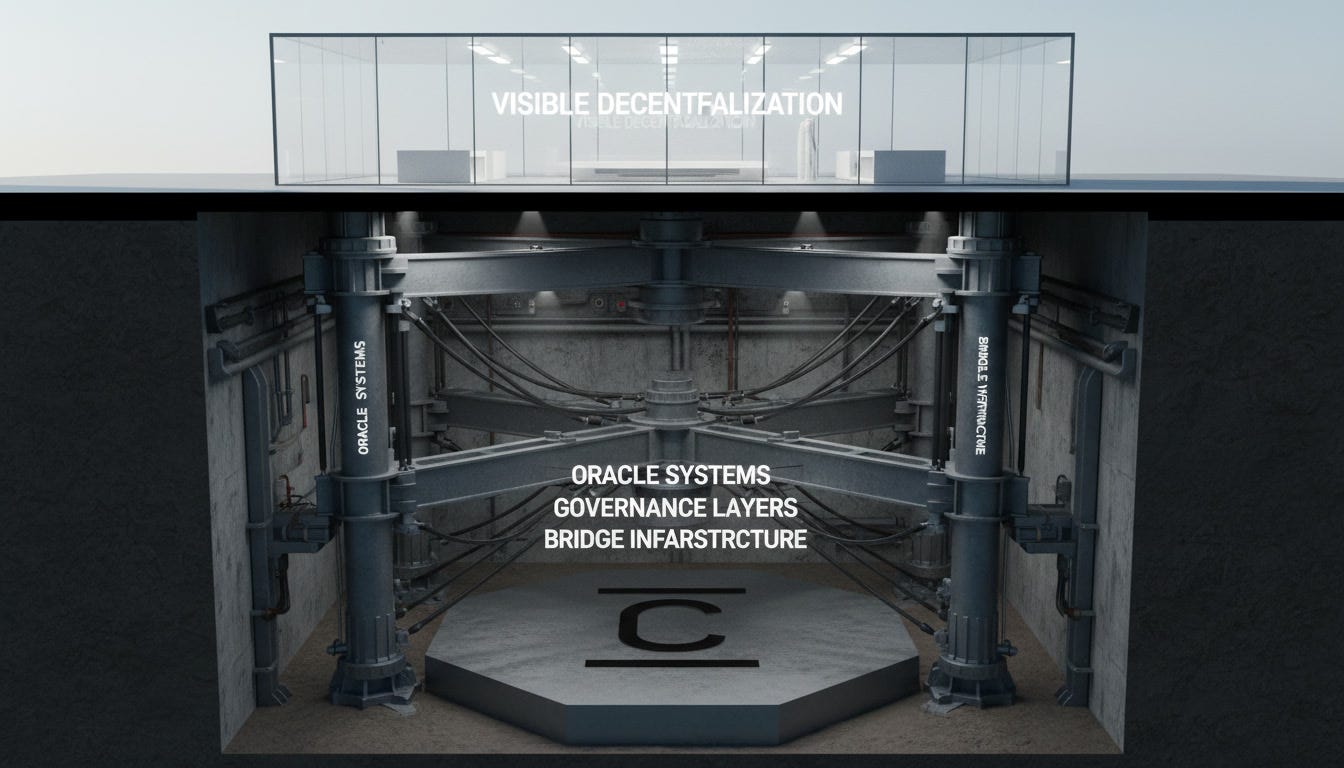
The Problem With Decentralization Theatre
This is where DeFi encounters a deeper issue:
The appearance of decentralization is not the same as resilience.
Some systems optimize for optics instead of operational safety.
A protocol may advertise decentralization while still depending on:
Small multisigs
Low-participation governance
Delayed response mechanisms
Weak operational oversight
Timelocks, for example, can slow governance changes.
But they do not automatically prevent failures.
Similarly, a DAO with minimal voter participation may technically be decentralized while functionally controlled by a small group.
This creates what can be called decentralization theatre:
Systems that appear trustless on the surface, but hide concentrated dependencies underneath.
And under stress, those hidden dependencies matter.
---
Trust Isn’t Removed — It’s Engineered
Mature systems understand something important:
Trust cannot be eliminated.
It can only be structured.
This is the idea behind engineered trust.
Instead of pretending trust does not exist, systems acknowledge it and design around it deliberately.
That means:
Clear responsibilities
Defined permissions
Enforced constraints
Controlled execution environments
Systems built to respond under failure conditions
This is how modern financial infrastructure operates.
Not through the absence of trust.
But through carefully engineered trust boundaries.
---
Why Operational Security Matters
Real-world systems cannot rely on static code alone.
Markets change.
Attacks evolve.
Edge cases emerge.
That is why operational security matters.
Strong DeFi infrastructure requires:
Continuous monitoring
Layered defenses
Rapid response capabilities
Human judgment during abnormal events
Code is powerful.
But code alone cannot predict every scenario.
A resilient system is not the one that assumes nothing will fail.
It is the one designed to handle failure when it happens.
---
How Concrete Approaches Engineered Trust
This is where Concrete vaults take a different approach.
Concrete does not hide trust assumptions behind marketing narratives.
Instead, trust is made explicit and structured.
Concrete’s architecture focuses on:
Role-based systems
Controlled execution layers
Onchain enforcement
Operational oversight
Systems designed for response, not just prevention
This matters because security is not only about removing control.
It is about ensuring control exists in the right places, with the right constraints.
Concrete’s approach reflects a more mature understanding of DeFi security:
The goal is not ideological purity.
The goal is resilience.
By combining on-chain enforcement with operational intelligence, Concrete prioritizes systems that can adapt under stress rather than simply appearing decentralized during normal conditions.
This becomes especially important for institutional DeFi, where reliability and operational discipline matter far more than slogans.
---
The Bigger Shift Happening in DeFi
DeFi is entering a new phase.
The industry is slowly moving beyond simplistic “trustless” narratives toward something more practical:
Structured trust systems.
Because ultimately:
Resilience matters more than ideology
Operational safety matters more than appearances
Infrastructure quality matters most during stress
The strongest systems will not be the ones that claim trust no longer exists.
They will be the ones that engineer trust most effectively.
---
Final Thought
Every financial system depends on trust somewhere.
Traditional finance hides it behind institutions.
DeFi tried to hide it behind code.
But the future belongs to systems that make trust explicit, enforceable, and resilient.
Because the next evolution of DeFi is not about pretending trust disappears.
It is about engineering it correctly.
---
Explore Concrete at https://concrete.xyz/