DeFi Doesn’t Remove Trust —
It Engineers It.
 Liet5 min read·Just now
--
The promise was simple: don’t trust people, trust code. But trust didn’t disappear from DeFi. It just moved — into contracts, oracles, bridges, and governance systems. The question was never whether trust exists. It’s whether anyone designed it deliberately.
The Story We Told Ourselves
The founding ideology of DeFi was seductive in its simplicity. Remove the banks. Remove the intermediaries. Replace human judgment with immutable code. “Don’t trust. Verify.”
Smart contracts would execute without bias. DAOs would govern without corruption. Protocols would run without downtime. The system would be, as the community liked to say, trustless.
It was a compelling narrative. And for a while, it framed everything — the products, the marketing, the culture. But as the ecosystem matured and the hacks accumulated, a more honest picture emerged.
“Trust didn’t disappear from DeFi. It was abstracted. Hidden behind technical complexity, decentralization branding, and the comforting idea that code can’t lie. It can. And it does.”
No system operates without trust. The question has never been whether trust exists — it’s where it lives, who holds it, and whether it was deliberately designed or accidentally assumed.
The Hidden Trust Stack
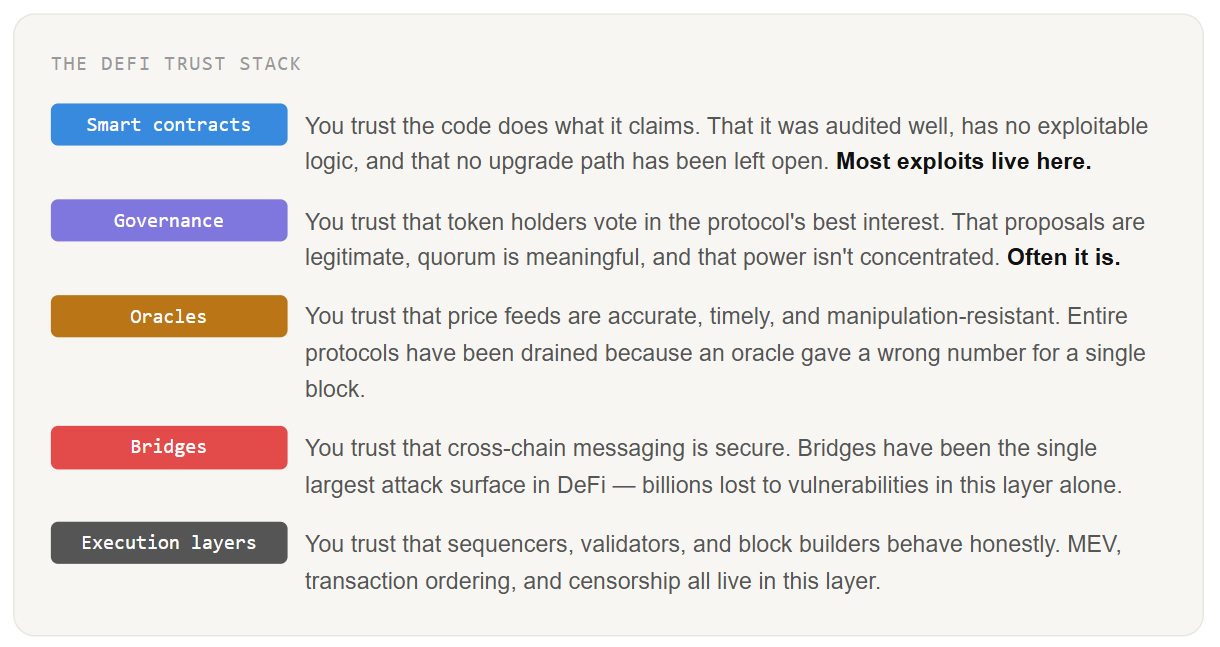
Every DeFi interaction involves a chain of trust assumptions. Most users never see them. Most UIs never surface them. But they’re there — and when they fail, they fail loudly.
None of these are trustless. They’re trust-structured — each one a deliberate or accidental decision about where to place reliance. The sophistication of the technology doesn’t eliminate that dependency. It just makes it harder to see.
Decentralization Theatre
Some of the most “decentralized” protocols in DeFi are, in practice, controlled by a small group of people who can move fast, upgrade contracts, and override governance outcomes. The decentralization is real in appearance. The resilience it implies is not.
“The appearance of decentralization and the reality of resilience are different things. Conflating them doesn’t protect users — it reassures them.”
Engineered Trust: Designing It Deliberately
The alternative to hidden trust isn’t no trust. It’s engineered trust — systems where the trust relationships are explicit, bounded, and designed to respond when things go wrong.
Mature financial infrastructure — whether traditional or onchain — doesn’t pretend trust doesn’t exist. It structures it. Defines who can do what. Builds in checks. Creates response mechanisms. Treats failure as an engineering problem, not a philosophical impurity.
This isn’t a retreat from DeFi’s values. It’s a maturation of them. The goal was never decentralization for its own sake — it was building systems that users could rely on. Engineered trust serves that goal better than the illusion of trustlessness ever did.
Why Code Alone Isn’t Enough
Code is deterministic. Markets are not. Users are not. Attackers are not. Every DeFi system that operates at scale will eventually encounter a situation its smart contracts weren’t designed to handle — and in that moment, the question becomes: who responds, and how fast?
The most secure DeFi infrastructure isn’t the one with the most decentralized governance. It’s the one that can detect an attack, respond in real time, and contain damage before it spreads — without waiting for a governance vote to authorize action.
Trust as Infrastructure, Not Ideology
Concrete takes the position that trust is a feature to be engineered, not a bug to be eliminated. The architecture reflects this — trust relationships are explicit, permissions are bounded, and the system is designed to respond, not just prevent.
This is what it looks like to prioritize operational security over decentralization theatre. The goal isn’t to appear trustless — it’s to be genuinely reliable. Those are different things, and the difference matters when real capital is at stake.
The Future Will Be Defined by Who Engineers Trust Best
DeFi is growing up. The protocols that define the next decade won’t be the ones with the most ideologically pure decentralization stories — they’ll be the ones that users, institutions, and capital allocators actually trust to behave well under pressure.
The systems that earn long-term institutional trust won’t be the ones that claimed to eliminate human judgment — they’ll be the ones that applied it wisely, embedded it carefully, and designed for the scenarios where pure code falls short.
“The future of DeFi won’t be defined by who claims to remove trust. It will be defined by who engineers it best — explicitly, deliberately, and with resilience at the center.”
That shift is already underway. The question for every protocol — and every user — is which side of it they want to be on.
Explore at https://concrete.xyz/