--
DeFi Doesn’t Remove Trust — It Engineers It
Decentralized Finance (DeFi) was born from a powerful idea:
“Don’t trust people. Trust code.”
For a while, this felt revolutionary. Smart contracts replaced intermediaries, protocols ran autonomously, and users interacted without relying on traditional institutions.
But as DeFi matured, a deeper truth emerged:
Trust never disappeared — it simply moved.
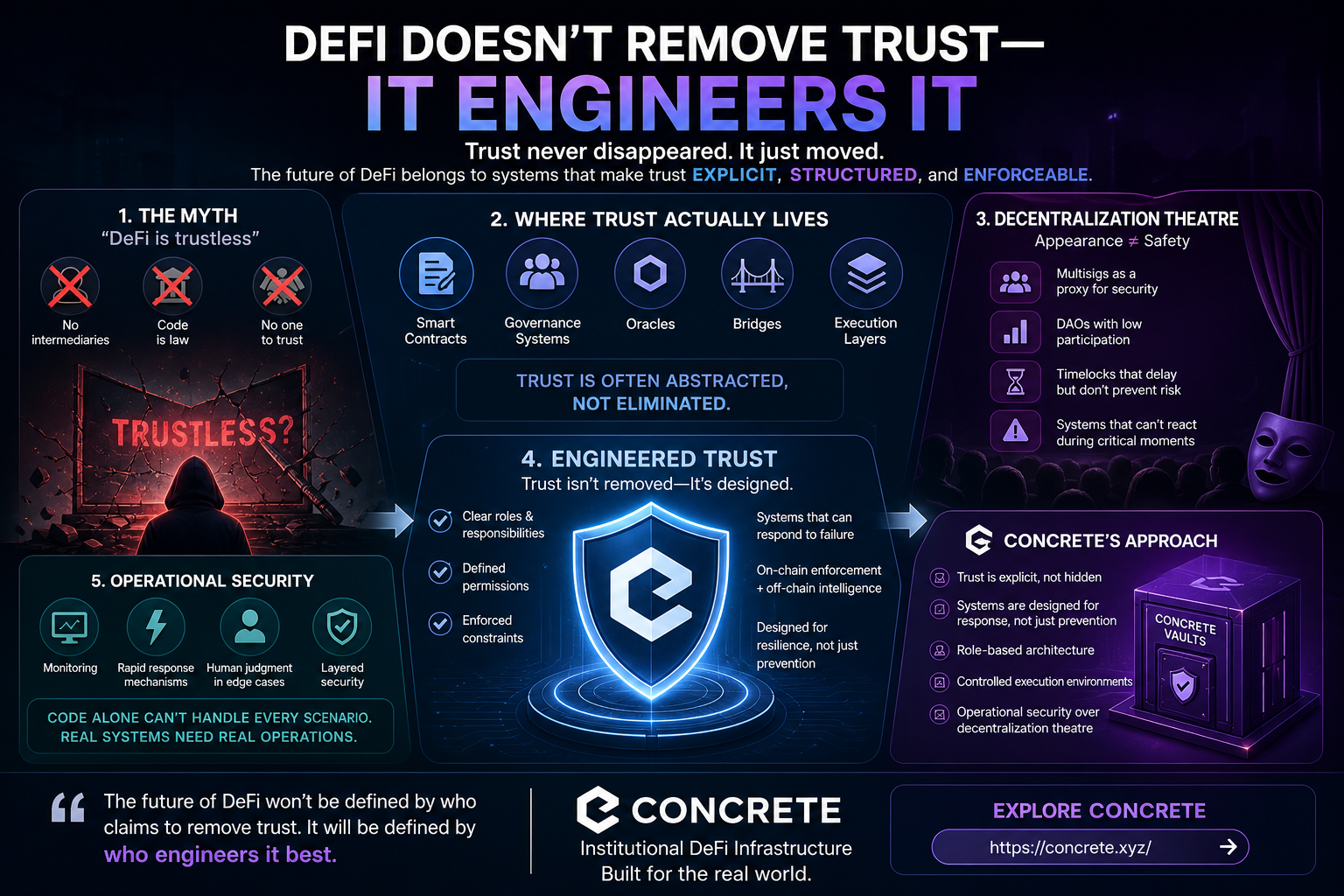
The Myth of “Trustless” Systems
DeFi is often described using phrases like:
“Trustless”
“Code is law”
“No intermediaries needed”
These ideas are compelling, but they are incomplete.
In reality, no system is fully trustless.
The real question is not whether trust exists — but where it exists and how it is managed.
Where Trust Actually Lives in DeFi
Behind every DeFi protocol, there are multiple layers where trust still plays a role:
Smart Contracts → You trust the code is secure and bug-free
Governance Systems → You trust decisions won’t be manipulated
Oracles → You trust external data feeds are accurate
Bridges → You trust cross-chain transfers are safe
Execution Layers → You trust transactions are processed correctly
In other words, trust hasn’t been removed — it has been abstracted away.
The Problem with “Decentralization Theatre”
Many systems appear decentralized on the surface but fail under stress.
This creates what can be called “decentralization theatre.”
Examples include:
Multisigs acting as centralized control points
DAOs with low participation and weak governance
Timelocks that delay actions but don’t prevent risk
Systems unable to respond during critical failures
There’s a clear difference between:
Looking decentralized
vs
Actually being resilient and secure
From Trustless to Engineered Trust
A more realistic and powerful approach is emerging:
Trust isn’t removed — it’s engineered.
Engineered trust means:
Clearly defined roles and responsibilities
Transparent permissions
Enforced constraints
Systems designed for accountability
This is how mature financial systems operate — and DeFi is moving in the same direction.
Why Operational Security Matters
Code alone cannot handle every situation.
Real-world systems require:
Continuous monitoring
Rapid response mechanisms
Human judgment in edge cases
Layered security models
Without these, even the most “decentralized” system can fail when it matters most.
A Different Approach: Concrete
Concrete represents a shift in how DeFi infrastructure is built.
Instead of hiding trust assumptions, it makes them explicit and structured.
Key principles include:
Trust is visible, not hidden
Systems are designed for response, not just prevention
On-chain enforcement combined with off-chain intelligence
Role-based architecture for controlled execution
Strong focus on operational security
This approach prioritizes real resilience over ideological decentralization.
👉 Explore Concrete at: https://concrete.xyz/
The Bigger Shift in DeFi
DeFi is evolving beyond the idea of being purely “trustless.”
The future belongs to systems that:
Acknowledge trust
Structure it properly
Enforce it transparently
Because in the end:
Resilience matters more than ideology.
The next generation of DeFi infrastructure won’t be defined by who claims to remove trust…
It will be defined by who engineers it best.