--
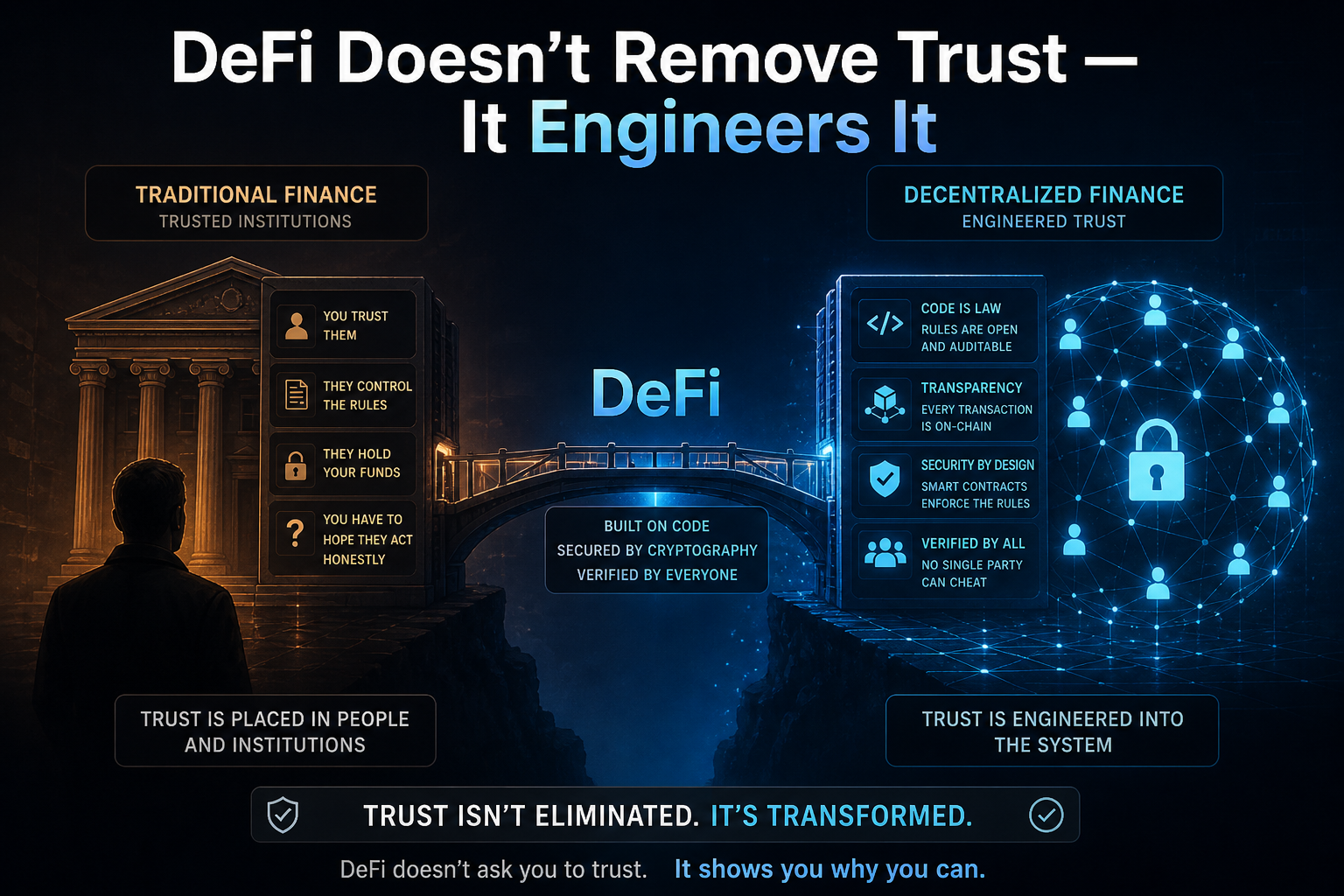
DeFi Doesn’t Remove Trust — It Engineers It
The early promise of decentralized finance was bold and simple: replace trust in people with trust in code. “Trustless systems” became the foundation of a new financial paradigm, where smart contracts would eliminate intermediaries and execute flawlessly.
But reality has proven more nuanced.
DeFi never removed trust — it redesigned it.
The Illusion of Trustlessness
The phrase trustless systems suggests complete independence from human judgment. Yet every DeFi protocol still relies on assumptions:
Code must be written, audited, and deployed. Governance must decide upgrades. Oracles must supply accurate data. Infrastructure must remain online.
These aren’t eliminations of trust — they are relocations of trust into systems.
Understanding this distinction is essential for advancing DeFi security.
Mapping Trust in DeFi Infrastructure
Modern DeFi infrastructure is layered, and each layer carries its own trust model:
- Smart contracts assume correctness and immutability
- Oracles introduce dependencies on external data
- Governance systems concentrate decision-making power
- Bridges expand functionality but increase attack surfaces
Each component introduces risk — not because DeFi is flawed, but because complex systems always require trust boundaries.
The Limits of “Decentralization”
Many protocols emphasize decentralization as a proxy for safety. But decentralization alone does not guarantee resilience.
- Multisigs can centralize authority
- DAOs often suffer from low engagement
- Automated systems can fail silently without intervention
This creates a gap between perceived security and actual operational strength.
True operational security goes beyond distribution of control — it requires visibility, accountability, and response mechanisms.
The Rise of Engineered Trust
A more advanced approach is emerging: engineered trust.
Instead of denying trust, systems are designed to:
- Define clear roles and permissions
- Enforce constraints through onchain enforcement
- Integrate monitoring and response systems
- Combine automation with human oversight
This model aligns DeFi closer to real-world financial systems, where resilience matters more than ideology.
Why Institutional DeFi Demands More
As institutional DeFi grows, expectations shift.
Institutions don’t rely on narratives — they rely on guarantees:
- Systems must be auditable
- Risks must be measurable
- Failures must be containable
This requires infrastructure that can operate under stress, not just in ideal conditions.
Concrete: Designing Trust for the Real World
Concrete represents a new direction in DeFi — one where trust is explicit and enforceable.
With Concrete vaults, the focus is on:
- Structured permissions and role-based control
- Integrated monitoring and rapid response
- A blend of automation and human intelligence
- Secure execution environments for sensitive operations
This approach strengthens DeFi security by acknowledging a simple truth:
Code alone is not enough. Systems must be prepared for the unexpected.
The Future of DeFi Infrastructure
The next phase of DeFi will not be defined by who claims to eliminate trust.
It will be defined by who builds systems that manage it effectively.
- Trust will be transparent, not hidden
- Security will be operational, not theoretical
- Infrastructure will be judged by resilience
Engineered trust is the foundation of sustainable DeFi.
More information link below : app.concrete.xyz