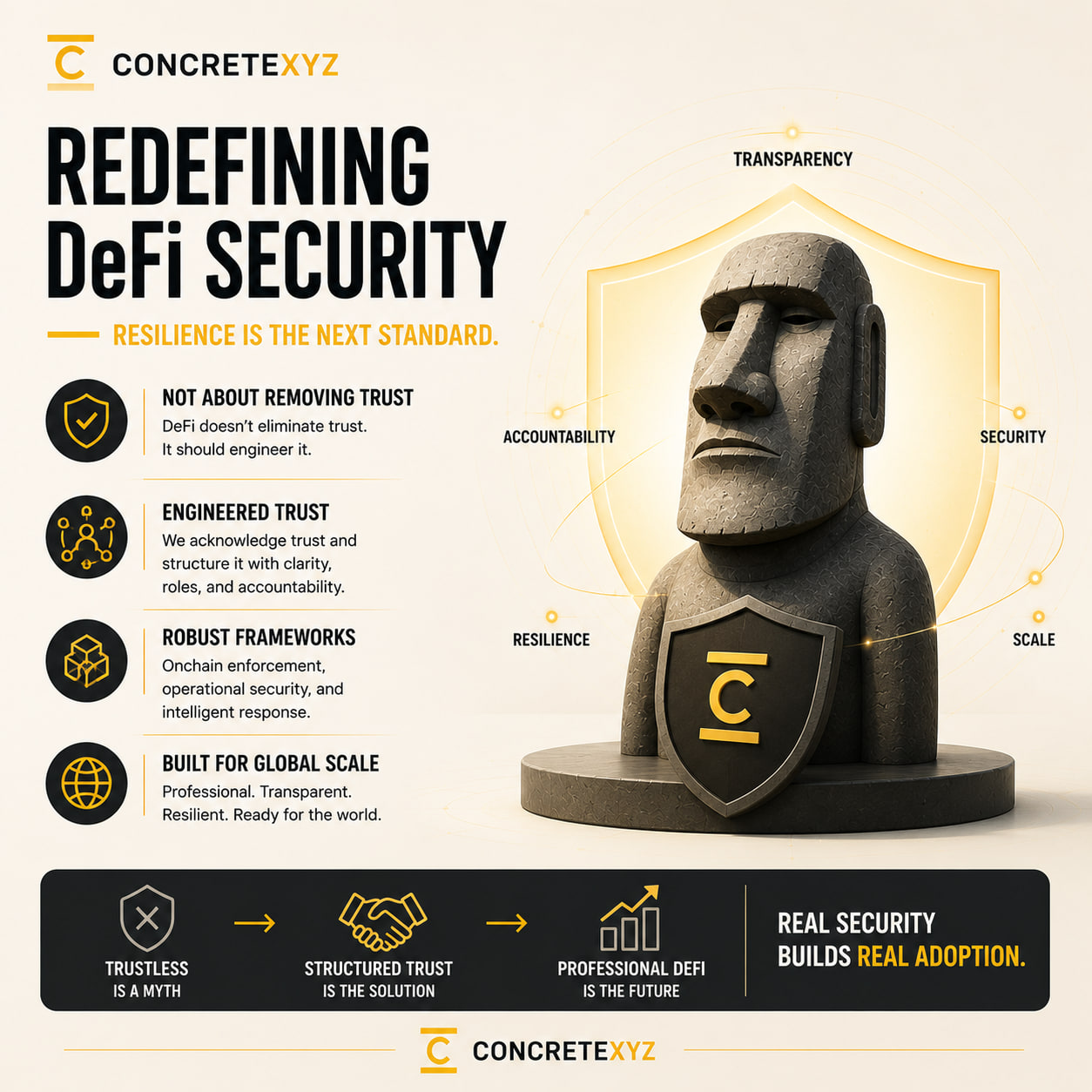
DeFi Doesn’t Remove Trust — It Engineers It
 Onanas3 min read·Just now
--
One of the most repeated ideas in crypto is that DeFi is “trustless”.
ೀ You don’t need banks.
ೀ You don’t need intermediaries.
ೀ You don’t need to trust people.
Just trust the code.
For a while, that idea felt revolutionary. Smart contracts replaced middlemen, transactions became transparent, and users gained direct control over their assets.
But as DeFi evolved, something became increasingly obvious:
Trust never disappeared.
It simply moved into different layers of the system.
And understanding where that trust exists may be one of the most important parts of understanding DeFi itself.
The Myth of “Trustless” Systems
The phrase “code is law” became one of the defining narratives of early DeFi.
The assumption was simple:
If rules are enforced by smart contracts, then human trust is no longer necessary.
But real systems are more complicated than that.
Even in DeFi, users still trust that:
- smart contracts are secure
- governance decisions are reasonable
- price oracles function correctly
- bridges remain safe
- execution layers behave as expected
The system may reduce certain forms of trust, but it does not eliminate them entirely.
The real question is not whether trust exists.
It’s where that trust exists — and whether it is visible, structured, and enforceable.
Where Trust Actually Lives
Most DeFi systems rely on multiple layers working together simultaneously.
A protocol may appear decentralized on the surface, but underneath, it still depends on assumptions.
Users trust smart contracts to execute correctly. They trust governance systems not to pass harmful proposals. They trust oracles to provide accurate pricing data. They trust bridges to move assets securely between chains.
In many cases, these dependencies are abstracted away from the user experience.
The interface feels simple.
But the trust assumptions remain underneath.
And when one of those assumptions fails, the consequences can spread quickly across the system.
The Problem With Decentralization Theatre
This is where an uncomfortable reality starts to appear.
Some systems look decentralized without necessarily being resilient.
A protocol may advertise governance, but only a small percentage of users actually participate in votes. A multisig wallet may improve operational control, but it still concentrates power among a few signers. Timelocks can delay malicious actions, but they do not automatically prevent bad decisions.
In other words:
The appearance of decentralization is not the same thing as actual safety.
This is sometimes called “decentralization theatre” — systems that market themselves as trustless while quietly depending on fragile structures behind the scenes.
And during periods of stress, those weaknesses become visible very quickly.
Trust as an Engineered System
As DeFi matures, a more realistic approach is beginning to emerge.
Trust is not removed.
It is engineered.
That means designing systems with:
- clearly defined roles
- transparent permissions
- enforced constraints
- operational procedures for failure scenarios
This is how mature financial infrastructure already works.
Not through the absence of trust, but through structured systems that define how trust operates.
In practice, engineered trust is often more reliable than pretending trust does not exist at all.
Why Operational Security Matters
One of the biggest lessons from DeFi over the last few years is that code alone cannot solve every problem.
Real systems require:
- monitoring
- rapid response mechanisms
- layered security models
- human judgment during edge cases
Markets move unpredictably. Liquidity conditions change. Exploits happen. Infrastructure fails.
A fully automated system without operational oversight may appear elegant in theory, but fragile in practice.
This is why operational security matters so much in modern DeFi infrastructure.
Resilience is not just about prevention.
It is also about response.
How Concrete Approaches Trust Differently
This is where Concrete takes a noticeably different approach.
Instead of hiding trust assumptions behind “trustless” narratives, the system makes them more explicit and structured.
Concrete focuses on:
- role-based architecture
- controlled execution environments
- onchain enforcement combined with off-chain intelligence
- systems designed for response as well as prevention
The goal is not to pretend trust disappears.
The goal is to design systems where trust is visible, constrained, and operationally manageable.
This creates a stronger foundation for both users and capital allocation over time.
In many ways, this approach reflects a broader shift happening across institutional DeFi and modern DeFi infrastructure.
The Bigger Shift
DeFi is slowly moving beyond simple “trustless” narratives.
As the industry matures, resilience is starting to matter more than ideology.
The systems that survive long term will likely be the ones that acknowledge trust honestly — and engineer it carefully.
Because in the end, infrastructure is not judged by slogans.
It is judged by how it behaves under stress.
And the future of DeFi may not belong to the protocols that claim to remove trust entirely.
It may belong to the ones that engineer it best.
──★ ˙🗿 ̟ !!
Explore Concrete at: https://concrete.xyz/