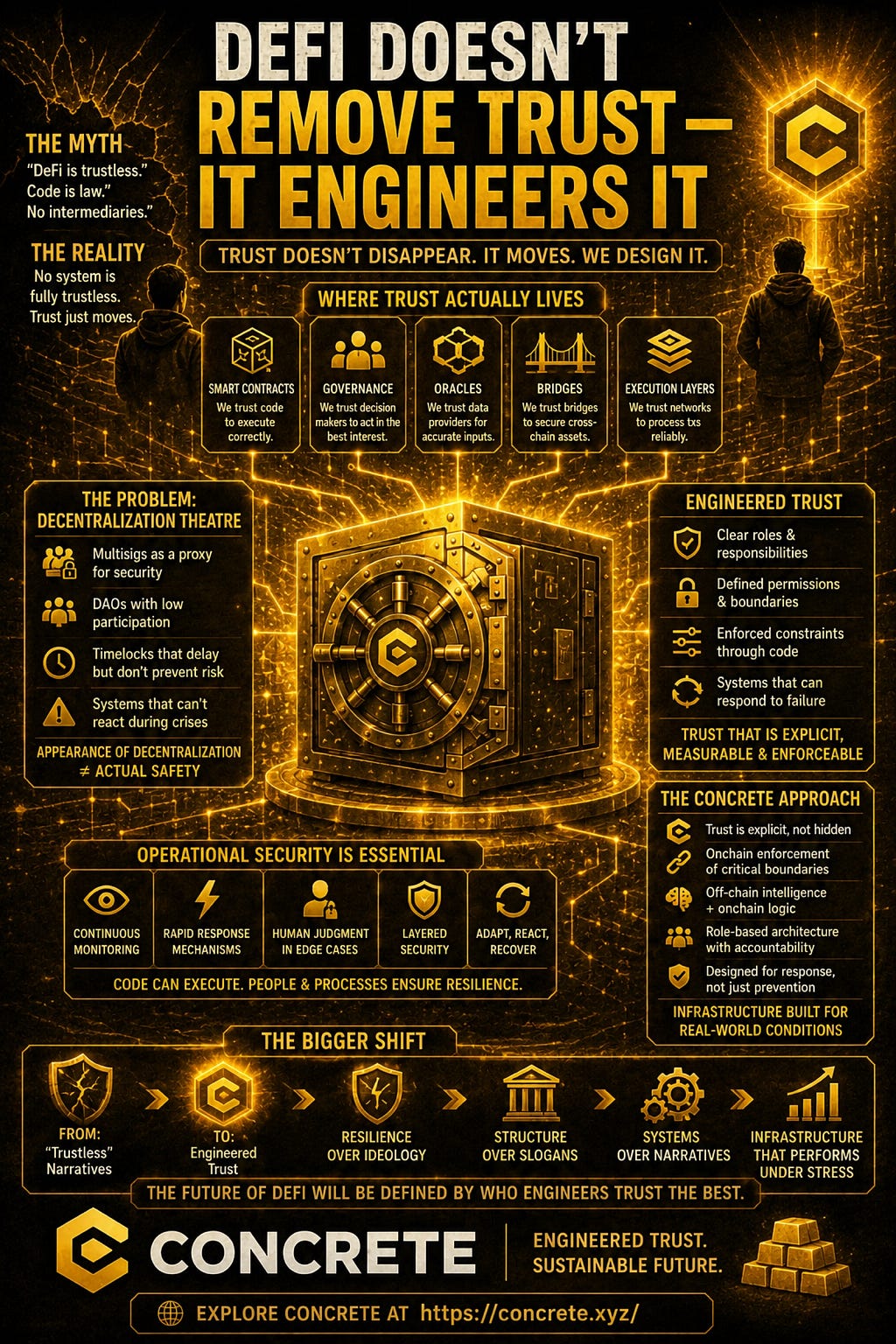
DeFi Doesn’t Remove Trust It Engineers It
 snowfall3 min read·Just now
--
DeFi was built on a powerful promise
“Don’t trust people Trust code”
At first this felt revolutionary
Smart contracts replaced intermediaries
Protocols ran autonomously
Finance without trust became the narrative
But as DeFi matured one thing became clear
Trust didn’t disappear It moved
The real question isn’t whether trust exists in DeFi
It’s where it exists and how it’s managed
1 The Myth of Trustless Systems
Early DeFi beliefs were simple
• Code is law
• Trustless systems
• No intermediaries required
These ideas challenged traditional finance but they also oversimplified reality
Truth
• No system is fully trustless
• Users still make trust assumptions
• Trust is just less visible not eliminated
2 Where Trust Actually Lives in DeFi
Trust exists across multiple hidden layers
Smart Contracts
• Users trust code is secure and audited
• Bugs or exploits can drain funds instantly
Governance Systems
• Token holders control decisions
• Participation is often low
• Power tends to concentrate
Oracles
• External data feeds power protocols
• Manipulation or failure can break systems
Bridges
• Move assets across chains
• One of the biggest attack surfaces in DeFi
Execution Layers
• Transaction ordering and MEV affect outcomes
• Users rely on fair and predictable execution
Key Insight
• Trust is not removed
• It is redistributed across layers
3 The Problem With Decentralization Theatre
Some systems look decentralized but are not truly resilient
This creates decentralization theatre
Common Patterns
• Multisigs
Small groups control critical functions
• DAOs with low participation
Governance exists but few actually vote
• Timelocks
Delay actions but do not prevent bad decisions
• Inflexible protocols
Cannot react during exploits or crises
Reality
• Appearance of decentralization does not equal safety
• Real resilience is tested during stress
4 Engineered Trust A Better Model
If trust is unavoidable the solution is to design it intentionally
Engineered trust means
• Clear roles and responsibilities
• Explicit permissions
• Enforced constraints
• Systems that can respond to failure
Shift happening in DeFi
• From ideology to infrastructure
• From trustless narratives to structured trust
5 Why Operational Security Matters
Code alone cannot handle every scenario
Real systems require
• Continuous monitoring
• Rapid response mechanisms
• Human judgment in edge cases
• Layered security models
Key Idea
• Prevention is not enough
• Systems must be able to respond
6 How Concrete Engineers Trust
A new approach is emerging where trust is explicit and designed
Concrete represents this shift
Core Principles
• Trust is explicit not hidden
• Trust is structured not assumed
• Trust is enforced not implied
How It Works
• Role based architecture
Clear permissions reduce ambiguity
• Onchain enforcement plus offchain intelligence
Combines automation with adaptability
• Controlled execution environments
Actions happen within strict boundaries
• Systems designed for response
Protocols can react safely during live incidents
Concrete Vaults
• Integrate DeFi security and operational controls
• Enable structured permissions
• Enforce actions directly onchain
Result
• Stronger operational security
• Better alignment with institutional DeFi needs
• Less reliance on decentralization theatre
7 The Bigger Shift in DeFi
The industry is evolving beyond the idea of removing trust
The future will be defined by
• Who acknowledges trust clearly
• Who structures it effectively
• Who enforces it reliably
• Who performs under stress
Final Thought
The strongest DeFi infrastructure will not be the one that claims to eliminate trust
It will be the one that engineers it best
🚨 Explore Concrete at https://concrete.xyz/