DeFi Doesn’t Remove Trust — It Engineers It
--
The siren song of the 2020 DeFi summer was a simple, revolutionary promise: “Trustless Finance.” We were told that “Code is Law,” that intermediaries were relics of a bloated past, and that for the first time in human history, we could transact without needing to believe in anyone or anything other than a cryptographic proof.
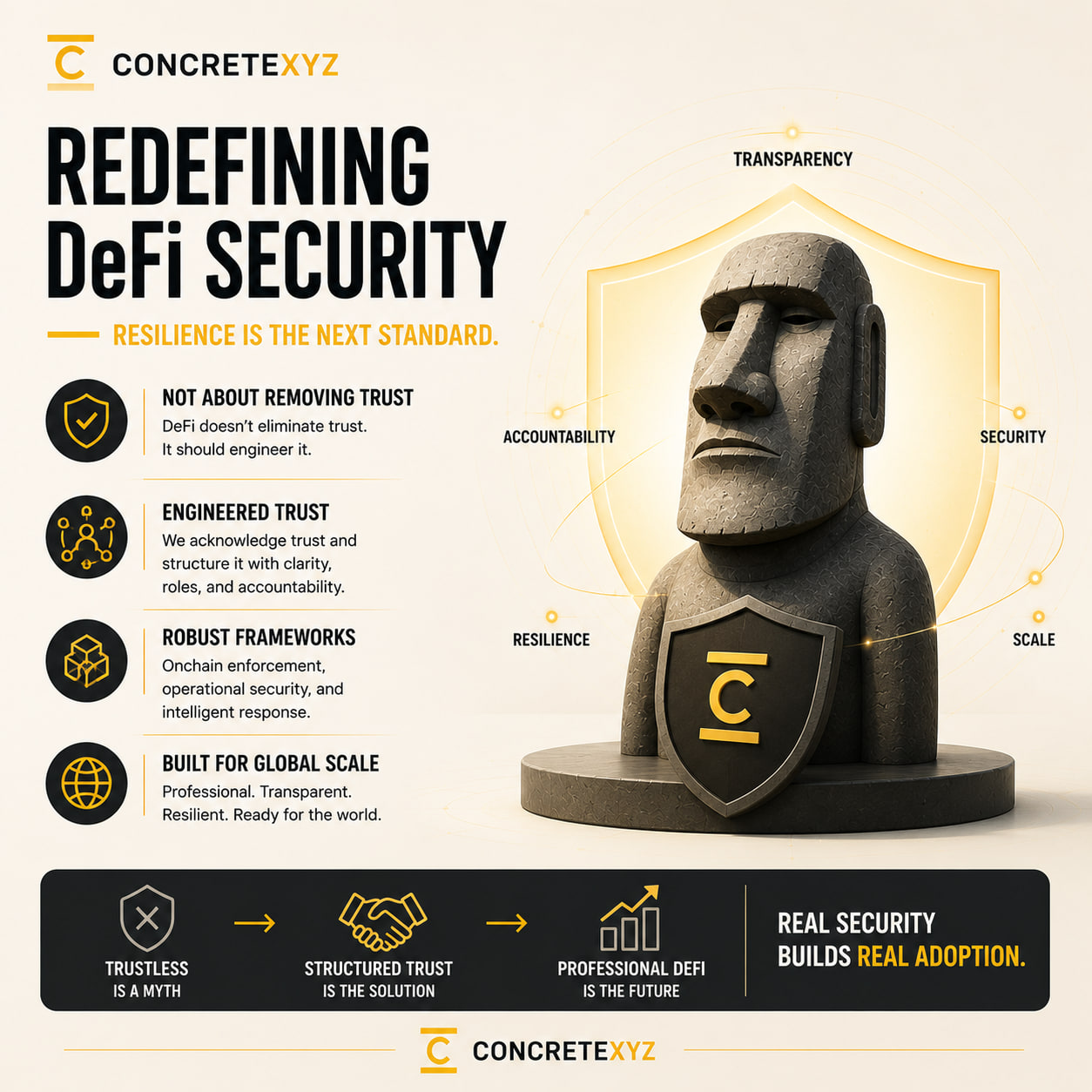
It’s a beautiful myth. But as the industry matures, we’re realizing that the myth is incomplete. DeFi doesn’t remove trust; it engineers it.
- The Myth of the Trustless Utopia
The core belief of DeFi infrastructure has always been rooted in the idea of total autonomy. The narrative suggests that once a contract is deployed, it exists in a vacuum, immune to human error, greed, or manipulation.
However, the tension is becoming impossible to ignore. In reality, no system is fully trustless. The moment you interact with a dapp, you aren’t removing trust; you are shifting it. You are moving your confidence from a bank manager in a suit to an anonymous developer’s logic, a third-party data feed, or a multisig quorum. The question isn’t whether trust exists, it’s where it lives and how it is managed.
2. Where Trust Actually Lives
If we peel back the “trustless” label, we find layers of hidden dependencies. Trust is abstracted, not eliminated:
- Smart Contract Assumptions: You trust that the compiler is bug-free and the logic accounts for every edge case.
- Oracle Dependencies: You trust that an external data feed won’t be manipulated or lag during a flash crash.
- Bridge Security: You trust that the locked collateral on Chain A is actually secured by the validators on Chain B.
- Governance Decisions: You trust that a handful of whales won’t vote for a proposal that drains the treasury.
3. The Danger of “Decentralization Theatre”
Many protocols suffer from Decentralization Theatre, the appearance of being community-led while hiding centralized points of failure.
We see DAOs with 2% participation making billion-dollar decisions, or “timelocks” that delay a rug-pull but don’t actually prevent it if the community isn’t paying attention. When systems are designed for the ideology of decentralization rather than the reality of safety, they become brittle. They lack the ability to react during critical moments, often paralyzed by the very “trustless” structures meant to protect them.
4. Transitioning to Engineered Trust
Mature financial systems don’t pretend that risk doesn’t exist. Instead, they utilize engineered trust. This means designing systems where trust is explicit, structured, and enforceable.
Engineered trust involves:
- Defined Permissions: Knowing exactly who can do what.
- Enforced Constraints: Code that doesn’t just run, but operates within strict safety bounds.
- Resiliency: Systems designed to fail gracefully rather than catastrophically.
This shift marks the transition from experimental DeFi to Institutional DeFi.
5. Why Operational Security Demands Human Intelligence
Code is excellent at executing “if/then” statements, but it is notoriously bad at handling “black swan” events. Real-world operational security requires:
- Constant monitoring.
- Rapid response mechanisms to pause or pivot.
- Layered security that assumes one layer will eventually fail.
Purely autonomous code cannot handle every scenario. True security requires a marriage between on-chain enforcement and intelligent, proactive oversight.
6. The Concrete Approach: Explicit over Implicit
This is where Concrete sets a new standard for the industry. While others hide behind the “trustless” label, Concrete prioritizes transparency and on-chain enforcement.
Concrete takes a fundamentally different approach to trust:
- Explicit Trust: We don’t hide the layers of the system. Roles are clear, and responsibilities are mapped.
- Response-Ready Design: Concrete is built for action, not just prevention. Our systems are designed to detect and respond to market stress in real-time.
- Hybrid Architecture: By combining on-chain enforcement with off-chain intelligence, Concrete ensures that Concrete vaults are protected by more than just static code.
- Controlled Execution: Through role-based architecture, we eliminate the “theatre” and replace it with professional-grade security.
7. The Bigger Shift: Resilience over Ideology
The trustless narrative served its purpose it got us started. But the next phase of DeFi will be defined by resilience.
We are moving into an era where infrastructure won’t be judged by how loudly it claims to be decentralized, but by how it behaves under extreme stress. The future belongs to the architects who acknowledge that trust is unavoidable and choose, instead, to engineer it with precision.
DeFi isn’t about removing faith in the system; it’s about building a system worthy of it.
For those looking to move beyond the myth, you can explore Concrete at https://concrete.xyz/