DeFi Doesn’t Remove Trust — It Engineers It
 Web3Kid4 min read·Just now
--
“Don’t trust people. Trust code.”
That idea helped define the early narrative of DeFi. Smart contracts replaced intermediaries. Transactions became transparent. Systems executed automatically.
For a while, it felt like trust had been removed entirely.
But as the ecosystem matured, something became clear.
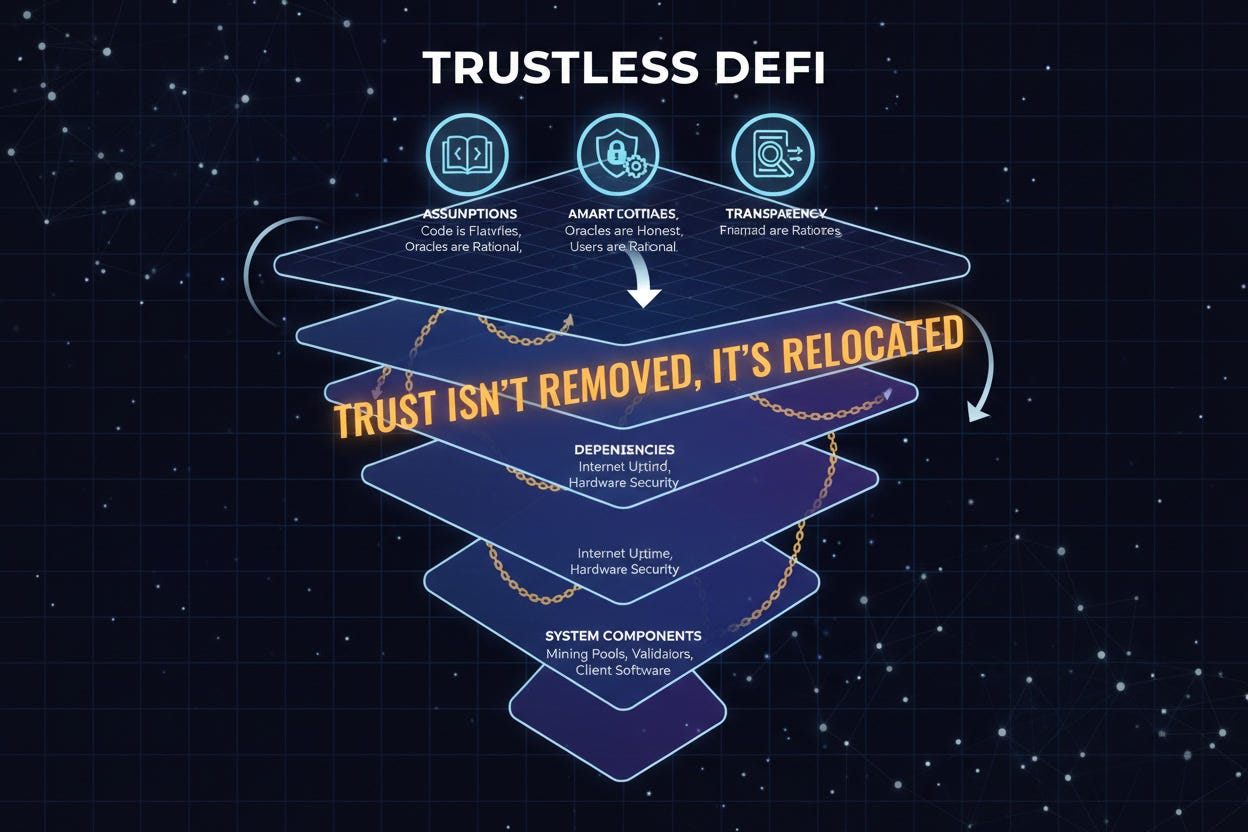
Trust didn’t disappear.
It just moved.
The Myth of Trustless Systems
DeFi is often described as “trustless.”
No banks. No centralized control. No need to rely on human judgment.
At a surface level, this is true. Code executes deterministically. Rules are visible. Anyone can verify how a system behaves.
But no real system operates without trust.
The question is not whether trust exists.
It is where it exists, and how it is managed.
Because even in DeFi, every interaction depends on a chain of assumptions.
Where Trust Actually Lives
Look closer at any DeFi system, and layers of trust begin to appear.
- You trust that smart contracts are written correctly and free of critical bugs.
- You trust that governance decisions are made responsibly.
- You trust that oracles provide accurate data.
- You trust that bridges move assets securely across chains.
- You trust that execution layers behave as expected under load.
None of these are optional.
They are foundational.
What DeFi does is not eliminate trust—it abstracts it, often pushing it into the background where users no longer see it directly.
The Problem With Decentralization Theatre
As DeFi has grown, so has the tendency to equate decentralization with safety.
But the two are not always aligned.
A protocol may rely on multisig wallets and appear secure, yet still depend on a small group of actors. A DAO may exist in name, but with minimal participation, leaving decisions concentrated among a few. Timelocks may delay changes, but not necessarily prevent harmful ones.
These structures create the appearance of decentralization, without always delivering true resilience.
This is what can be described as decentralization theatre.
It signals trustlessness, but does not fully enforce it.
And in critical moments—when markets are stressed or systems are attacked—these gaps become visible.
From Hidden Trust to Engineered Trust
If trust cannot be removed, the alternative is to design it deliberately.
This is the idea behind engineered trust.
Instead of assuming systems are safe because they are decentralized, engineered trust focuses on building structures where:
- Roles and responsibilities are clearly defined.
- Permissions are explicitly controlled.
- Constraints are enforced at the system level.
- Mechanisms exist to respond when things go wrong.
This approach mirrors how mature financial systems operate.
Trust is not eliminated. It is structured, monitored, and reinforced through design.
Why Operational Security Matters
In practice, no system can rely on code alone.
Markets evolve. Edge cases emerge. Unexpected conditions appear.
This is where operational security becomes critical.
Effective systems incorporate:
- Continuous monitoring of activity and risk.
- Rapid response mechanisms for abnormal conditions.
- Human judgment when predefined rules are insufficient.
- Layered defenses that reduce single points of failure.
These elements acknowledge a simple reality.
Code defines the rules, but real-world systems require adaptability.
Without it, even well-designed protocols can struggle under stress.
How Concrete Approaches Trust
This shift toward engineered trust is reflected in modern DeFi infrastructure, particularly in systems like Concrete vaults.
Instead of relying on the assumption of trustlessness, Concrete makes trust explicit and structured.
The architecture is designed with clear roles and controlled execution environments. Onchain enforcement ensures that rules are followed, while off-chain intelligence allows the system to adapt when conditions change.
Permissions are defined. Actions are constrained. Responses are possible.
This creates a model where trust is not hidden behind abstraction, but intentionally designed into the system.
The focus moves away from signaling decentralization and toward delivering reliable, resilient operation—a key requirement for both retail users and institutional DeFi participants.
A Different Standard for DeFi
As the ecosystem evolves, the definition of security is changing.
It is no longer enough for a system to claim it is trustless.
It must demonstrate how trust is handled, where it exists, and how it behaves under pressure.
This is especially important as more capital enters the space. Larger participants do not rely on narratives. They evaluate systems based on structure, controls, and response capabilities.
They look for infrastructure that is designed to operate not just in ideal conditions, but in difficult ones.
For those exploring this shift toward more robust systems, Concrete provides an example of how engineered trust can be applied in practice. You can learn more at https://concrete.xyz/
The Future Is Built on Designed Trust
DeFi began with a powerful idea.
Remove intermediaries. Replace trust with code.
But the next phase requires a more grounded perspective.
Trust is not something that can be eliminated from financial systems.
It can only be designed, structured, and enforced.
The protocols that recognize this will build stronger foundations. The ones that ignore it will continue to rely on assumptions that may not hold under stress.
In the end, the future of DeFi will not be defined by who claims to remove trust.
It will be defined by who engineers it best.