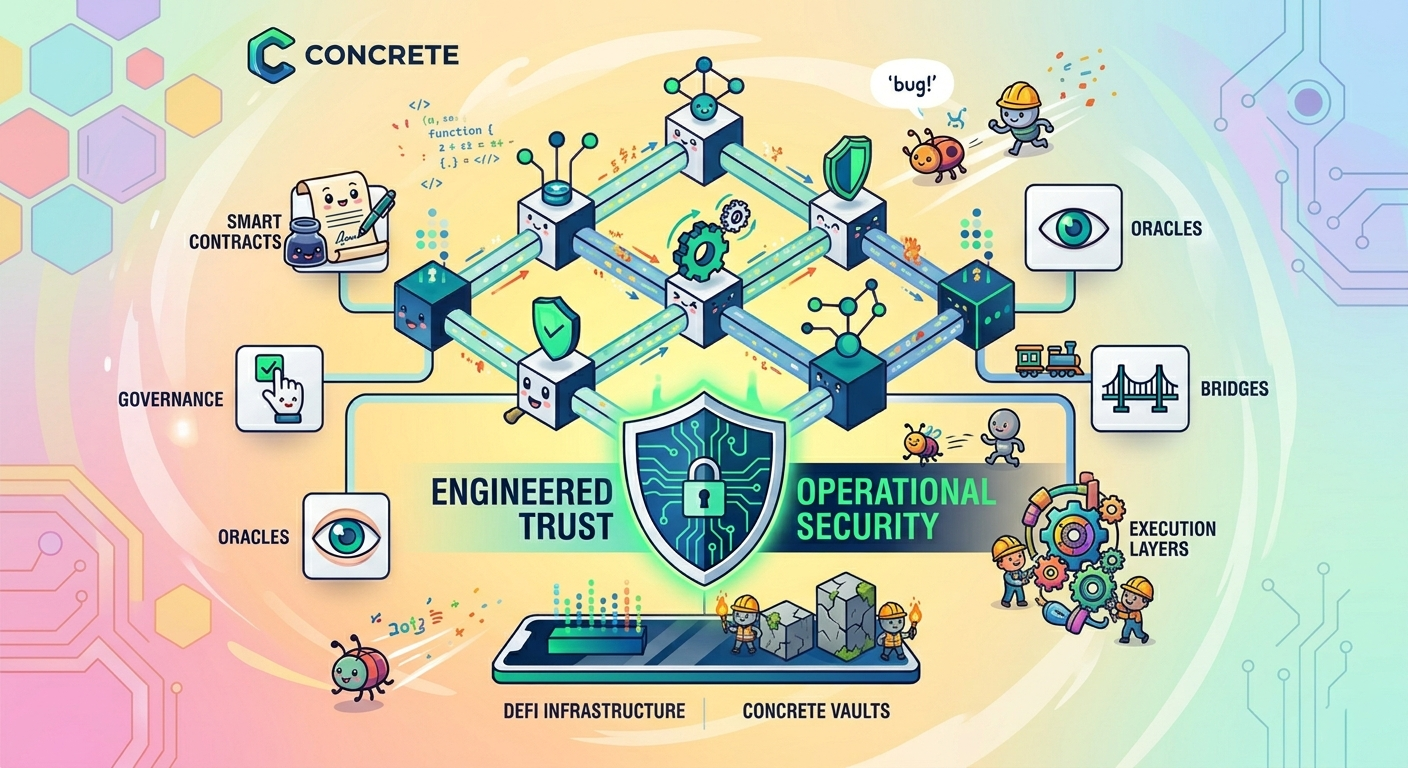
DeFi Doesn’t Remove Trust — It Engineers It
--
The founding myth of Decentralized Finance (DeFi) is as poetic as it is simple: “Don’t trust people. Trust code.”
We were promised a world where “Code is Law,” where intermediaries vanish, and where the phrase “trustless” acts as a silver bullet against human error and corporate greed. For a time, this narrative was enough to fuel an industry. But as the ecosystem matures, we are hitting a wall of reality.
In any complex financial system, trust is like energy — it cannot be destroyed, only transformed. The truth is that DeFi didn’t remove trust; it simply moved it.
The Hidden Architecture of Trust
When we say a protocol is trustless, we are often just participating in a collective abstraction. In reality, every interaction in DeFi is an act of faith in multiple layers of a technical stack:
- Smart Contract Assumptions: You trust that the logic is flawless and that the compiler didn’t introduce vulnerabilities.
- Oracle Dependencies: You trust that external data feeds won’t be manipulated or lag during a flash crash.
- Governance Systems: You trust that a handful of whales won’t vote in their own interest at the expense of the protocol.
- Bridges & Execution Layers: You trust the security of the “plumbing” that moves assets between chains.
Trust hasn’t disappeared; it has been abstracted away into code, often becoming harder to see — and therefore harder to manage.
The Trap of “Decentralization Theatre”
The industry’s obsession with the appearance of decentralization has led to a dangerous phenomenon: Decentralization Theatre.
This occurs when a project claims to be trustless but relies on fragile structures behind the curtain. We see it in DAOs with such low participation that a single entity controls the vote, or in multisigs that act as a proxy for security until a key is compromised. We see it in timelocks that provide the illusion of safety but offer no real protection when a black swan event requires a millisecond response.
The difference between the appearance of decentralization and actual safety is often found at the moment of failure. If a system cannot react during a crisis, it isn’t decentralized — it’s just defenseless.
Transitioning to Engineered Trust
Mature financial systems don’t rely on the hope that nothing will go wrong; they rely on Engineered Trust.
Engineered trust acknowledges that trust is unavoidable and, therefore, must be designed deliberately. It involves:
- Defined Permissions: Clear roles for who can do what and when.
- Enforced Constraints: Hardcoded limits that prevent catastrophic outcomes.
- Failure Response: Systems built to survive edge cases that code alone cannot predict.
This is the shift from ideology to operational security. Real-world DeFi infrastructure must recognize that while code is the foundation, human judgment and rapid response mechanisms are the walls that keep the house standing during a storm.
How Concrete Reimagines the Stack
At Concrete, we’ve moved past the “trustless” narrative to build something more resilient. We believe the next phase of institutional DeFi depends on making trust explicit, structured, and enforceable.
Instead of hiding behind decentralization theatre, Concrete prioritizes a framework of onchain enforcement combined with off-chain intelligence.
- Explicit Trust: We don’t pretend trust doesn’t exist; we define it through role-based architecture.
- Controlled Execution: Our environments are designed for response, not just prevention.
- Operational Security: By utilizing Concrete vaults, we ensure that assets are protected by layered security that accounts for market volatility and technical risk in real-time.
We focus on how the system behaves under stress, ensuring that the infrastructure is as robust as the assets it carries.
The igger Shift: Resilience Over Ideology
The future of DeFi infrastructure will not be defined by who makes the loudest claims about being “trustless.” It will be defined by who engineers trust the most effectively.
We are moving into an era where resilience matters more than ideology. To scale to the next trillion dollars, DeFi must embrace engineered trust — a model where roles are clear, security is layered, and the system is built to withstand the unpredictability of the real world.
The evolution of finance isn’t about removing the need for trust; it’s about finally building a system worthy of it.
Explore the future of engineered trust at Concrete.xyz