DeFi Doesn’t Remove Trust — It
 Asdf Asdf3 min read·Just now
--
Engineers It
Decentralized Finance (DeFi) was born from a powerful idea:
“Don’t trust people. Trust code.”
For a time, this belief shaped the entire industry. Smart contracts replaced intermediaries, protocols replaced institutions, and “trustless” became the defining narrative. The promise was simple — a financial system where human trust was no longer required.
But as DeFi evolved, reality told a different story.
Trust didn’t disappear. It just moved.
---
The Myth of “Trustless” Systems
The idea that DeFi is completely trustless is more of a slogan than a fact. While code reduces reliance on traditional intermediaries, it does not eliminate trust entirely.
Instead, users now place trust in:
- Smart contracts executing correctly
- Governance systems making sound decisions
- Oracles providing accurate data
- Bridges securing cross-chain assets
- Execution layers processing transactions reliably
No matter how decentralized a system claims to be, trust still exists — just in different forms.
The real question is not whether trust exists, but where it exists and how it is managed.
---
Where Trust Actually Lives in DeFi
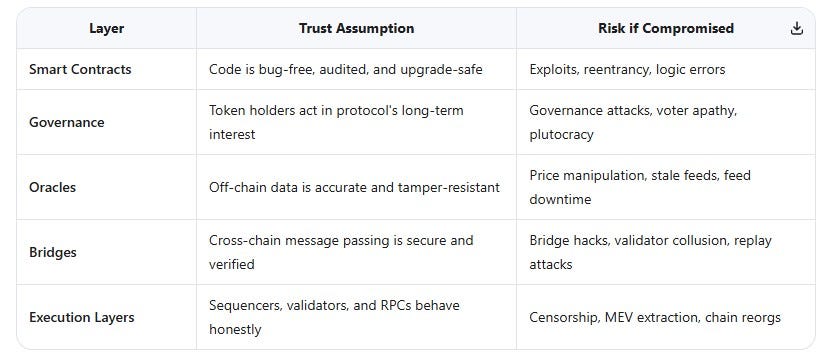
DeFi systems are built on multiple layers, each introducing its own assumptions and risks.
Smart contracts, for example, are only as secure as their code. Bugs or exploits can lead to massive losses. Governance systems rely on token holders, but low participation often concentrates power in a few hands.
Oracles act as the bridge between on-chain and off-chain data, yet they introduce external dependencies. Similarly, cross-chain bridges — often targeted by attackers — represent one of the most fragile points in the ecosystem.
What appears to be “trustless” is often trust abstracted away from the user’s view.
---
The Problem With Decentralization Theatre
Not all decentralization is meaningful.
Many protocols create the appearance of decentralization without delivering true resilience. This is often referred to as decentralization theatre.
Examples include:
- Multisig wallets that act as centralized control points
- DAOs with low voter participation
- Timelocks that delay actions but don’t prevent harmful decisions
- Systems that fail to respond quickly during crises
These mechanisms may look decentralized on the surface, but they don’t necessarily improve security or reliability.
There is a clear difference between:
- Appearing decentralized
- Actually being safe and resilient
---
Engineered Trust: A Better Model
Instead of pretending trust doesn’t exist, the next phase of DeFi focuses on engineering trust deliberately.
Engineered trust means:
- Clearly defined roles and responsibilities
- Explicit permission structures
- Enforced operational constraints
- Systems designed to respond to failures
This approach mirrors mature financial systems, where trust is not hidden — it is structured and continuously managed.
---
Why Operational Security Matters
Real-world systems are complex. Code alone cannot handle every possible scenario.
That’s why effective DeFi infrastructure requires:
- Continuous monitoring
- Rapid response mechanisms
- Human judgment for edge cases
- Layered security frameworks
Without these elements, even the most advanced smart contracts can fail under unexpected conditions.
Operational security is not optional — it is essential.
---
How Concrete Engineers Trust
Concrete represents a shift in how DeFi infrastructure is designed.
Instead of hiding trust assumptions, Concrete makes them explicit and enforceable.
Its approach includes:
- Transparent trust structures rather than hidden dependencies
- Systems built for response, not just prevention
- A combination of on-chain enforcement and off-chain intelligence
- Role-based architecture with clearly defined permissions
- Controlled execution environments for safer operations
Concrete vaults are designed with operational security at their core, prioritizing resilience over narrative-driven decentralization.
This is not about removing trust — it’s about designing it properly.
The Bigger Shift in DeFi
DeFi is entering a new phase.
The industry is moving beyond the idea of being “trustless” and toward systems that acknowledge reality:
- Trust is unavoidable
- Security must be structured
- Resilience matters more than ideology
The future of DeFi infrastructure will not be defined by who claims to eliminate trust.
It will be defined by who engineers it best.