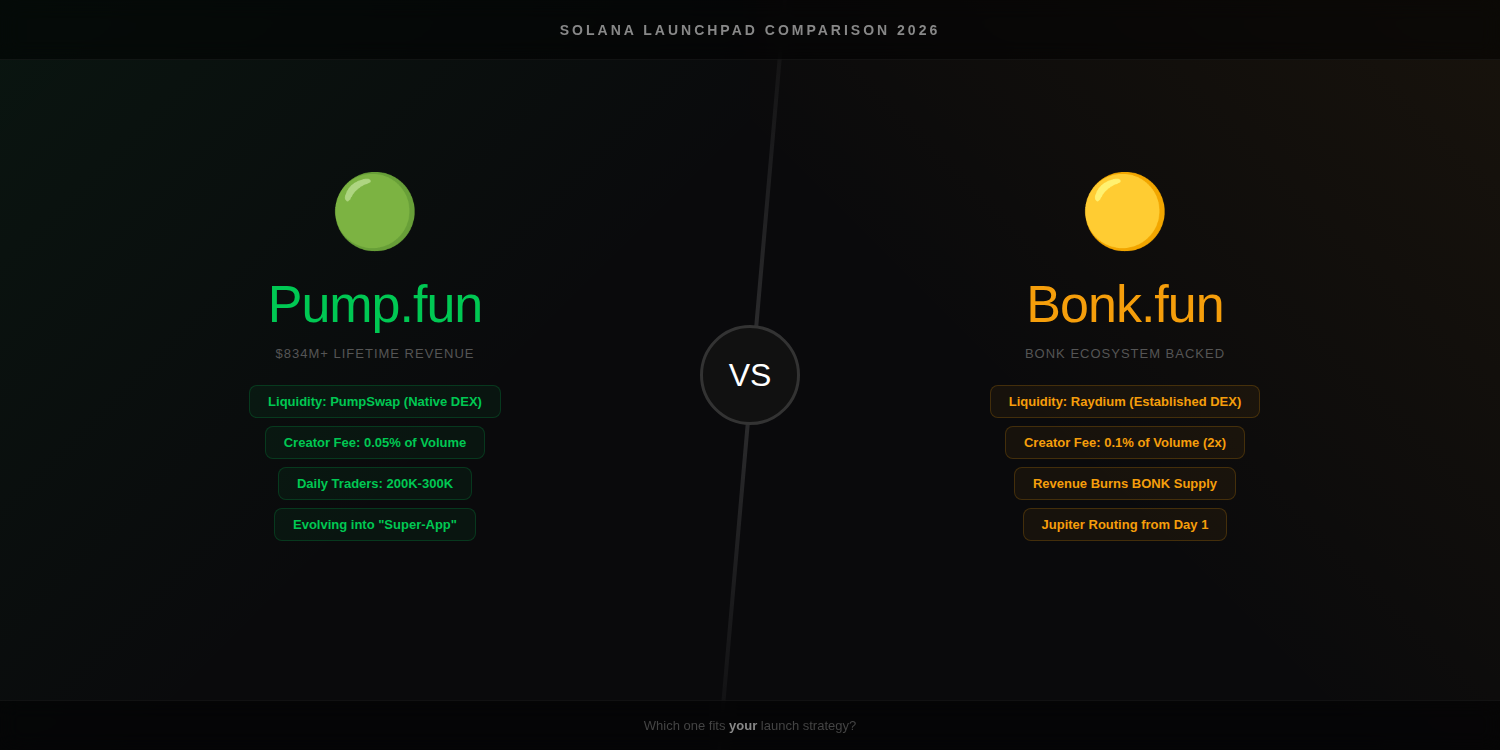
Decision flowchart helping token creators choose between Pump.fun for speculative volume or Bonk.fun for broader ecosystem exposurePump.fun vs Bonk.fun: Which Solana Launchpad Should You Use in 2026?
 J Tools8 min read·Just now
--
A year ago, Pump.fun owned 90% of the Solana memecoin launchpad market. Then Bonk.fun showed up and took more than half of it in three weeks. Now the landscape looks completely different. Here’s what actually matters if you’re choosing where to launch.
If you’re launching a token on Solana in 2026, you’re probably looking at two platforms: Pump.fun and Bonk.fun (formerly LetsBonk). They look similar on the surface. Both let you create a memecoin in under a minute, no code required. (If you’re going the Pump.fun route, tools like Pumpfun Create and Pumpfun Create & Bundle Buy handle the entire process, including coordinated buys in the same block for anti-frontrun protection.) Both use bonding curves for initial price discovery. Both have massive daily volume.
But the similarities end there. How they handle fees, where your token’s liquidity ends up, what happens after graduation, and who’s actually trading on each platform are all very different. And those differences matter a lot more than most comparison articles will tell you.
This isn’t a “which one is better” article. It’s a “which one is better for your specific situation” breakdown. Because the answer genuinely depends on what you’re trying to do.
The Market Share War: A Quick Timeline
Before we compare features, you need to understand the context. The Pump.fun vs Bonk.fun story is one of the most dramatic market share swings in DeFi history.
Early 2025: Pump.fun dominates everything. Over 90% of all Solana memecoin launches happen on their platform. They’ve generated over $250 million in revenue. Nobody comes close.
April 2025: Bonk.fun launches. Built by the team behind the BONK memecoin (one of Solana’s largest memecoins with a $1.8 billion market cap at the time), it arrives with an existing community of over a million BONK holders. It offers higher creator rewards and channels fees into BONK buybacks and burns.
July 2025: The flip. Bonk.fun overtakes Pump.fun in daily token launches, revenue, and trading volume. At its peak, Bonk.fun controls about 64% of the launchpad market while Pump.fun drops to 24%. Top creators leave Pump.fun in droves. Headlines declare Pump.fun dead.
August 2025: Pump.fun fights back. It introduces dynamic fees, a massive buyback program (over $68 million in PUMP token buybacks), and regains dominance. By mid-August, Pump.fun is back at 73.6% market share while Bonk.fun collapses to 15.3%.
September 2025 onward: Pump.fun accounts for 91% of daily Solana token listings. Bonk.fun drops to 3%. But Bonk.fun isn’t dead. It retains a loyal user base and continues innovating.
2026: Both platforms evolve significantly. Pump.fun pivots toward becoming a “super-app” with prediction markets (Pumpcade), perpetual futures, multi-asset trading, and creator fee overhauls. Its lifetime revenue crosses $834 million. Bonk.fun maintains steady activity with its BONK-ecosystem advantages and Raydium integration. A $5.5 billion class-action lawsuit hangs over Pump.fun. And a federal judge rules that memecoins launched on these platforms are not securities (the Jenner ruling, April 2026), giving both platforms some regulatory relief.
That’s a lot. Now let’s break down what actually matters for your launch decision.
Where Does Your Token’s Liquidity Go?
This is the single most important technical difference between the two platforms, and most people don’t fully understand it.
Pump.fun: When your token completes its bonding curve (reaches $69,000 market cap), it automatically migrates to PumpSwap, Pump.fun’s own native DEX. No migration fee. The liquidity pool is created automatically on PumpSwap’s AMM (similar to Uniswap v2 / Raydium v4). Your token lives inside Pump.fun’s ecosystem. One thing worth knowing: if you launch through a bundle buy tool (like Pumpfun Create & Bundle Buy), your initial buys execute in the same block as the token creation. This means no one can frontrun your launch, which is a real problem on Pump.fun where snipers are constantly watching for new tokens.
Bonk.fun: When your token graduates, liquidity migrates to Raydium, the largest established DEX on Solana with over $1 billion in TVL. Your token gets a Raydium liquidity pool and is accessible through Jupiter routing, which means better discoverability across the broader Solana ecosystem.
Why this matters for you:
If your goal is to build something beyond the initial launch hype, Raydium integration (Bonk.fun) gives you broader exposure. Your token appears on more aggregators, more trading terminals, and more portfolio trackers by default. Raydium’s deeper ecosystem liquidity also means your token can benefit from cross-pair routing.
If you want to stay within the Pump.fun ecosystem (which has 200,000 to 300,000 daily active traders), PumpSwap keeps your token where the most speculative volume happens. For short-lifecycle memecoins, this concentration of attention can actually be an advantage.
For J Tools users specifically: Liquidity Add/Remove supports both PumpSwap and Raydium (plus Meteora and Orca), so you can manage your LP position regardless of which platform you launch on.
Fee Structure and Creator Rewards
This is where Bonk.fun has historically been more generous, though Pump.fun has been closing the gap.
Pump.fun fees:
- 0.25% per trade on PumpSwap (0.20% to LP providers, 0.05% to protocol)
- 0.05% of trading volume goes to token creators
- Dynamic fee model introduced in late 2025 links creator fees to market cap
- Platform revenue funds PUMP token buybacks
Bonk.fun fees:
- 1% transaction fee, split three ways: 40% platform development, 30% validator support, 30% BONK buybacks and burns
- 0.1% of volume goes to token creators (double what Pump.fun offers)
- Revenue allocated to buybacks directly reduces BONK circulating supply
The bottom line: If you’re launching a token and want to maximize your creator earnings, Bonk.fun pays you roughly 2x what Pump.fun does on a per-volume basis. But Pump.fun has significantly more volume, so your total earnings might still be higher there.
The real question isn’t “which fee is better” but “which platform will your specific token get more trading volume on?” A token that gets 10x the volume on Pump.fun will earn more even at half the creator fee rate.
Token Graduation and Survival Rates
Both platforms create thousands of tokens daily. The vast majority die within hours. But the survival rates tell an interesting story.
Pump.fun: Launches 20,000 to 30,000 tokens per day. Graduation rate (tokens that complete the bonding curve) hovers around 0.84%. That means roughly 170 to 250 tokens graduate daily out of tens of thousands.
Bonk.fun: At its peak, launched over 26,000 tokens in a single day. Graduation rate sits around 1.07% to 2.26% depending on the period. Slightly higher than Pump.fun, possibly because Bonk.fun’s smaller but more engaged community creates slightly more “intentional” launches versus bot-generated spam.
What this means: On both platforms, over 98% of tokens never graduate. The platform you choose matters far less than what you do with your token after launch. The metadata, the community, the liquidity management, the authority settings. These are what determine whether your token survives, not whether you pressed “Create” on Pump.fun or Bonk.fun.
The Ecosystem Factor
Beyond the technical comparison, each platform exists within a different ecosystem context.
Pump.fun’s ecosystem (2026):
- PumpSwap (native DEX)
- Pumpcade (prediction market, launching 2026)
- Multi-asset trading support (WBTC, WETH on Pump.fun)
- Glass Full Foundation (liquidity support for promising tokens)
- Social trading features, livestreams
- $5.5 billion class-action lawsuit pending (RICO allegations)
- PUMP token down 60% from ICO price despite $352 million in buybacks
Bonk.fun’s ecosystem (2026):
- Raydium integration (LaunchLab)
- Jupiter aggregator routing
- BONK ecosystem (BonkBot telegram trader, Buddies for Paws charity, gaming integrations)
- BONK token with established market cap and community
- No major pending legal issues
- Revenue directly burns BONK supply (deflationary pressure)
The ecosystem difference matters because it affects your token’s long-term trajectory. A token launched on Pump.fun lives in a walled garden that’s expanding rapidly but faces legal uncertainty. A token launched on Bonk.fun enters the broader Raydium/Jupiter ecosystem from day one, but with less concentrated speculative attention.
So Which One Should You Use?
Here’s my honest framework. The answer depends on four things:
Choose Pump.fun if:
- Your token is designed for fast, speculative trading (memecoins, trend tokens)
- You want maximum initial exposure (200K-300K daily active traders)
- You plan to manage the token actively within the first 48 hours
- You’re comfortable with PumpSwap as your primary liquidity venue
- Short lifecycle is acceptable or expected
Choose Bonk.fun if:
- You want your token to have broader Solana ecosystem exposure from day one
- Higher creator revenue share matters to your project economics
- You prefer Raydium liquidity (deeper, more established, better cross-pair routing)
- Your audience overlaps with the BONK community
- You’re building something that needs longer-term sustainability
Consider both if:
- You’re running a campaign and want to test which platform gives better results
- You have multiple token concepts with different goals
The J Tools angle: Regardless of which platform you launch on, the post-launch work is identical. You still need to revoke unnecessary authorities (Revoke Mint, Revoke Freeze). You still need clean metadata (Update Metadata). You still need to monitor holders (Token Snapshot) and manage liquidity (Liquidity Add/Remove). The platform choice affects where your token starts. What you do after launch determines where it ends up.
What Neither Platform Will Tell You
Both Pump.fun and Bonk.fun want you to launch tokens. That’s how they make money. Neither platform has strong incentives to tell you that over 98% of tokens launched on their platform will be worthless within a week.
The launchpad is just the starting line. The real work, the stuff that separates the 2% that graduate from the 98% that don’t, happens after your token is live. Metadata. Authorities. Liquidity. Distribution. Community. Operations.
If you’re spending more time choosing between Pump.fun and Bonk.fun than you are planning your post-launch strategy, your priorities are backwards.
Pick a platform. Launch. Then do the actual work.
This content is for educational purposes only and does not constitute financial advice. Token launches carry significant risk. Always do your own research.
Launchpad comparison data sourced from DeFiLlama, Dune Analytics, and platform documentation. Tools referenced in this article are available at j.tools. Non-custodial, no private keys required.