
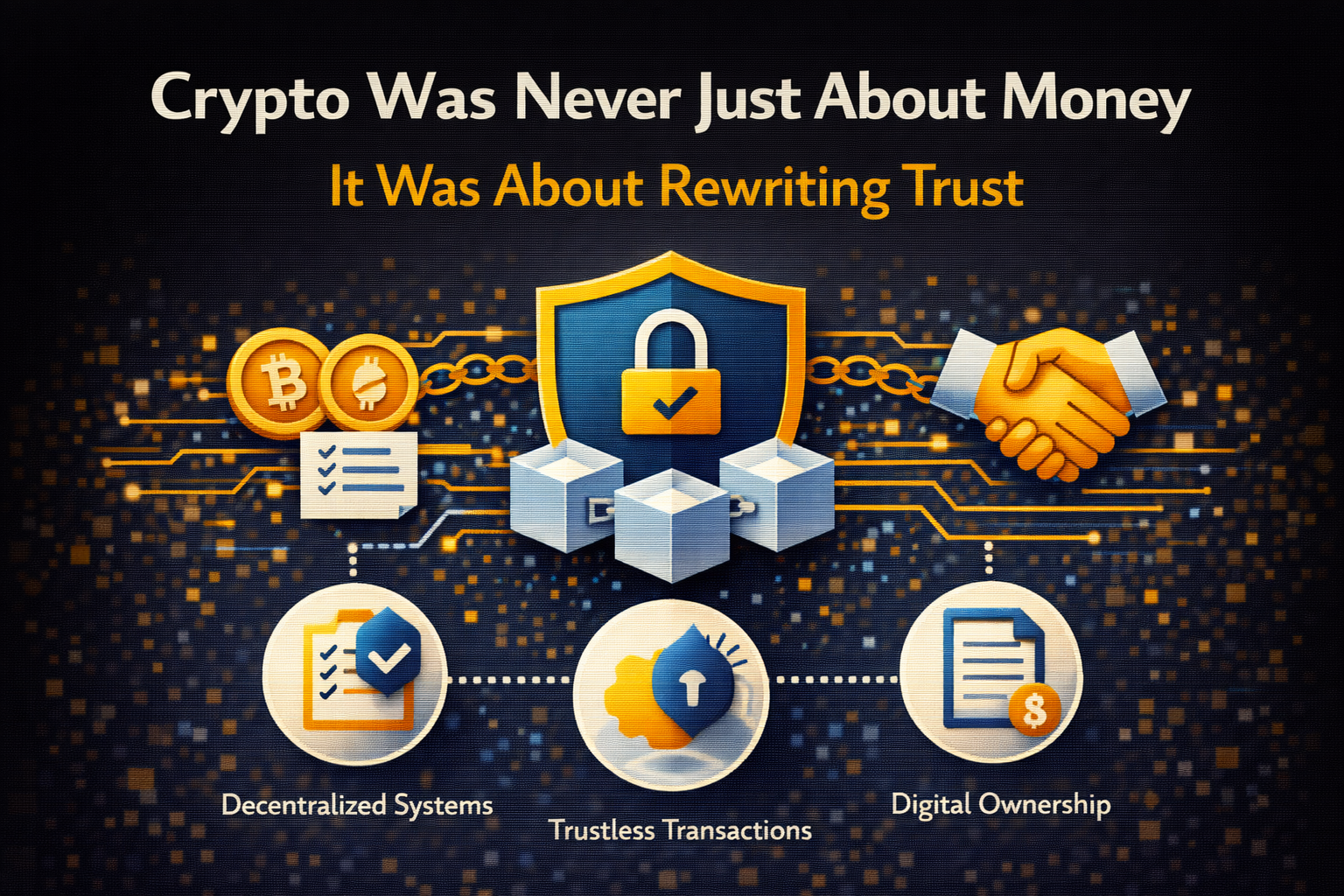
Crypto Was Never Just About Money-It Was About Rewriting Trust
When most people hear the word crypto, they think of price charts.
 AniketBuilds4 min read·Just now
--
Bitcoin hitting new highs.
Tokens crashing overnight.
Memecoins appearing out of nowhere.
The conversation often revolves around speculation.
But focusing only on prices misses something deeper.
Cryptocurrency is not just about digital money.
It is about a new way of coordinating trust between strangers on the internet.
And that idea is far more important than any market cycle.
The internet solved communication; but not trust
The internet made it possible for billions of people to communicate instantly.
You can send messages across continents in seconds.
You can publish information that anyone can access.
But one thing the internet struggled with for decades was trust.
If someone you’ve never met sends you a digital file, how do you know it’s authentic?
If someone promises to send money online, how do you verify it without relying on a third party?
For years, the solution was intermediaries.
Banks confirmed financial transactions.
Platforms verified identities.
Companies maintained centralized databases.
These institutions acted as trust layers for the digital world.
Crypto proposed a different approach.
The idea that changed everything
In 2008, a person (or group) known as Satoshi Nakamoto introduced Bitcoin.
The whitepaper described something radical:
A decentralized system where participants could agree on the history of transactions without trusting a central authority.
Instead of relying on banks, the system relied on:
Cryptography
Distributed networks
Economic incentives
This combination allowed thousands of independent computers to maintain a shared ledger.
No single entity controlled it.
And yet the system could still verify transactions.
This was the birth of blockchain-based trust systems.
Why digital scarcity matters
Before cryptocurrencies existed, digital objects could be copied endlessly.
A digital file could be duplicated thousands of times without losing quality.
That made it impossible to create scarcity online.
Bitcoin introduced the concept of provable digital scarcity.
The network enforces a fixed supply of 21 million coins.
Every transaction is recorded publicly.
And ownership can be verified mathematically.
For the first time in internet history, a digital asset could be both:
Copyable in theory, but scarce in practice.
This changed how people think about digital value.
Crypto as programmable money
Traditional financial systems are rigid.
Sending money across borders can take days.
Financial contracts often require lawyers, banks, and intermediaries.
Crypto introduced a different concept:
Programmable money.
With blockchain networks like Ethereum, developers can write smart contracts that automatically execute financial logic.
For example:
A loan agreement can release funds once collateral is deposited.
A payment can occur automatically when a condition is met.
An investment pool can distribute profits according to predefined rules.
These systems operate through code rather than institutions.
This is why crypto is often described as financial infrastructure built on software.
The rise of open financial networks
One of the most interesting aspects of crypto is that many protocols are open source.
Anyone can inspect the code.
Anyone can build applications on top of existing networks.
This creates financial systems that behave more like the internet itself.
Developers build new services by stacking protocols together.
Wallets connect to exchanges.
Exchanges connect to lending platforms.
Lending platforms connect to liquidity pools.
Instead of isolated institutions, crypto creates interconnected financial networks.
Why crypto keeps evolving
Every technological revolution goes through cycles.
The internet had the dot-com bubble.
Mobile technology had app market saturation.
Crypto is no different.
Speculation often moves faster than infrastructure.
But underneath the noise, developers continue building.
Today the crypto ecosystem includes innovations such as:
Decentralized finance (DeFi)
Stablecoins that maintain price stability
Tokenized assets representing real-world value
Decentralized identity systems
Blockchain-based governance structures
Many of these ideas are still experimental.
But experimentation is how technological ecosystems mature.
The tension between decentralization and regulation
As crypto grows, governments and regulators are paying closer attention.
Financial systems cannot operate entirely outside regulatory frameworks.
Issues such as fraud prevention, consumer protection, and financial transparency must be addressed.
This creates an ongoing tension.
Crypto was born from the idea of decentralization.
Regulation introduces oversight and structure.
The future of the industry will likely involve a balance between these forces.
Innovation must coexist with responsibility.
Why crypto still matters
After years of headlines, hype cycles, and criticism, it’s easy to forget why crypto attracted attention in the first place.
At its core, crypto is about expanding the possibilities of digital systems.
It allows value to move across borders without friction.
It enables financial experimentation without traditional barriers.
It gives individuals more direct control over digital assets.
Whether every current project succeeds is less important than the broader shift.
Crypto introduced a new way of thinking about ownership, trust, and coordination on the internet.
The bigger question
The real question surrounding crypto is not:
“Which token will increase in value?”
The more interesting question is:
“What happens when financial infrastructure becomes open, programmable, and globally accessible?”
That transformation could influence:
Banking
Payments
Digital identity
Asset ownership
Online communities
Crypto may not replace traditional finance entirely.
But it has already introduced ideas that will shape the next generation of financial technology.
Final thought
Technologies often look chaotic in their early stages.
The internet once seemed confusing and speculative.
Social media once appeared trivial.
But over time, the underlying ideas reshape entire industries.
Crypto might follow a similar path.
Not because every token succeeds.
But because the concept of decentralized trust systems has permanently changed how people think about the future of finance.
And sometimes, the most important innovations are not the ones that dominate headlines.
They are the ones quietly redefining how systems work underneath.