Crypto Exchange API Integration: A Practical Way to Add Cross-Chain Swaps to Your Platform
--
Crypto products are evolving quickly, but one problem remains consistent: integrating exchange functionality is still complex. Whether it is a wallet, payment gateway, or crypto service, enabling users to swap assets across chains often requires significant development effort.
Crypto exchange API integration has emerged as a solution, yet many implementations still involve technical overhead that slows down product deployment.
The Real Problem: Exchange Infrastructure Complexity
Building an exchange feature internally involves more than connecting blockchains. It requires:
- Monitoring transactions across multiple networks
- Managing liquidity and pricing mechanisms
- Handling confirmations and execution timing
- Ensuring secure and automated delivery
This level of complexity creates delays, especially for teams that are focused on user-facing products rather than backend infrastructure.
Why APIs Are Changing the Approach
Instead of building everything internally, platforms are increasingly turning to exchange APIs. These APIs allow developers to plug exchange functionality directly into their systems.
The benefits are clear:
- Faster time to market
- Lower operational burden
- Simplified architecture
However, not all APIs solve the problem completely. Some still require user accounts, additional steps, or partial manual handling.
What Makes an Effective Exchange API
An effective exchange API should provide:
- Full automation from deposit to delivery
- Cross-chain support without extra configuration
- Transparent tracking of transactions
- Minimal friction for end users
In practical terms, users should not feel like they are interacting with multiple systems.
CCE Cash as an API Integration Option
CCE Cash provides a crypto exchange API integration designed to simplify this process.
The system is fully automated:
- A deposit is detected
- The exchange is processed
- Funds are delivered to the destination address
No user registration is required, which removes a major barrier in user experience design.
How This Applies to Real Products
Consider a multi-chain wallet. Users often hold assets across different networks but lack an easy way to rebalance or convert them within the same interface.
By integrating an exchange API:
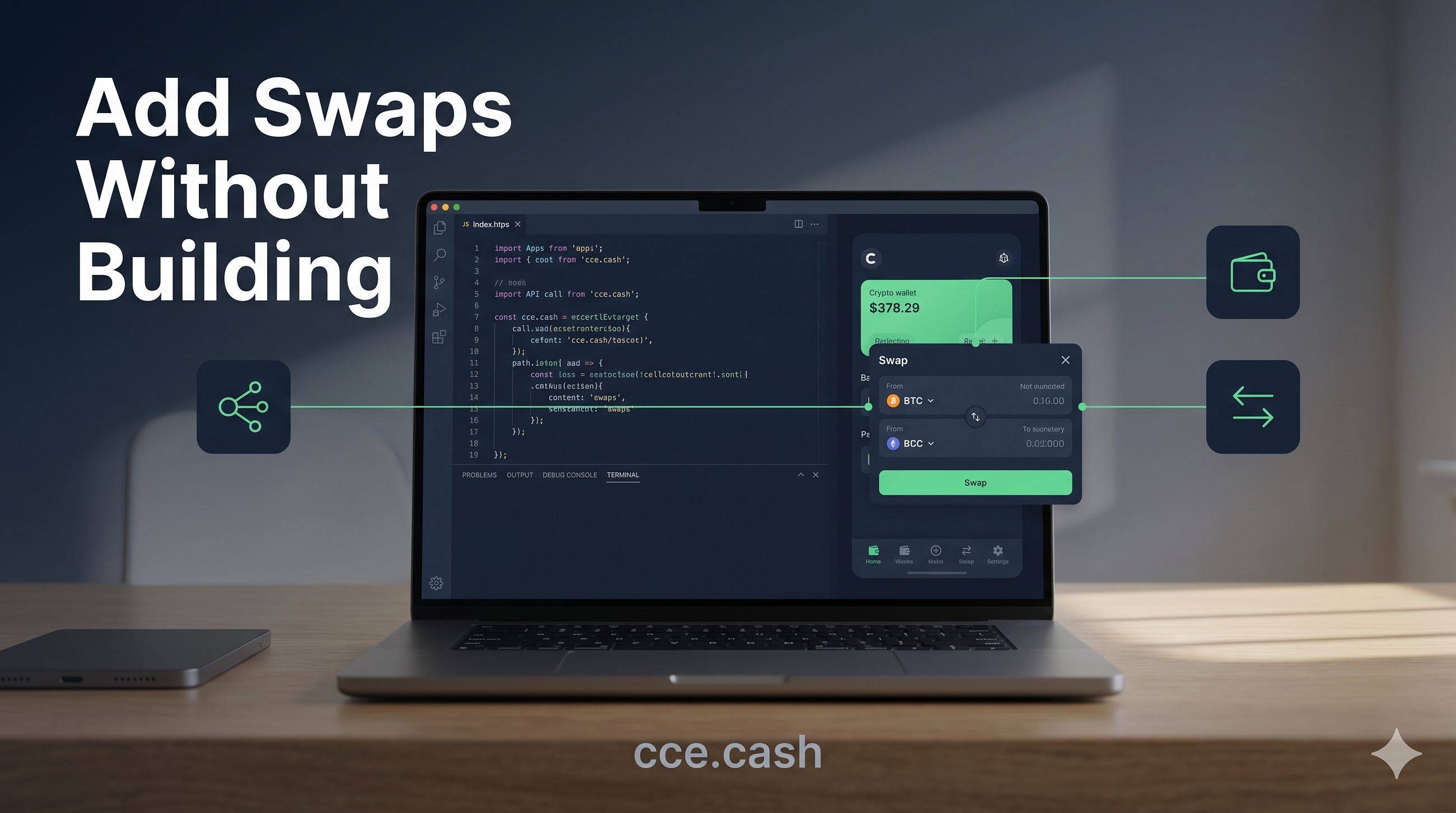
- Users can swap assets directly inside the wallet
- No external redirection is required
- The process completes within minutes after confirmations
This significantly improves usability and retention.
Example Scenario
A user holds SOL but needs BTC for a transaction. Without integrated exchange functionality, the user would need to:
- Transfer funds to an exchange
- Convert assets
- Withdraw to another wallet
With API integration, the entire process is handled within the platform itself.
The Role of Automation
Automation is central to this model. CCE Cash processes exchanges without manual intervention, ensuring that:
- Transactions are handled consistently
- Delays are minimized
- User trust is maintained
Conclusion
Crypto exchange API integration is becoming a standard requirement for platforms operating in a multi-chain ecosystem. The decision is no longer about whether to offer exchange functionality, but how efficiently it can be implemented.
For developers and product teams, integrating an automated solution may provide a more practical path than building infrastructure from the ground up.
Explore API integration with CCE Cash:
https://cce.cash