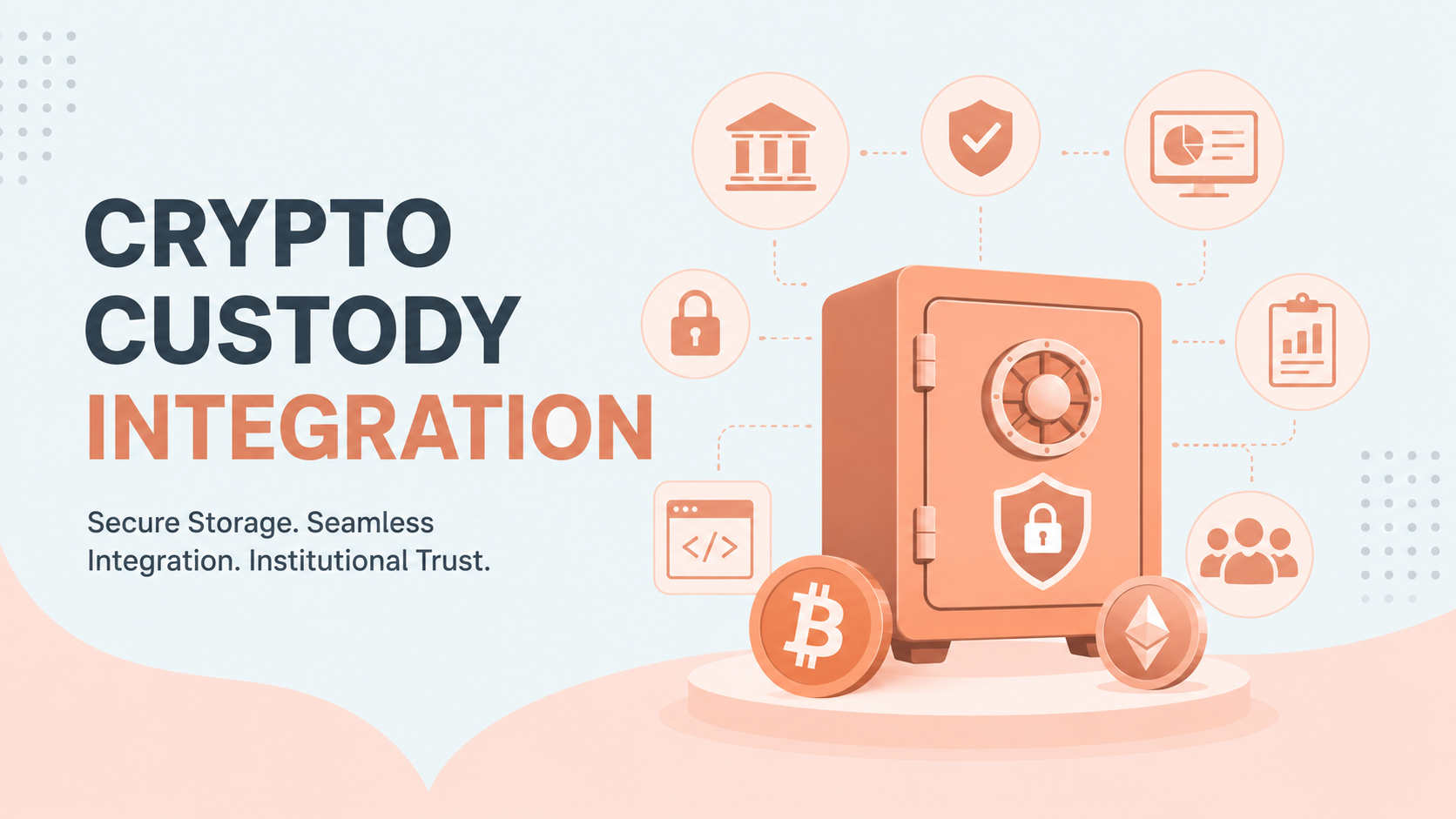
Crypto Custody Integration: The Hidden Backbone of Institutional Digital Finance
How secure custody infrastructure is quietly shaping the future of crypto adoption at scale
 Christine Soliman6 min read·Just now
--
In the early days of cryptocurrency, the biggest concern was simple: how do you store it safely?
For individual users, the answer was often a personal wallet, a seed phrase written on paper, and a constant fear of losing access forever. But as digital assets matured into a multi-trillion-dollar ecosystem, the question evolved. It was no longer just about storing crypto securely.
It became about how institutions, banks, fintech platforms, and enterprises can integrate custody into their core financial systems without compromising security, compliance, or operational efficiency.
This evolution has given rise to a critical but often overlooked layer of infrastructure: crypto custody integration systems.
These systems are not visible to end users. They do not appear in dashboards or trading apps.
Yet, they form the backbone of institutional crypto adoption, enabling secure storage, seamless transactions, and regulated access to digital assets at scale.
Understanding Crypto Custody in the Modern Era
At its simplest, crypto custody refers to the secure storage and management of digital assets such as Bitcoin, Ethereum, and tokenized instruments. However, modern custody systems go far beyond storage.
They are designed to handle:
- Secure key management
- Transaction authorization
- Multi-party governance
- Regulatory compliance
- Integration with financial platforms
Unlike traditional bank custody systems that deal with fiat assets, crypto custody must address a unique challenge: control over private keys determines ownership. If keys are lost or compromised, assets are effectively gone.
This makes custody not just a storage problem, but a cryptographic security problem combined with operational governance.
What Makes Custody Integration Different
Crypto custody integration refers to embedding custody infrastructure directly into financial platforms, exchanges, fintech applications, and enterprise systems. Instead of operating as a standalone service, custody becomes a native layer within broader financial ecosystems.
This integration is essential because institutions cannot rely on isolated wallets or manual processes when dealing with large-scale digital asset operations.
Key characteristics of custody integration include:
- API-based connectivity with trading and banking systems
- Real-time transaction signing and verification
- Automated compliance and reporting workflows
- Role-based access control across teams
- Seamless interaction between hot and cold storage systems
Without integration, custody remains fragmented. With integration, it becomes operational infrastructure.
Why Crypto Custody Integration Matters Now
The demand for custody integration is being driven by the rapid institutionalization of digital assets. Hedge funds, payment processors, neobanks, and corporate treasuries are increasingly interacting with crypto in structured ways.
However, they face a common problem: existing crypto tools were not built for institutional workflows.
Some of the key drivers include:
- Increasing regulatory scrutiny of digital asset handling
- Growing demand for institutional-grade security standards
- Need for real-time settlement and liquidity management
- Expansion of tokenized assets and digital securities
- Rising importance of auditability and compliance transparency
Without integrated custody systems, institutions are forced to rely on manual processes, which are slow, error-prone, and non-scalable.
Core Architecture of Crypto Custody Integration Systems
Behind every custody integration platform lies a carefully designed architecture that balances security, speed, and compliance.
A typical system includes several interconnected layers:
1. Key Management Layer
This is the foundation of custody systems. Private keys are stored using secure mechanisms such as:
- Multi-party computation (MPC)
- Hardware security modules (HSMs)
- Sharded key storage systems
These methods ensure that no single entity has full control over a private key.
2. Transaction Authorization Layer
Every transaction must be verified through predefined policies. This may include:
- Multi-signature approvals
- Role-based permissions
- Threshold-based signing rules
For example, a corporate treasury might require approvals from both finance and compliance teams before funds can move.
3. Integration Layer (APIs & SDKs)
This layer connects custody systems to external platforms such as:
- Exchanges
- Banking systems
- Payment gateways
- Trading engines
It enables real-time asset movement without exposing private keys.
4. Compliance and Monitoring Layer
Regulatory compliance is embedded directly into transaction flows. This includes:
- AML (Anti-Money Laundering) checks
- Transaction monitoring
- Audit logging
- Geographic restrictions
5. Storage Segmentation Layer
Assets are divided between:
- Hot wallets for active transactions
- Cold storage for long-term security
- Deep cold storage for high-value reserves
This segmentation reduces exposure risk while maintaining liquidity.
How Integration Transforms Institutional Workflows
Without custody integration, institutions operate in fragmented environments where crypto operations are separate from financial systems. With integration, workflows become unified.
Some of the major transformations include:
- Automated treasury management: Digital assets can be managed alongside fiat holdings
- Real-time settlement: Transactions execute instantly across platforms
- Unified reporting: All asset classes are tracked in a single system
- Reduced operational friction: No manual wallet switching or key handling
- Improved audit readiness: Every transaction is traceable and verifiable
This transformation is especially important for regulated entities that must maintain strict financial oversight.
Real-World Applications of Custody Integration
Crypto custody integration is already powering a wide range of real-world use cases across industries.
1. Digital Asset Exchanges
Exchanges rely on custody integration to manage billions in daily trading volume while ensuring user funds remain secure and segregated.
2. Fintech Platforms
Payment apps and neobanks use custody layers to enable crypto buying, selling, and transfers without exposing users to private key management.
3. Institutional Investment Firms
Hedge funds and asset managers use integrated custody systems to manage diversified crypto portfolios with institutional-grade controls.
4. Tokenization Platforms
Real-world assets such as bonds, real estate, and commodities are increasingly tokenized, requiring secure custody infrastructure for digital representation.
5. Corporate Treasury Systems
Companies holding crypto on balance sheets integrate custody systems to manage long-term holdings securely while maintaining liquidity access.
Key Challenges in Custody Integration
Despite its advantages, integrating crypto custody into financial systems is not without challenges.
Some of the most significant issues include:
- Security complexity: Protecting private keys across distributed systems
- Regulatory fragmentation: Different jurisdictions impose different rules
- Interoperability issues: Connecting legacy financial systems with blockchain infrastructure
- Operational risk: Misconfigured policies can lead to asset lockouts
- Scalability concerns: High transaction volumes require robust infrastructure
Another subtle challenge is trust. Institutions must trust not only the technology but also the governance model behind custody providers.
Security Models Driving Custody Evolution
Modern custody systems rely on advanced cryptographic and architectural innovations to reduce risk.
Some of the most important models include:
- Multi-party computation (MPC): Splits key control across multiple parties so no single point of failure exists
- Hardware security modules (HSMs): Physical devices that securely store cryptographic keys
- Threshold signatures: Require multiple approvals before executing transactions
- Zero-trust architecture: Assumes no system component is inherently secure without verification
These models collectively reduce dependency on single-key ownership, which has historically been one of the biggest vulnerabilities in crypto systems.
The Future of Crypto Custody Integration
The next phase of custody integration is expected to be even more deeply embedded into financial infrastructure.
Emerging trends include:
- Embedded custody in banking systems rather than third-party platforms
- Cross-chain custody management for multi-network asset portfolios
- AI-driven risk monitoring for transaction anomalies
- Regulated custody networks shared across financial institutions
- Real-time compliance automation embedded at the protocol level
As digital assets become more mainstream, custody will no longer be a separate layer. It will become invisible infrastructure, just like cloud storage in modern computing.
Conclusion: The Silent Infrastructure of Digital Finance
Crypto custody integration is not the most visible part of the blockchain ecosystem, but it is one of the most important. It enables institutions to participate in digital asset markets without compromising on security, compliance, or operational control.
What makes it powerful is not just the technology itself, but the way it transforms complexity into structure. It replaces fragmented wallet management with unified financial systems. It replaces manual processes with automated governance. And it replaces uncertainty with controlled, auditable infrastructure.
As digital finance continues to evolve, custody integration will remain a foundational pillar, quietly ensuring that billions in digital value can move safely, efficiently, and at scale.
In many ways, the future of crypto adoption will not be defined by trading platforms or token prices, but by something far more fundamental: the invisible systems that keep everything secure in motion.