concrete
 Fahmi Jembar3 min read·Just now
--
DeFi Doesn’t Remove Trust — It Engineers It
When people first discovered DeFi, the pitch was simple:
“You don’t need to trust anyone anymore.”
No banks.
No intermediaries.
Just code running on-chain.
For many, that was the breakthrough.
But if you’ve spent enough time in DeFi, you start to notice something:
👉 you’re still trusting things… just different ones.
Trust Didn’t Disappear — It Changed Shape
In traditional finance, trust is obvious.
You trust institutions, custodians, regulators.
In DeFi, that layer gets replaced.
But it doesn’t go away.
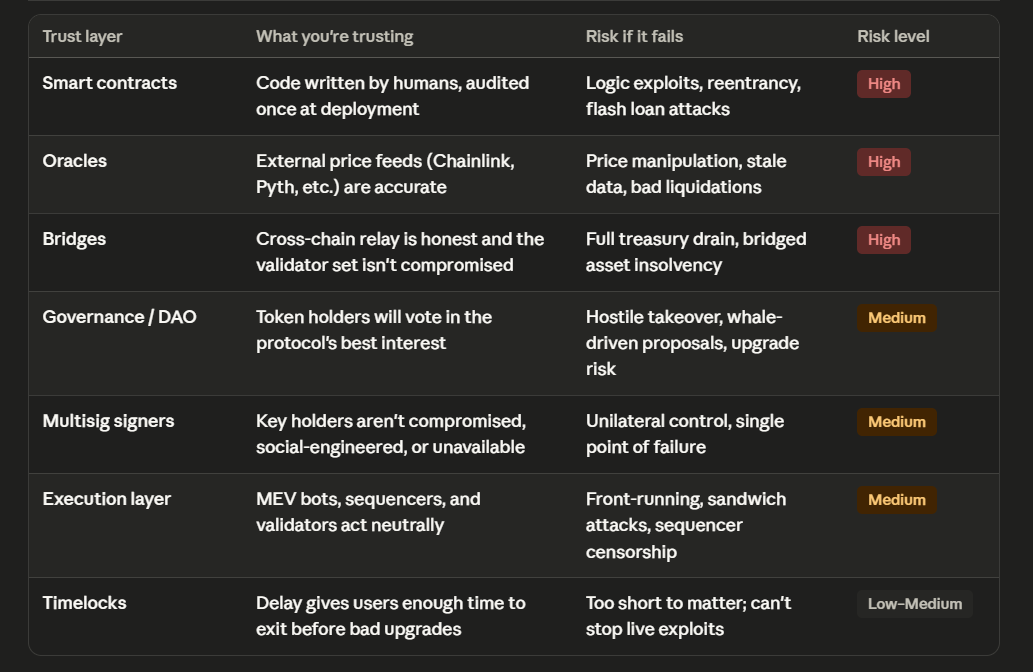
Instead, you trust:
- that a smart contract behaves exactly as intended
- that governance won’t make harmful decisions
- that price feeds reflect reality
- that cross-chain systems won’t fail
The system feels different.
But trust is still there — just embedded deeper.
The Invisible Layer Most People Ignore
The tricky part is that most of this trust is invisible.
You don’t see it when you deposit into a protocol.
You just see:
- a clean interface
- a clear APY
- a working flow
But behind that, there are assumptions everywhere.
And the more complex DeFi becomes, the more layers you rely on without realizing it.
When “Decentralized” Doesn’t Mean Safe
There’s another subtle issue.
Something can look decentralized…
without actually being resilient.
We’ve seen systems where:
- a small multisig controls critical functions
- governance exists, but few people participate
- safety mechanisms delay problems instead of stopping them
- protocols struggle to respond in real time
From the outside, everything looks fine.
Until something breaks.
That’s when structure matters more than narrative.
The Shift: From Removing Trust to Designing It
At some point, the conversation has to mature.
Because the real question isn’t:
👉 “Can we remove trust?”
It’s:
👉 “How do we design trust properly?”
Engineered trust means:
- knowing who (or what) has control
- defining what actions are allowed
- enforcing limits on behavior
- building systems that can handle failure
It’s less idealistic, but far more practical.
Why Real Systems Need More Than Code
“Code is law” works in theory.
But real markets are messy.
Unexpected things happen:
- volatility spikes
- liquidity disappears
- exploits emerge
- edge cases show up
In those moments, static rules aren’t always enough.
You need:
- monitoring
- response mechanisms
- structured intervention
The strongest systems aren’t the most rigid.
They’re the ones designed to adapt.
How Concrete Approaches This
This is where Concrete vaults take a more grounded path.
Instead of pretending trust doesn’t exist, they treat it as something to be explicit and structured.
That includes:
- role-based permissions
- controlled execution environments
- a mix of onchain enforcement and off-chain intelligence
- a focus on operational security
The goal isn’t to eliminate trust.
It’s to make it visible, constrained, and reliable.
Where DeFi Is Heading
As DeFi evolves, priorities are shifting.
Less focus on:
- “fully trustless” narratives
More focus on:
- systems that actually work under pressure
Because in the end, users don’t just care about ideology.
They care about:
- safety
- consistency
- outcomes
And those require well-designed systems.
Final Thought
DeFi didn’t remove trust.
It just moved it into places that are harder to see.
The next phase of the space isn’t about pretending trust is gone.
It’s about understanding it — and building around it.
Because the systems that last won’t be the ones that claim to eliminate trust.
They’ll be the ones that engineer it properly from the start.
Explore Concrete:
👉 https://concrete.xyz/