Clean Flagged Bitcoin: A Practical Guide to Managing High AML Coins
--
Bitcoin users often assume that once a transaction is complete, the story ends there. In reality, every coin carries a traceable history. Over time, that history can influence how funds are perceived and used.
For users dealing with uncertain or mixed sources, the need to clean flagged bitcoin becomes a practical consideration rather than a theoretical one.
Understanding AML Risk in Bitcoin
AML scoring systems evaluate the risk associated with a coin’s transaction history. While these scores are not part of Bitcoin itself, they are widely used by services to assess exposure.
Coins may receive a high AML score due to:
- Previous association with flagged wallets
- Transfers through unknown sources
- Historical activity linked to multiple addresses
For users, this creates a challenge. Even legitimate funds can carry a complex or unclear history.
Why High AML Bitcoin Matters
Handling high AML bitcoin can affect:
- Transaction acceptance across services
- Perceived legitimacy of funds
- Privacy of financial activity
The issue is not ownership, but traceability. When every step is visible, unwanted associations can persist.
How Mixing Helps Reduce Exposure
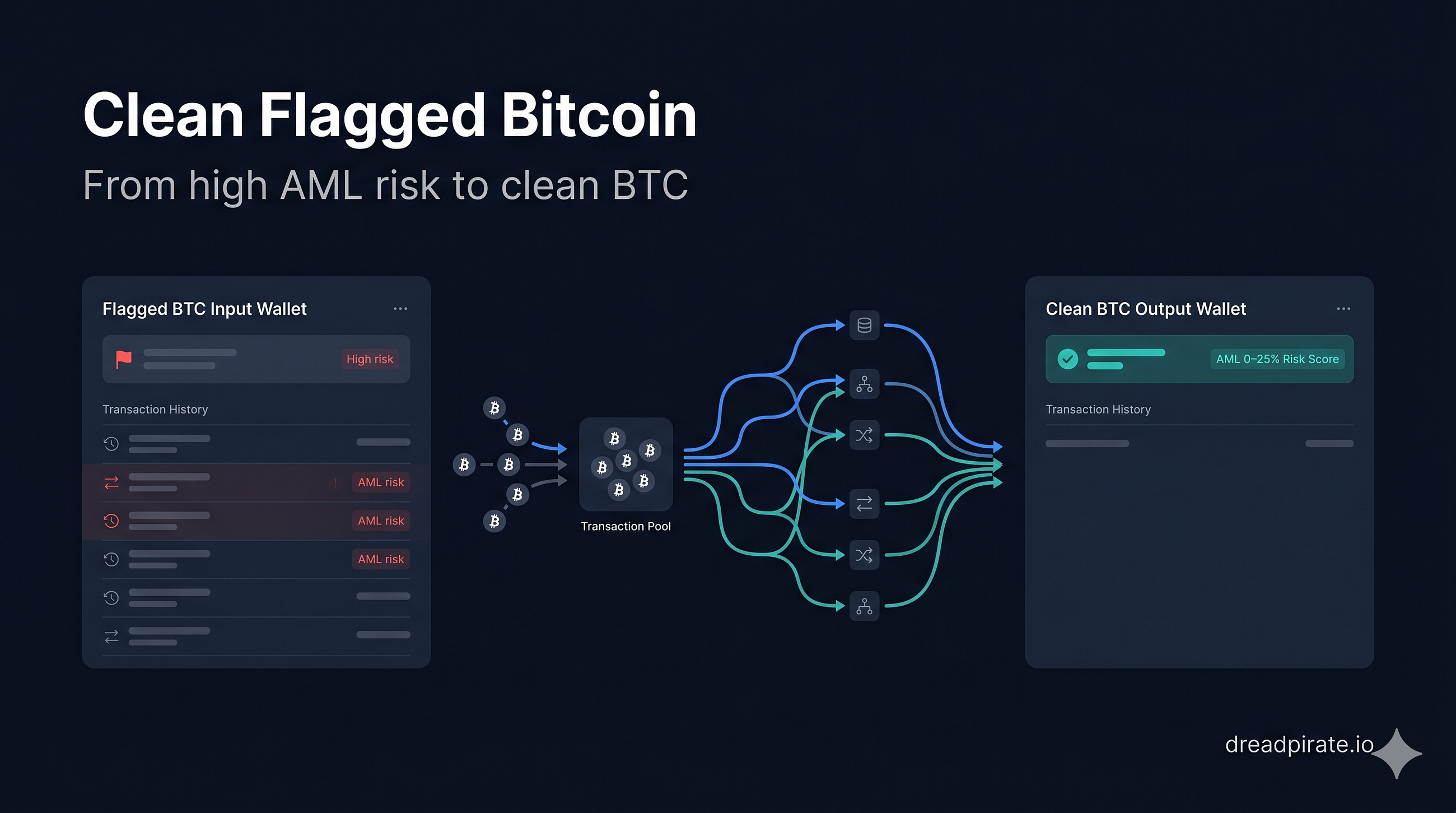
A mixing system is designed to remove direct transaction links. Instead of forwarding coins as-is, it introduces separation between input and output.
The process typically involves:
Pooling
Incoming BTC is combined with a large volume of unrelated coins.
Splitting
Funds are divided into smaller transactions to prevent one-to-one mapping.
Redistribution
Outputs are sourced from independent pools, often across exchange-based liquidity.
This is the foundation of a bitcoin cleaning service in functional terms.
Example Scenario
Consider a trader who has accumulated BTC through multiple P2P deals.
Without mixing:
- Each transaction remains connected
- Wallet history becomes fully traceable
With mixing:
- All inputs are merged
- Outputs originate from unrelated sources
- The link between old and new coins is removed
This allows users to fix flagged BTC exposure without altering the blockchain itself.
DreadPirate’s Approach
Dread Pirate applies these principles through a proprietary mixing system developed entirely in-house.
Key features include:
- Acceptance of BTC from any origin or AML level
- Output coins sourced from exchanges with AML 0–25%
- No KYC requirement at any stage
- Zero-log policy ensuring no data retention
- PGP-signed Letters of Guarantee as verifiable proof of transaction details
The system does not rely on external APIs, reducing third-party risks.
Monero as an Optional Output
In addition to BTC, users can choose to receive Monero (XMR). This provides an alternative for those seeking a different privacy structure.
A Question for the Community
If transaction history cannot be changed, should users accept exposure, or actively manage how their coins are perceived?
Conclusion
The ability to clean flagged bitcoin is not about hiding activity, but about removing unnecessary connections.
By separating input from output, users gain greater control over how their funds move and how they are interpreted.
See how DreadPirate protects your BTC:
https://dreadpirate.io/