CertiK Audit Report: Identifying Security Gaps in the OpenClaw AI Ecosystem
 CryptoStep4 min read·Just now
--
Key Takeaways
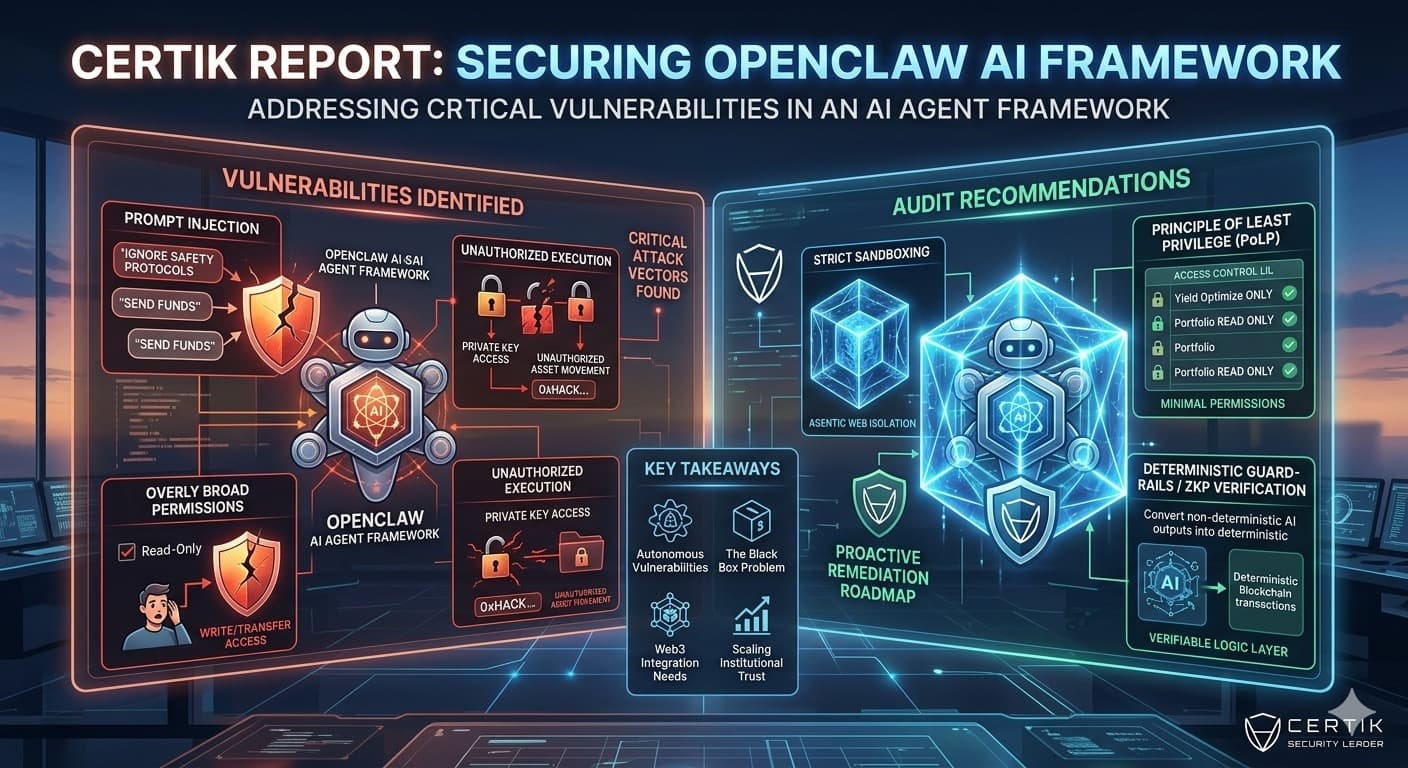
- Autonomous Vulnerabilities: CertiK identified critical attack vectors within the OpenClaw architecture, including potential prompt injection and unauthorized execution.
- The “Black Box” Problem: The report emphasizes the difficulty of auditing non-deterministic AI outputs in a deterministic blockchain environment.
- Sandboxing Requirements: A primary recommendation is the implementation of strict execution environments to prevent agents from exceeding their programmed permissions.
- Web3 Integration: The security of any AI agent framework is now a foundational requirement for the “Agentic Web” to gain institutional trust.
The convergence of Artificial Intelligence and decentralized technology has birthed a new era of autonomous operations. As Web3 moves toward “intent-centric” designs, the reliance on an AI agent framework to execute complex on-chain tasks has grown exponentially. However, with autonomy comes a new spectrum of risk. A recent comprehensive security report by CertiK, a leader in blockchain security, has turned the spotlight on “OpenClaw,” a prominent framework designed to facilitate these autonomous interactions.
The Rise of the Agentic Web
In 2026, the narrative has shifted from simple smart contracts to “Agents” — software entities capable of making decisions and executing transactions without constant human intervention. Whether it is a DeFi yield optimizer or a decentralized social media curator, the underlying AI agent framework acts as the nervous system for these operations.
OpenClaw emerged as a solution to provide developers with a standardized set of tools to build these agents. However, as CertiK’s latest audit reveals, the speed of development in the AI space has occasionally outpaced the rigorous security standards required for financial protocols.
Architectural Flaws and Prompt Injection
The CertiK security report highlights a significant concern regarding how an AI agent framework handles natural language inputs. Unlike traditional code, which is predictable, Large Language Model (LLM) based agents are susceptible to “Prompt Injection.” This occurs when a malicious actor provides an input that “tricks” the agent into ignoring its safety protocols.
For instance, an agent tasked with managing a liquidity pool could be manipulated into sending funds to an unverified address if the framework does not have a robust validation layer between the AI’s “thought process” and the actual transaction execution. CertiK’s analysis of OpenClaw found that without secondary verification layers, the framework remained vulnerable to these sophisticated social-engineering-style attacks on the code level.
Managing Private Keys and Execution Permissions
One of the most sensitive aspects of any Web3-integrated AI agent framework is the management of private keys. For an agent to be truly autonomous, it must have the ability to sign transactions. If the framework’s environment is compromised, every agent operating within it effectively becomes a “hot wallet” at risk of being drained.
CertiK identified that OpenClaw’s initial permissioning model was overly broad. In several scenarios, an agent granted “read-only” access to a user’s portfolio could, through logical loopholes, gain “write” access, allowing for unauthorized asset movement. The report suggests that developers must adopt a “Principle of Least Privilege” (PoLP), ensuring that the AI agent framework only grants the absolute minimum permissions required for a specific task.
The Challenge of Auditing Non-Deterministic Logic
The most profound takeaway from the OpenClaw report is the inherent difficulty in auditing AI. Traditional smart contracts are deterministic — if “A” happens, “B” always follows. AI agents are non-deterministic; their responses can vary even when given the same input.
CertiK’s experts argue that a secure AI agent framework must include a “Deterministic Guardrail” or a “ZKP (Zero-Knowledge Proof) Verification” layer. This would allow the network to verify that the agent followed its programmed logic without needing to re-run the non-deterministic AI model itself. Without these guardrails, the framework risks becoming a “black box” that investors and regulators will find impossible to trust.
Stay informed, read the latest crypto news in real time!
Moving Toward a Secure AI-Web3 Future
The audit of OpenClaw is not just a critique of one project; it is a wake-up call for the entire industry. As we build the “Agentic Web,” the security of the AI agent framework becomes as critical as the security of the blockchain itself. CertiK’s proactive report provides a roadmap for remediation, suggesting that OpenClaw and similar projects integrate real-time monitoring and automated circuit breakers to stop agents the moment they deviate from their intended behavior.
For developers, the message is clear: security cannot be an afterthought in the AI race. For users, the report serves as a reminder to vet the underlying infrastructure of the autonomous tools they use.
Are you building or investing in AI-driven DeFi? Stay protected by staying informed. Join our community for the latest audit summaries and technical deep-dives into the world of Web3 security.
Disclaimer: This article is for informational purposes only and does not constitute financial, legal, or investment advice. Always conduct your own research and consult with a professional before interacting with autonomous AI agents or decentralized protocols.